About Gastrophryne carolinensis (Holbrook, 1835)
Scientific Naming and Size
The eastern narrow-mouthed toad, scientifically named Gastrophryne carolinensis, is a relatively small species that reaches a maximum length of 53 mm (2.1 in).
Body and Head Shape
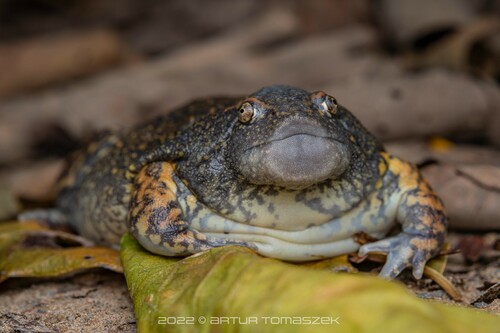
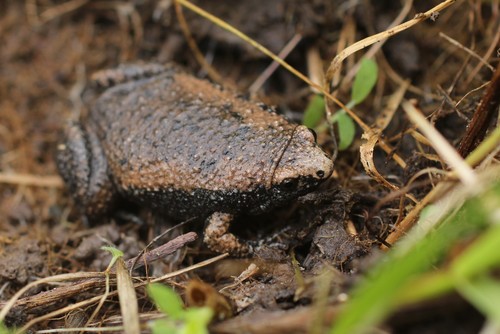
It has an oval-shaped body, a narrow head with a pointed snout, and a fold of skin at the back of the head that can cover the eyes.
Basal Body Coloration
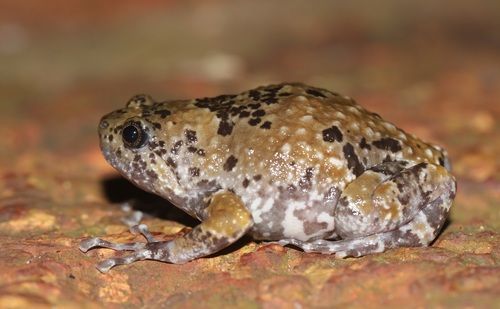
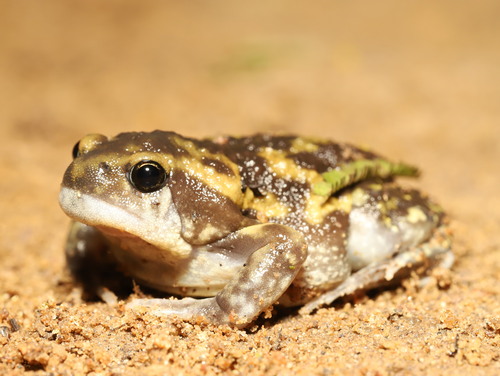
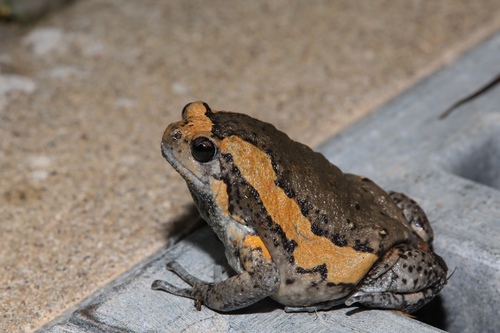
Its body color ranges from brown and grey to green, and often has black and white spotting. A dark brown stripe is usually present on both sides of the body.
Family-Typical Body Shape
This species has a characteristic teardrop-shaped body that is typical of members of the Microhylidae family.
Auditory and Vocal Structures
While it does not have a tympanum (eardrum), its subgular vocal sac is clearly visible.
Toe Structure
Its toes are long and unwebbed.
Skin Texture and Toughness
The skin of G. carolinensis is smooth, with no ridges or warts, but it is extremely tough. This tough skin most likely protects the toads from the ants they feed on.
Protective Neck Fold
A distinctive protective skin fold sits directly behind the eyes on the toad’s neck, evolved to shield it from ant bites during feeding.
Color Change Capability
The toad’s color can change based on its activities and surrounding environment.
Dorsal and Lateral Color Patterns
Colors on its sides are generally faded, while its dorsum is dark and broad, with various light or dark spots, mottling, or patches that cover the light strip along its middorsal area.
Ventral Color Patterns
Its abdomen is generally highly mottled, but its ventral surface is nearly light or unmarked. Among Great Plains populations of this narrow-mouthed toad, venters are generally or almost entirely unmarked, while venters of eastern populations are strongly pigmented.
Leg and Toe Tip Morphology
Its legs are typically stubby, short, and heavy, with round, tapered tips on the toes.
Webbing and Toe Pad Absence
Like members of Leptodactylidae, this species has no webbing or toe pads on its toes.
Back Foot Digging Structure
The heels of its back feet have one digging spade, or tubercle.
Sexual Dimorphism
Eastern narrow-mouthed toads exhibit clear sexual dimorphism that makes determining sex simple: males have a dark, heavily pigmented throat region, while females have a lighter throat.
Vocalization Characteristics
The call of G. carolinensis is described as sounding like a bleating sheep or an electric buzzer, and it is somewhat similar to the call of Anaxyrus fowleri.
Elevation Range and Mountain Absence
This narrow-mouthed toad occurs at elevations up to 550 m (1,800 ft), and is generally absent from most of the Blue Ridge Mountains and the Appalachian Mountains.
Taxonomic Status in the US
G. carolinensis is one of only three Microhylidae species native to the United States.
Native US Range
It lives in the southeastern quarter of the U.S., with a range extending from Missouri and eastern Texas, and from southern Maryland to the Florida Keys; there is also an isolated colony in Iowa.
Introduced Populations
Many individuals have been introduced to the Little and Great Bahamas, as well as the Cayman Islands.
Key Habitat Requirements
Though the species occupies a broad range of habitats and is rather widespread, it requires moisture and shelter as key environmental conditions.
Habitat System Types
It lives in either freshwater or terrestrial systems, and can use both temporary and permanent water, as well as human-modified habitats.
Habitat Avoidance and Edge Tolerance
Members of this species generally avoid dry areas and mountains, though some may live in near desert-like conditions.
Brackish Water Tolerance
Adult eastern narrow-mouthed toads are tolerant of brackish water, which allows them to inhabit barrier islands and coastal marshes.
Natural Habitat Types
Recorded general habitat types for the species include: swamp borders, cypress-gum swamps, bottomland hardwoods, live-oak ridges, pine-oak uplands, sandy woodlands and hillsides, open woods, pine forests, coastal secondary dune scrub forest, maritime forests, small streams, areas beneath logs, and areas near ponds with fallen logs and other debris.
Anthropogenic Habitat Types
It also occurs in urban habitats such as woodland lots and sandy pinelands, and suburban habitats such as lawn areas with sandy soil.