About Gambusia affinis (Baird & Girard, 1853)
Common Name and General Appearance
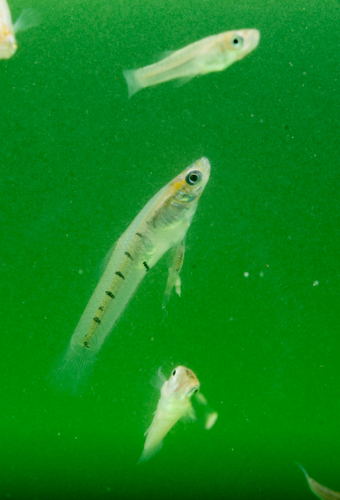
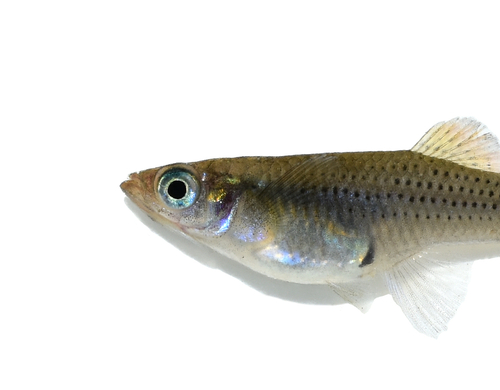
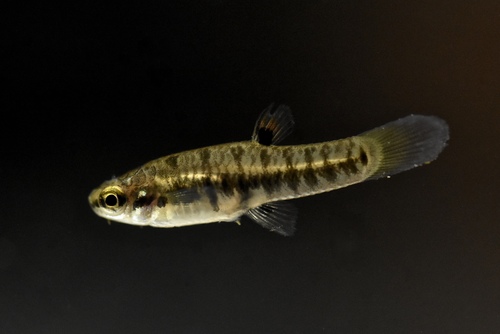
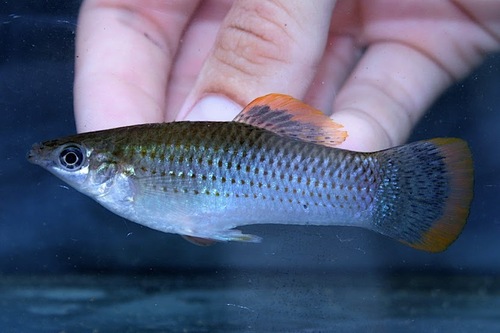
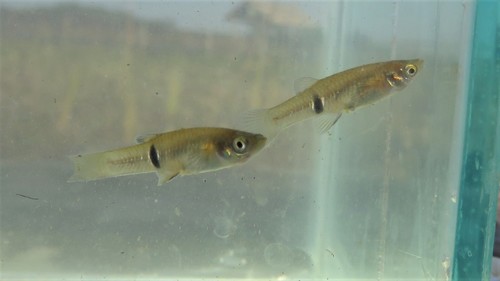
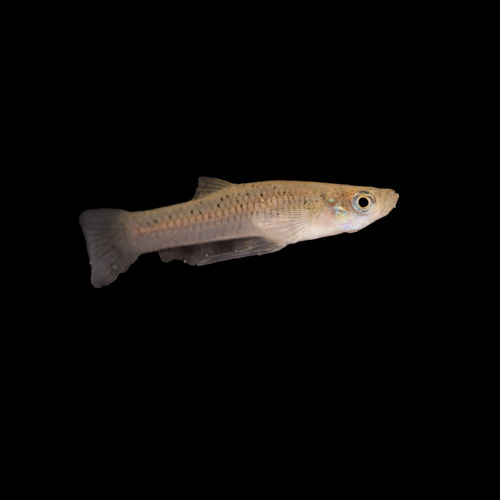
Gambusia affinis, commonly called mosquitofish, are small fish with a dull grey coloration, a large abdomen, rounded dorsal and caudal fins, and an upturned mouth.
Sexual Size Dimorphism
The species displays clear sexual dimorphism: mature females grow to a maximum overall length of 7 cm (2.8 in), while mature males only reach 4 cm (1.6 in).
Sexual Structural Dimorphism
Sexual dimorphism also appears in the species' body structures. The anal fins of adult females have a similar shape to the dorsal fins, while the anal fins of adult males are pointed.
Gonopodium Function
This modified pointed fin, called a gonopodium, is used to deposit milt inside the female.
Gonopodium Species Distinction
G. affinis can be distinguished from the closely related G. holbrooki by its gonopodium's smooth third ray, which is the anteriormost elongated ray; G. holbrooki's gonopodium has minute denticles instead.
Female Gravid Spot
Adult female mosquitofish can also be identified by a distinct gravid spot located on the posterior of their abdomens.
Similar Misidentified Species
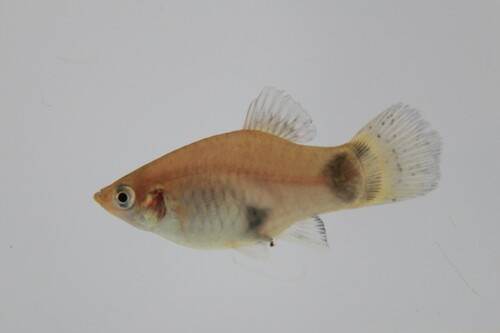
Poecilia reticulata, Poecilia latipinna, and Xiphophorus maculatus are similar species that are commonly misidentified as mosquitofish.
Native Range
The native range of mosquitofish extends from southern Illinois and Indiana, through the Mississippi River and its tributary waters, south to the Gulf Coast in northeastern Mexico.
Preferred Habitat
They are most abundant in shallow water that provides protection from larger fish.
Environmental Tolerance
Mosquitofish can survive in relatively inhospitable environments, and are resilient to low oxygen concentrations, high salt concentrations up to twice the salinity of seawater, and short exposures to temperatures as high as 42 °C (108 °F).
Global Distribution Status
Due to their notable adaptability to harsh conditions and global introduction to many habitats for mosquito control, they have been described as the most widespread freshwater fish in the world.
Natural Predators
Natural predators of mosquitofish include bass, catfish, and bluegill.
Reproductive Gonopodium Modification
Mosquitofish reproduction begins when the male arranges the rays of the gonopodium into a slight tube. The male uses this tubular fin to secrete milt into the female's genital aperture, in a process of internal fertilization.
Female Genital Aperture
The female's genital aperture is located just behind the anal fin, and is the opening through which milt fertilizes ova inside the ovary.
Gestation Anatomy
As members of the infraclass Teleostei, mosquitofish lack a uterus, so oocyte production and gestation both occur within the female's ovary.
Sperm Storage
Inside the female, sperm from multiple males can be stored to fertilize ova at a later time.
Temperature-Dependent Oocyte Development
Laboratory experiments show that female mosquitofish become vitellogenic when springtime temperatures reach 14 °C (57 °F), and oocytes mature once the average temperature reaches about 18 °C (64 °F).
Photoperiod Oocyte Trigger
Late in the summer, when the daily photoperiod is shorter than 12.5 hours, the next clutch of oocytes develops.
Seasonal Brood Production
Over one reproductive season, a female can produce two to six broods of embryos using stored milt, and brood size decreases as the season progresses.
Reproduction Rate Drivers
Reproduction rates are highly dependent on temperature and food ration level.
Temperature Impact on First Reproduction
When temperature increases from 20 to 30 °C, the mean age at first reproduction drops from 191 to 56 days, and brood size and offspring mass increase significantly.
Interbrood Interval
The estimated interbrood interval is 23 days at 25 °C, and 19 days at 30 °C.