About Fundulus chrysotus (Günther, 1866)
Taxonomic Classification
The golden topminnow, Fundulus chrysotus, is a native United States fish belonging to the genus Fundulus.
General Distribution
It is mostly distributed across the southeastern United States, ranging from Kentucky and Ohio south into Florida.
Habitat Consistency
Even with this wide southern distribution, the habitats and microhabitats it occupies remain largely consistent across its range.
Feeding Behavior Basics
Golden topminnow are small fish that feed at the water's surface.
Life Cycle Overview
They tend to reproduce from late spring into early summer, and while their fry reach maturity fairly quickly, the species has a relatively short lifespan.
Diet Habitat Context
As small fish low on the trophic level, they primarily feed on small or drifting organisms at or near the surface of vegetated areas.
Conservation Status
Currently, the golden topminnow is not listed as an endangered species, and no specific management plan exists for the species.
Geographic Range Scope
The golden topminnow's geographic range covers the southeastern continental United States.
Core Range Boundaries
Specifically, it inhabits the Santee River Drainage of South Carolina westward to the Trinity River Drainage of Texas, and can be found throughout the Mississippi Embayment north to Kentucky and Missouri.
Southern Range Distribution
Further south, it lives in the Lower Coastal Plain and is widely scattered across Florida.
Northwestern Range Occurrences
It has also been documented extending northwest into the Gulf Coastal Plain of McCurtain County, Oklahoma, and Mississippi County, Missouri.
Peripheral Range Status
Outside these core areas, the species is extremely localized and uncommon.
General Diet Composition
The golden topminnow's diet ranges from aquatic plants to terrestrial invertebrates, but it consists mostly of aquatic invertebrates.
Lake Seminole Feeding Study Context
A study of fish feeding habits in Lake Seminole, on the Florida-Georgia border, included observations of golden topminnow.
Documented Diet Prey Items
The species was found to consume small amounts of aquatic macrophytes and a wider variety of aquatic invertebrates, including gastropods (snails and slugs), large quantities of ostracods (seed shrimp), ephemeropterans (mayflies), coleopterans (water beetles), and chironomids (non-biting midges).
Diet Key Findings
The golden topminnow's diet does not include vertebrate prey; the most common food sources are seed shrimp and midge larvae, with water beetles and mayflies as minor diet components.
Predator Context
Due to its low trophic position, the golden topminnow is prey for a wide variety of predators that hunt small, surface-feeding vertebrates.
Known Predator Species
These predators include, but are not limited to, largemouth bass (Micropterus salmoides), redear sunfish (Lepomis microlophus), bluegill sunfish (Lepomis macrochirus), and bluespotted sunfish (Enneacanthus gloriosus).
Salinity Tolerance Range
The golden topminnow can tolerate a range of salinity levels.
Salinity Survival Experiment Results
Experiments recorded a 100% mean survival rate at 7 and 14 percent salinity; survival dropped to 91% at 21% salinity, fell to 24% at 28% salinity, and reached 0% at 35% salinity.
Salinity Tolerance Ecological Role
This tolerance range allows the species to survive and reproduce in the narrow range of salinities found in its native coastal and brackish water habitats.
Human Threats
Major human impacts on golden topminnow populations include habitat pollution, and the conversion of marshlands and brackish water areas for agricultural use.
Breeding Period
Golden topminnow breed from spring through summer, between April and July, and sometimes as late as September.
Courtship Behavior
During courtship, the male swims in loops or circles above or beside the female, occasionally pausing to bob his head up and down.
Egg Deposition and Fertilization
The female releases eggs individually, and deposits them on the roots of floating plants or other fibrous material; the male then fertilizes the eggs one at a time.
Larval Development and Maturation
After hatching, larvae rest on leaves or the bottom, and grow quickly to reach maturation after 10 months.
General Morphology
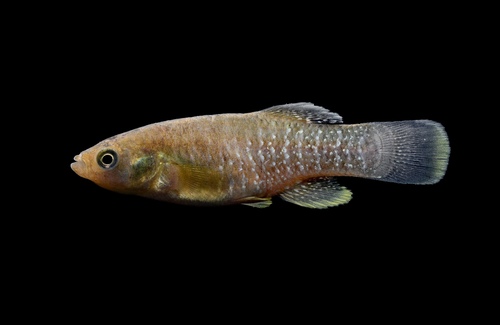
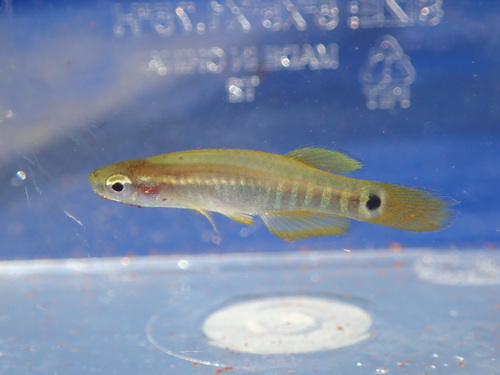
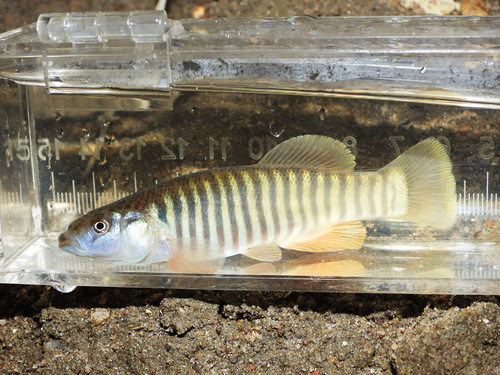
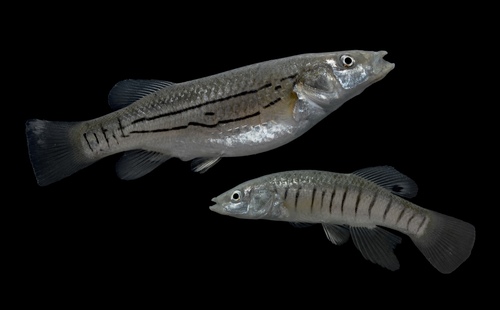
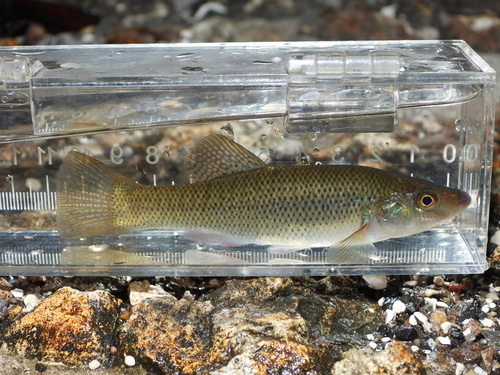
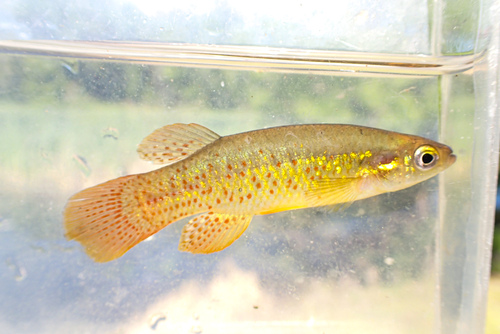
Mature golden topminnow have a slender body, a rounded caudal fin, and a deep caudal peduncle.
Mouth and Fin Positioning
Their mouth is small and slightly superior, their dorsal fin is set far back on the body and starts posterior to the origin of the anal fin.
Fin Ray Counts
They lack a lateral line, have 7–9 dorsal rays, 9–11 anal rays, 12–14 pectoral rays, and 6 pelvic rays.
Breeding Season Male Morphology
During the breeding season, males develop prickly contact organs on the side of the body between the dorsal and anal fins, on the ends of the last few dorsal rays, on the anal fin, and on the outermost pectoral fin rays.
Life Expectancy
The life expectancy of the golden topminnow is approximately 2 years.
Citation
Citation: Ross, S. T. 2001. The Inland Fishes of Mississippi. University Press of Mississippi, Jackson. 624 pp.