About Fundulus heteroclitus (Linnaeus, 1766)
Common Name and Body Shape
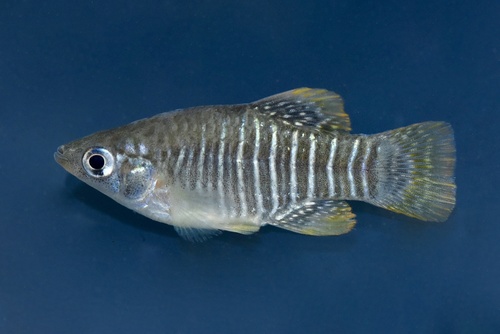
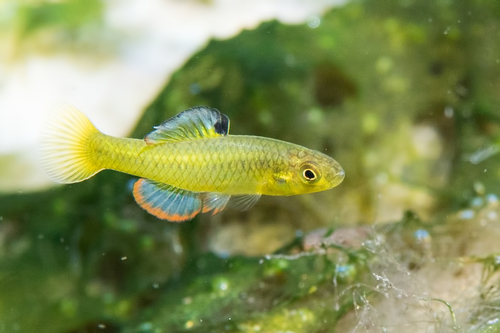
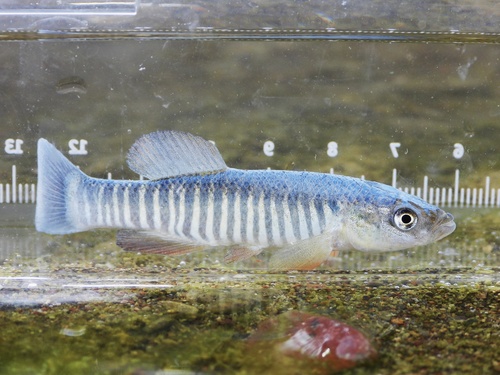
Fundulus heteroclitus, commonly called the mummichog, has an elongated but thick body with a deep caudal peduncle.
Size
It typically reaches 7.5 to 9 cm (3.0 to 3.5 in) in length, with a maximum recorded length of 15 cm (5.9 in).
Mouth and Fin Shape
Its mouth is upturned, and the lower jaw protrudes when the mouth is closed; both the pectoral and tail fins are round.
Fin Ray Count
Mummichogs have 10–13 dorsal fin rays, 9–12 anal fin rays, and 16–20 pectoral fin rays.
Sexual Dimorphism in Fins
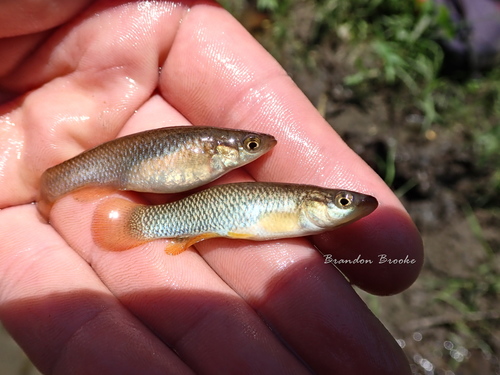
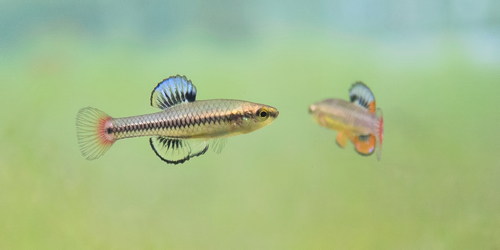
Males have larger dorsal and anal fins than females.
Lateral Line Features
While the body has no lateral line, lateral line pores are present on the head.
Base Coloration
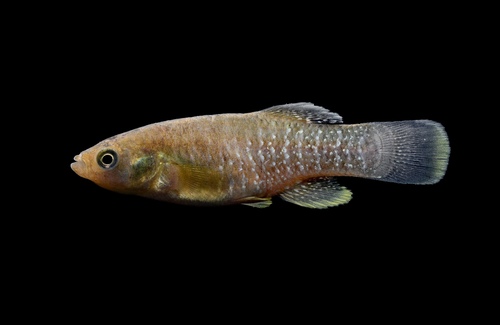
Coloration is variable, and individual mummichogs can even change shade when placed near different backgrounds; overall color is generally olive-brown or olive-green.
Side Markings
Thin, wavy, silvery vertical bars may be present on the sides.
Breeding Male Coloration
During the reproductive season, males display more intense coloration: they become dark olive-green on the back, steel-blue on the sides with around 15 silvery bars, and yellow or orange-yellow on the underside.
Male Dorsal Fin Features
The male dorsal fin is mottled, and a small eyespot may be present near its rear edge.
Female Coloration
Females are typically paler, lack bars and intense belly yellowing, and have uniformly colored dorsal fins.
Subspecies Classification
The species is split into two subspecies, which can be distinguished by slight morphological and genomic differences.
Subspecies Egg and Spawning Differences
Northern subspecies eggs have adhesive chorionic fibrils (filaments) that southern subspecies eggs lack; the northern subspecies deposits eggs in sand, while the southern subspecies often lays eggs inside empty mussel shells.
Similar Species and Hybridization
The mummichog is very similar to the banded killifish, Fundulus diaphanus, and the two species are known to interbreed.
Habitat Overlap with Banded Killifish
Their habitats may overlap, but banded killifish are more commonly found in freshwater, which is not typical for mummichog.
External Differences from Banded Killifish
Banded killifish have thin dark bars on a light-colored side, while mummichog have thin light bars on a dark-colored side.
Internal Differences from Banded Killifish
Internally, banded killifish have 4–7 gill rakers, while mummichog have 8–12 gill rakers.
Native Range
This species is native to the Atlantic coast of North America, ranging from the Gaspé Peninsula, Anticosti Island, and Port au Port Bay in the north to northeastern Florida in the south.
Sable Island Population
It is also found on Sable Island, 175 km (109 mi) southeast of the nearest point of mainland Nova Scotia in the Atlantic Ocean.
Subspecies Boundary
The approximate geographic boundary between the two subspecies runs through New Jersey, Delaware, and Virginia.
Introduced European Populations
Introduced populations have become established on the Atlantic coast of Portugal and southwestern Spain beginning in the 1970s, and some have now spread to the western Mediterranean basin.
Other Possible Introduced Populations
Possible introduced populations also exist in Hawaii and the Philippines.
Freshwater Introductions from Bait Release
As bait fish, mummichogs are sometimes released into freshwater habitats where they can survive; there are documented records of individuals in New Hampshire ponds, the upper Ohio River, and the Beaver River.
Typical Coastal Habitats
Mummichogs are common in coastal habitats including salt marshes, muddy creeks, tidal channels, brackish estuaries, eelgrass and cordgrass beds, and sheltered shorelines.
River and Landlocked Populations
They occur in coastal rivers but rarely venture beyond the head of tide. A small number of landlocked populations exist in freshwater lakes close to shore, for example on Digby Neck, Nova Scotia.
Spawning Season
Spawning occurs from spring through fall. In the southernmost populations, up to eight spawning events can occur in a single season.
Spawning Timing
Spawning most often takes place at high tide, during new or full moons. Maximum spawning occurs when high spring tides coincide with night, though spawning can also happen during the day.
Courtship Behavior
During courtship, males may pursue females, and females may attract males by turning onto their sides near the bottom and flicking their tails.
Spawning Behavior
After a male and female swim together for some time, the male crowds the female against a rock or plant and clasps her, curving his larger dorsal and anal fins around her body.
Male Spawning Adaptations
Finger-like projections that develop on the male's scales behind and below the dorsal fin may help him maintain contact with the female.
Gamete Release
The pair quivers vigorously to release eggs and sperm.
Egg Characteristics
The eggs are pale yellow, around 2 mm (0.08 in) in diameter, and strongly adhesive.
Fecundity
During a single spawning event, a female can deposit up to 740 eggs in separate clutches of 10 to 300 eggs each.
Egg Deposition Sites
The eggs adhere to plants, algal mats, empty mussel shells, sand, or mud at sites that are only covered by water during high spring tides.
Egg Development and Hatching Trigger
Eggs develop while exposed to moist air, and hatch when the next high spring tides reach them. Eggs cannot hatch in air or moving water; hatching is triggered by low oxygen, which occurs in the boundary layer of relatively still water surrounding the metabolically active egg at high tide, but not in air or moving water.
Sexual Maturity
Most mummichogs reach sexual maturity at two years old, when they are around 3.8 cm (1.5 in) in length.
Lifespan
The typical lifespan of a mummichog is four years.