About Eutropis multifasciata (Kuhl, 1820)
Please refer to the page on Snake scales for relevant terminology.
Species Identification Note
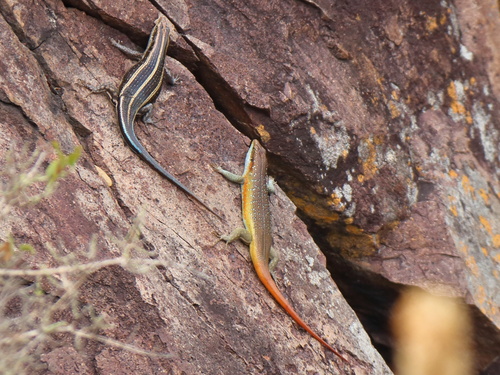
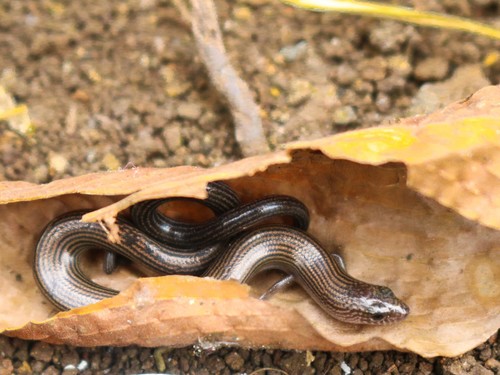
Eutropis multifasciata is a skink species that frequently has distinct colored dorsal bands. It has several other distinctive traits that set it apart from other skink species, most notably in the arrangement of its scales.
Snout and Eyelid Characteristics
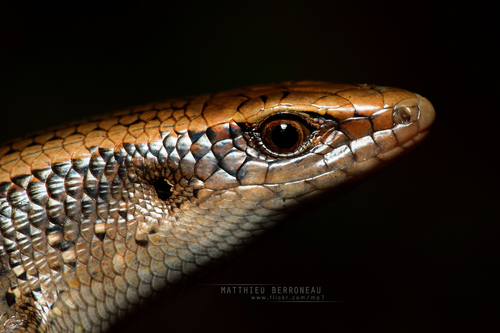
Its snout ranges from moderate to obtuse, and its lower eyelid is covered in scales. The nostril sits behind the vertical line of the suture between the rostral and first labial scale, and a postnasal scale is present.
Loreal Scale Features
The anterior loreal scale is no deeper than the second loreal scale, and it contacts the first labial scale. The supranasal scales are mostly in contact with each other behind the rostral scale.
Frontonasal and Prefrontal Scales
The frontonasal scale is broader than it is long, and the prefrontal scales always form a median suture.
Frontal Scale Characteristics
The frontal scale is as long as, or shorter than, the combined length of the frontoparietals and interparietal, and it contacts the second (and occasionally the first) supraocular.
Supraocular and Supraciliary Scales
There are four supraoculars, and the second is the largest; there are six supraciliaries, and the first is the largest.
Fronto-parietal and Parietal Scales
The fronto-parietal scales are distinct and larger than the interparietal, and completely separate the parietals.
Nuchal and Labial Scales
There is one pair of nuchals, and four labials located anterior to the subocular, which is large and not narrower at its lower end.
Ear-opening Features
The ear-opening is rounded or oval, and is around the size of a lateral scale, or slightly smaller.
Dorsal Scale Keeling
The dorsal scales are more or less clearly tricarinate, with three ridges, or rarely five. The nuchal and lateral scales usually have very faint keels, or are sometimes smooth.
Midbody Scale Count
There are 30 to 34 scales around the midsection of the body, and the dorsal scales are the largest.
Limb Characteristics
When extended, the hind limb reaches either the wrist or the elbow of the forelimb. The subdigital lamellae are smooth.
Tibia Scale Features
Most scales on the upper surface of the tibia are tricarinate.
Tail Length Ratio
The tail is between 1.3 and 1.6 times the combined length of the head and body.
Upper Body Coloration
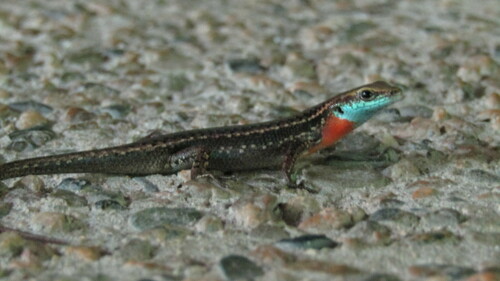
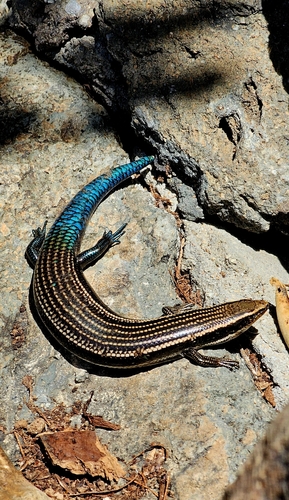
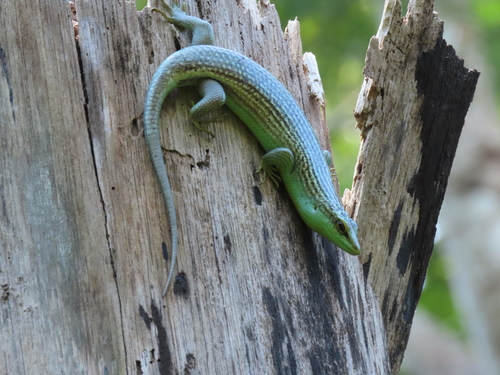
The upper body is brown or olive; some individuals are uniformly colored, while others have a large whitish or red patch on each side of the body.
Dorsal Spot Pattern
Small black spots appear on the back, and these sometimes merge into longitudinal lines.
Lateral and Ventral Coloration
The sides are usually dark brown, with whitish ocelli edged in black. A distinct light dorso-lateral band is only very rarely present, and the lower surfaces of the body are yellowish or greenish white.
Native Distribution
This species is widely distributed across southern Asia: it occurs from India (including Assam and the Nicobar Islands) and southern China, through all of continental Southeast Asia, to southern Indonesia, with scattered records from New Guinea.
Introduced Range
It has been introduced to Australia and the United States of America.