About Chalcides sexlineatus Steindachner, 1891
Common Name & General Body Form
Chalcides sexlineatus, commonly called the Gran Canaria skink, has a flattened body and a wide head.
Leg Morphology
Its legs are strong, and the northern subspecies has longer legs than the southern subspecies.
Scale Variation
The southern subspecies has one phrenocular scale, while the northern subspecies usually has two.
Total Body Length
The average total body length of the species is around 150 mm (6 inches) including the tail, and females are on average a few millimeters longer than males.
Geographic Size Variation
Individuals from the southern part of the range are slightly smaller than those from the north.
Nominate Subspecies Coloration
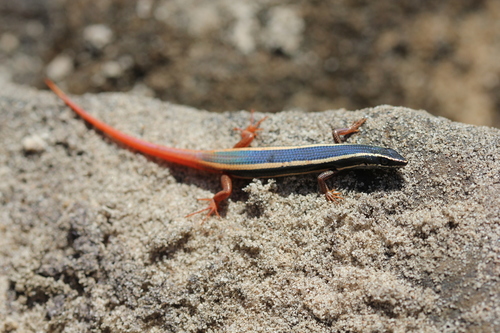
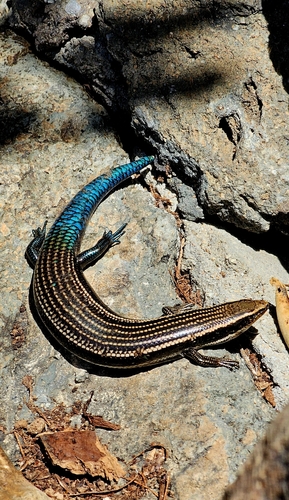
In the northeast, the nominate subspecies C. s. sexlineatus has a distinct bright blue tail and a light bluish belly. It has a black dorsolateral band, which is separated from the side by a whitish or yellowish line, and four yellowish brown lines run along its back.
Southwest Subspecies Coloration
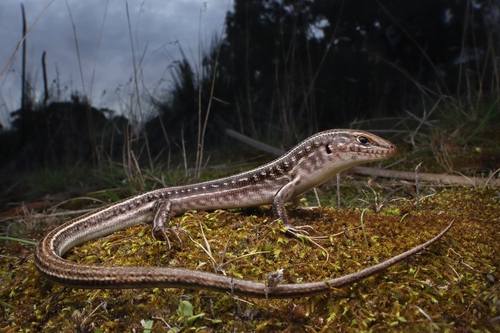
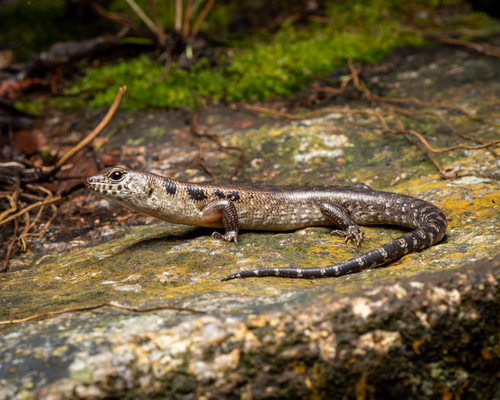
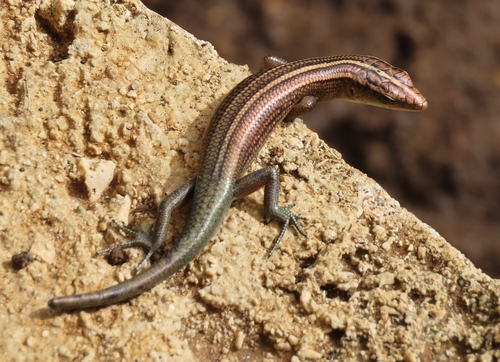
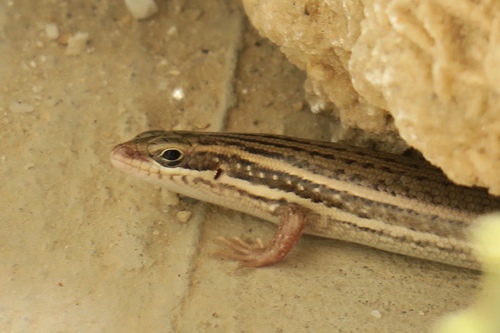
In the southwest, the subspecies C. s. bistriatus has a brown tail and a white to yellowish belly. Its back is brown with white spots arranged in a line down the body, and a narrow light band runs along each side of its back.
Intermediate Form Coloration
Populations that are intermediate between northern and southern forms have green tails.
Species Distribution
This species is endemic to the island of Gran Canaria and the small islet Roque de Gando, which are part of the Canary Islands, Spain, and has also been introduced to the island of La Palma.
Altitudinal Range
It occupies a wide altitudinal range, from the coast up to 1,850 meters above sea level.
Morphological Difference Origin
Researchers have attributed the distinct morphological differences between the subspecies to volcanic activity on Gran Canaria over the past 2.8 million years.
Common Habitats
This skink is abundant in nearly all habitats across Gran Canaria, including coastal areas, temperate forests, grasslands, rocky peaks, and agricultural areas.
Rarer Habitats
It is rarer in pine forests and the drier areas of southern Gran Canaria.
Reproductive Mode
Chalcides sexlineatus is ovoviviparous.
Breeding & Offspring
Breeding takes place in July and August, and females give birth to between 2 and 7 offspring starting in September.
Behavioral Trait
These skinks are elusive and can be difficult to spot.
Diet
They feed mainly on insect larvae and other small invertebrates.