About Dasia olivacea Gray, 1839
Taxonomy
Dasia olivacea was first described by Gray in 1839.
Dorsal Coloration
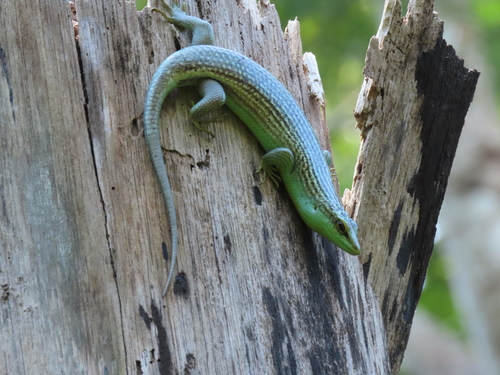
Mature individuals of this species have a green back, with bronze-colored scales along their flanks, and 12 bands of ocelli (eye-like spots) that stretch across the body from side to side.
Head Coloration
The head is mainly dark olive-green with black markings, while the underside of the head ranges from bluish green to yellowish green.
Distribution Range
Dasia olivacea occurs in Southeast Asia, south of roughly 15° north latitude.
Mainland Distribution
Its range includes parts of Laos, Malaysia, Myanmar, Thailand, Singapore, and Vietnam.
Island Distribution
It is also found across the entire island of Borneo, covering Sarawak, Kalimantan, and Brunei, plus the Indonesian islands of Bali, Java, Sumatra, and other smaller islands, as well as India's Andaman and Nicobar Islands.
Cambodia Distribution
The species was originally recorded from only one location in Cambodia.
Northern Distribution Limit
The northernmost confirmed record of D. olivacea is possibly at the Sakaerat Environmental Research Station, located in Nakhon Ratchasima Province, eastern Thailand.
Habitat
In terms of ecology, D. olivacea lives almost entirely in trees, and only rarely descends to the ground to nest or move between different trees.
Reproduction
Females can lay eggs multiple times per year, with clutches containing up to 14 eggs, and an incubation period of 69 days.
Conservation Status
Due to its very wide distribution and ecological flexibility, D. olivacea is classified as a species of Least Concern on the IUCN Red List.