About Eulampis holosericeus (Linnaeus, 1758)
Taxonomy and Classification
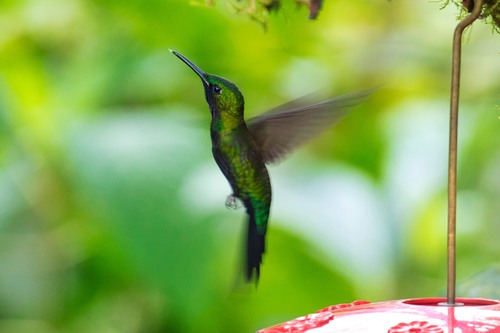
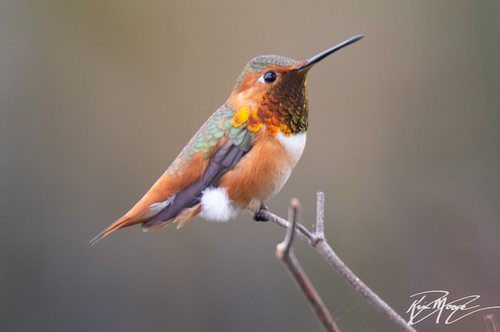
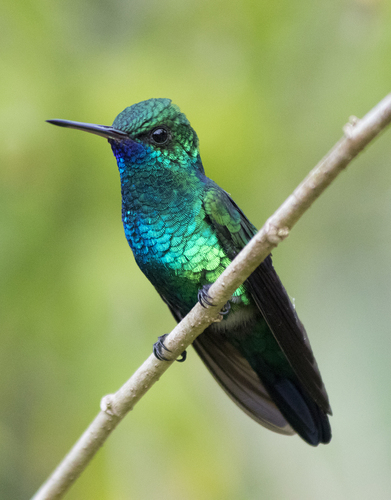
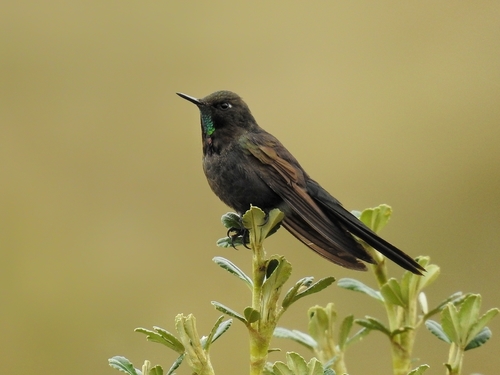
The green-throated carib, scientifically named Eulampis holosericeus (Linnaeus, 1758), is a large species of hummingbird.
Adult Size
Adults measure 10.5 to 12 cm (4.1 to 4.7 in) in length.
Back and Gorget Coloration
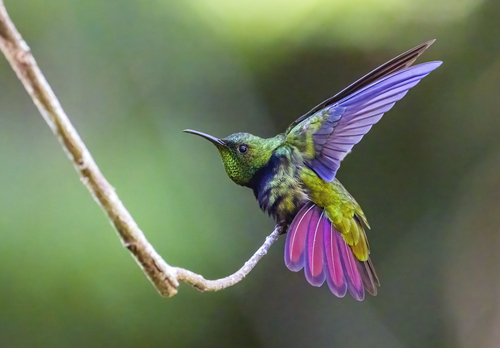
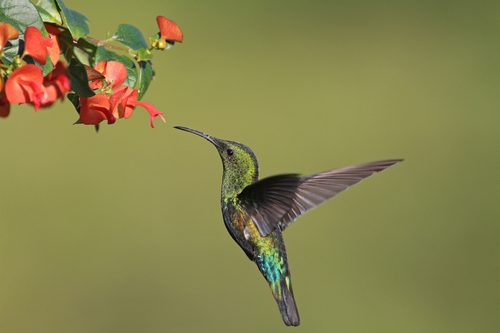
Both sexes have a bright green back, though the female’s back is duller than the male’s, and both also have a bright green gorget. The male’s gorget has a blue border that is usually not visible.
Underpart and Tail Coloration
Both males and females have a black belly, a green vent area, and a dark blue tail that looks black in low light.
Subspecies Underpart Variation
The underparts of the subspecies E. h. chlorolaemus are somewhat darker than the underparts of the nominate subspecies.
Bill Morphology
Males have a medium-length bill that is slightly decurved, while the female’s bill is longer and more strongly curved.
Vocalizations and Wing Sounds
Its calls include a sharp chup! or chuwp!, and during territorial disputes, the bird sometimes produces rattling and whirring sounds with its wings.
Movement Patterns
The green-throated carib is generally sedentary, but some individuals are known to move to wetter areas after the breeding season.
Nominate Subspecies Range
The nominate subspecies ranges from eastern Puerto Rico through the Virgin Islands and the Lesser Antilles chain, reaching as far as (but not including) Grenada.
E. h. chlorolaemus Range
The subspecies E. h. chlorolaemus is endemic to Grenada.
General Habitat
The species lives in a variety of landscapes, including wet forest, semi-deciduous forest, cultivated areas, gardens, and parks.
Martinique Habitat
On Martinique, it also occurs in drier habitat.
Elevational Distribution
On many islands, it is most common near sea level, though on Dominica it is found mostly in foothills.