About Ocreatus peruanus (Gould, 1849)
Sexual Dimorphism in Racket-tails
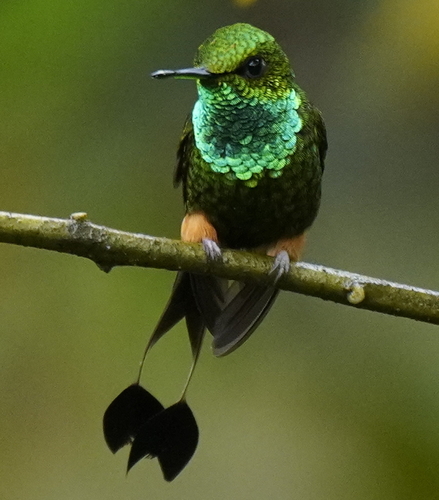
All racket-tail species show strong sexual dimorphism, where only males have elongated outer tail feathers (outer rectrices) with bare shafts and terminal flag-like tips.
Male Peruvian Racket-tail Tail Features
For the Peruvian racket-tail (Ocreatus peruanus), these male tail feathers are straight, do not cross, and have narrow oval terminal flags that slightly overlap.
Male Size and Weight
Males of this species are 11 to 15 cm (4.3 to 5.9 in) long including the 7 to 8 cm (2.8 to 3.1 in) outer tail feathers, and weigh 2.5 to 2.7 g (0.088 to 0.095 oz).
Female Size and Weight
Females measure 7.6 to 9 cm (3.0 to 3.5 in) long and weigh 2.6 to 3.2 g (0.092 to 0.11 oz).
Shared Physical Traits
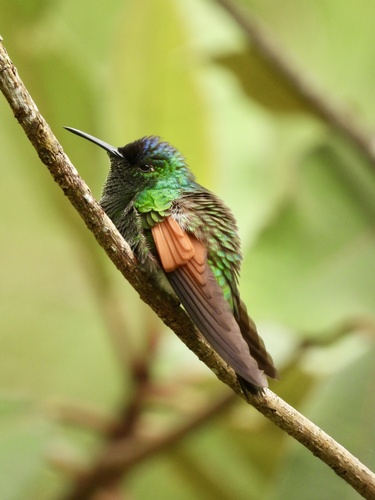
Both sexes share several physical traits: greenish upperparts without a glittering forehead, a white spot behind the eye, and cinnamon leg puffs.
Male Plumage Details
Males have a greenish gray throat, a solid green belly, and greenish black tail flags.
Female Plumage Details
Females have a white throat and breast that are heavily spotted with green.
Species Distribution
Ocreatus peruanus is distributed in eastern Ecuador and northeastern Peru, extending as far south as Huánuco Department.
Habitat Range
It lives in the temperate and subtropical Andes mountains.
Preferred Habitats
It prefers the edges of humid to wet forest, but also occurs in forest interiors and more open secondary forest.
Elevation Range
It is most abundant between 1,600 and 2,200 m (5,200 and 7,200 ft) elevation, but can be found as low as 600 m (2,000 ft) and as high as 4,000 m (13,000 ft).