About Spheniscus humboldti Meyen, 1834
Scientific Classification and Size
Humboldt penguins (scientific name Spheniscus humboldti Meyen, 1834) are medium-sized penguins, growing 56–70 cm (22–28 in) long and weighing 2.9 to 6 kg (6.4 to 13.2 lb).
Sexual Dimorphism
They are sexually monomorphic, so sex cannot be identified by differences in plumage; however, males are heavier and larger than females, and can be distinguished by longer bills and wider heads.
Genus Size Comparison
Among all Spheniscus penguins, which are closely similar in overall size, Humboldt penguins are the heaviest species in the genus: 123 sampled females averaged 4.05 kg (8.9 lb), while 165 sampled males averaged 4.7 kg (10 lb).
Adult Head Markings
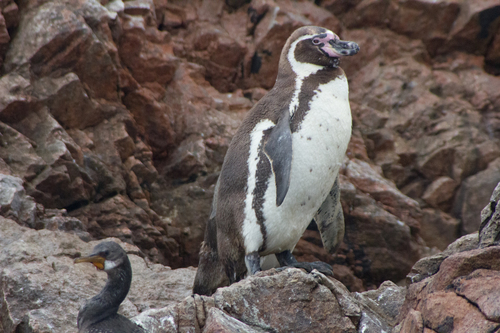
This species has a black head marked with a white border that runs from behind the eye, around the black ear-coverts and chin, and meets at the throat.
Body Plumage
They have blackish-grey upperparts and whitish underparts, with a black breast-band that extends down the flanks to the thigh.
Bill Coloration
The base of their bill is fleshy-pink.
Juvenile Appearance
Juveniles have dark heads and no breast-band.
Tongue Adaptation
They have spines on their tongue that they use to hold prey.
Predator Status and Endemic Range
The Humboldt penguin is a top predator endemic to the west coast of South America.
Breeding Distribution
Its breeding distribution stretches from southern Chile, along the dry, arid coastal regions of the Atacama Desert near former Bolivia, to subtropical Isla Foca in northern Peru.
Habitat Association
Its range is restricted to the coast and offshore islands influenced by the Humboldt Current, which supplies a consistent stream of nutrients and food that supports large seabird populations.
Key Breeding Colony
The most important breeding colony in Chile is located at Isla Chañaral.
North American Sighting
In July 2002, a Humboldt penguin was caught in a fishing net off the coast of Prince of Wales Island in Alaska. After being released from the net, the penguin was eventually returned to the water by a fisherman.
Sighting Context
This is the only recorded wild occurrence of this penguin in North America, and it remains unknown whether the individual was a wild penguin or an escaped pet or zoo animal.
Threat Overview
Introduced feral species and habitat disturbance have harmed Humboldt penguin populations.
Feral Goat Impacts
On the Puñihuil islands, the introduction of feral goats caused detrimental impacts: goats browse the vegetation penguins use to build nests, and their activity can cause dirt burrows to collapse.
Mainland Connection Risks
Connecting the islands to the mainland also allowed new mammal species to move onto the islands.
Nest Vegetation Grazers
In central Chile, European rabbits and Norway rats graze on nesting vegetation.
Predation by Invasive Species
Norway rats and black rats also prey on penguin eggs, while feral cats and dogs kill chicks, fledglings, and adult Humboldt penguins.
Nesting Structure
Humboldt penguins nest in loose colonies.
Egg Laying Basics
Most pairs lay two equally sized eggs 4 days apart, and the eggs require 41 days of incubation.
Breeding Timing Drivers
Their breeding schedule shifts based on food abundance; they breed immediately after moulting, when food is abundant and solar radiation is lower.
Egg Laying Period
They lay eggs from March to December, with peaks in activity in April and August–September, because many individuals lay a second clutch.
Clutch Frequency
Half of all females successfully produce two clutches per year, and most of these result in double broods.
Replacement Clutches
If a pair loses their eggs during the first breeding season, they will lay a new clutch within 1–4 months.
Incubation Shifts
On average, incubation shifts between parents last 2.5 days: one parent takes over incubation to allow the other to leave and forage for food.
Chick Provisioning Roles
Males and females contribute equally to provisioning for chicks.
Chick Hatching
Chicks generally hatch 2 days apart.
Chick Guarding Behavior
They are semi-altricial and nidicolous, so one parent always guards the chick while the other forages.
Chick Feeding Frequency
Chicks are fed only once per day.
Later Chick Rearing
After chicks reach a certain age, they are left unattended at the nest site, and both parents forage at the same time.