About Eudyptes pachyrhynchus G.R.Gray, 1845
Species Identity
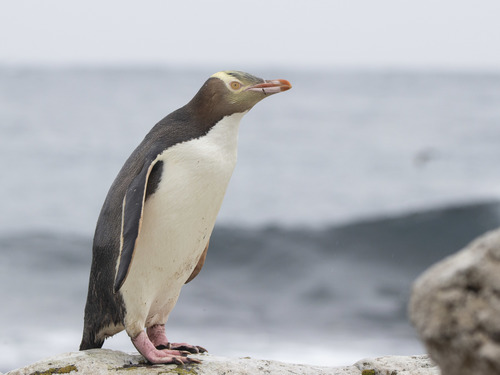
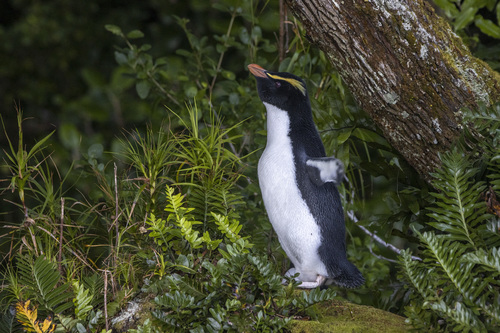
This species, the Fiordland crested penguin, is a medium-sized yellow-crested black-and-white penguin.
Size Measurements
It grows to approximately 55 cm (22 in) long, with an average weight of 3.5 kg (7.7 lb) and a weight range of 2 to 5 kg (4.4 to 11.0 lb).
Basic Plumage
It has white markings on its face, a white front, and black head and body.
Crest Characteristics
Its broad yellow crest starts at the base of the beak, extends over the eye, and drops down the neck.
Species Distinction Features
It can be told apart from the similar erect-crested penguin (Eudyptes sclateri) and Snares penguin (Eudyptes robustus) by having no bare skin around the base of its bill.
Egg Laying Traits
Female Fiordland penguins lay a clutch of two eggs: the first-laid egg is much smaller than the second, generally hatches later, and has higher mortality.
Brood Reduction System
This forms a brood reduction system that differs from that of other avian groups.
Breeding Success
The Fiordland crested penguin has much higher breeding success than most other Eudyptes species, with the exception of the southern rockhopper penguin, even at sites with introduced and/or native predators.
Nesting Habitat
This penguin nests in colonies among tree roots and rocks in dense temperate coastal forest.
Current Breeding Range
It breeds along the shores of the West Coast of the South Island of New Zealand, south of roughly Bruce Bay and the Open Bay Islands, around Fiordland and Foveaux Strait, and on Stewart Island/Rakiura and its outlying islands.
Fossil Distribution Evidence
Fossils of this species have been found as far north as the northern end of the South Island, and the species probably once nested in the North Island as well.
Historical Range Reduction
Its range was drastically reduced by hunting in Polynesian times, and it is now only found in the least-populated part of New Zealand.
Former Australian Presence
The species was also present in Australia.
Foraging Group Segmentation
For this penguin species, foraging groups are split by location in the fjord and hunting area: inner-fjord, mid-fjord, and outer-fjord groups.
Diving Behavior Variation
Outer-fjord Fiordland crested penguins make long, deep dives, with descent velocities that reach higher values than those of mid-fjord individuals, which forage in the upper 20 meters of the water column.
Food Resource Impacts
In isolated populations of the species, patterns in autochthonous food sources and subsidies from allochthonous resources impact the population, and locally produced resources are very important to every colony.