About Etheostoma tippecanoe Jordan & Evermann, 1890
Common Name and Size
Etheostoma tippecanoe, commonly called the Tippecanoe darter, is one of the smallest darter species: adults commonly reach 1.3 inches in length, and the species never grows longer than 2.0 inches.
Male Non-breeding Coloration
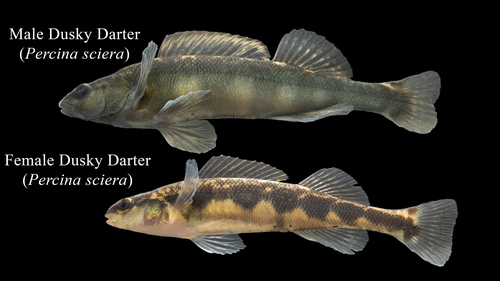
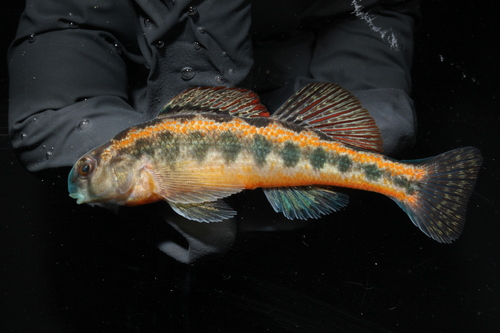
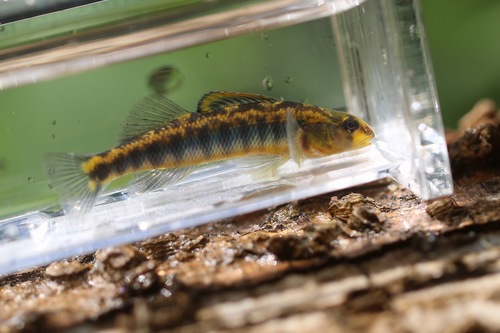
Males have a dusky body and fins marked with scattered spots and vertical banding; their blue-black side bars are darkest toward the rear of the body.
Lateral Scale Count
This species has 40–65 lateral scales.
Breeding Male Coloration
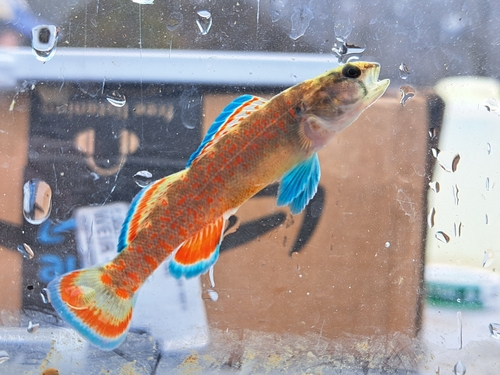
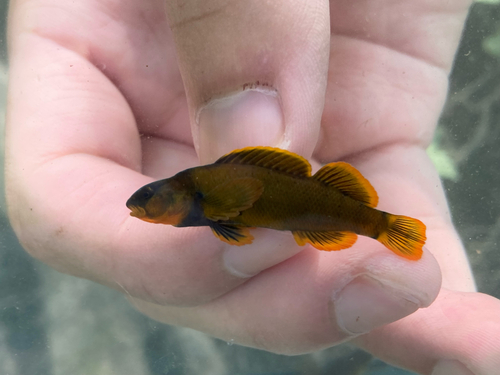
Breeding males develop bright orange coloration on the throat, belly, spots at the caudal fin base, and fin margins.
Female Body Markings
Females also have dark vertical bars on their sides that are most visible near the tail, but these bars are usually less distinct than those found on males. Females have two yellow spots at the caudal fin base.
Fin Appearance
All fins of this species are clear with many scattered dark spots that often form rows.
Belly Scale Coverage
Both sexes have very few scales on the belly.
Distinguishing Species Traits
Two distinguishing characteristics of the species are two light spots at the base of the caudal fin that form an hourglass shape, and circular banding around the head.
Pelvic Fin Coloration
The center portion of the pelvic fins is dark blue-black.
Core Geographical Range
The Tippecanoe darter is distributed across Pennsylvania, Ohio, Indiana, West Virginia, Kentucky, and Tennessee, where it occurs most often in medium to large streams and rivers.
Illinois Population Record
Very small populations have also been found in the Vermillion River (Wabash Basin) in Illinois since 2014.
Age-specific Habitat Partitioning
Adults inhabit deeper fast gravel and cobble riffles greater than 20 inches deep, while juveniles occupy separate shallower riffle habitats.
Microhabitat Use
The species spends most of its time between rocks and under gravel, making it very difficult to locate.
Habitat Indicator Plants
Previous capture attempts confirm that Tippecanoe darters prefer habitat with American water willow (Justicia americana); other similar plant species can also serve as good indicators of potential E. tippecanoe habitat.
Recent Range Expansion Record
The species has expanded its range in some areas, including the 2017 discovery of Tippecanoe darters in Alum Creek on the Ohio Dominican University campus in Columbus, Ohio.
Feeding Guild
The Tippecanoe darter is an opportunistic, general ambush feeder that preys on immature insects. It consumes prey in proportion to the prey’s occurrence in its habitat.
Ambush Feeding Behavior
As an ambush feeder, it lies in wait and darts upward to grab passing insects from overhead.
Juvenile Diet Differences
Juveniles consume proportionally smaller prey, and eat more chironomids, than adults. This pattern may be related to ease of capture, or to the greater availability of chironomids in the shallower riffles where juveniles live.
Adult Prey Size Limit
Adults rarely eat prey longer than 6 mm.
Winter Diet Specialization
During winter months, when food availability is low, E. tippecanoe may become more specialized due to interspecific competition within its habitat.
Interspecific Competitors
It is a direct competitor with other Etheostoma species that share its range, including E. zonale, E. blennioides, and E. flabellare.
Pollution Threat
Localized human pollution that reduces insect availability can directly impact the Tippecanoe darter; as food becomes scarcer, the species is quickly lost from affected areas because it cannot alter its prey size selection.