About Etheostoma blennioides Rafinesque, 1819
Common Name & Body Shape
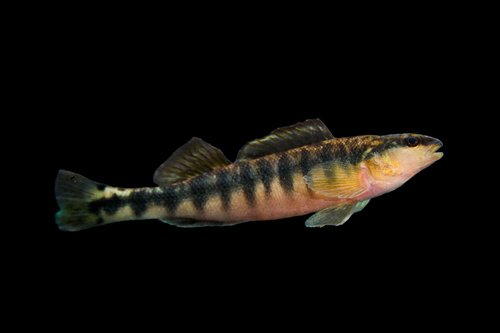
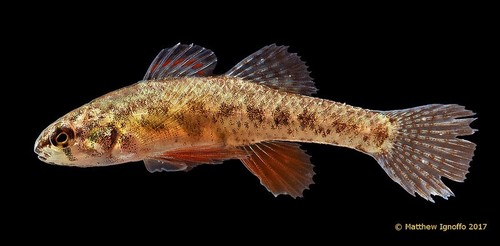
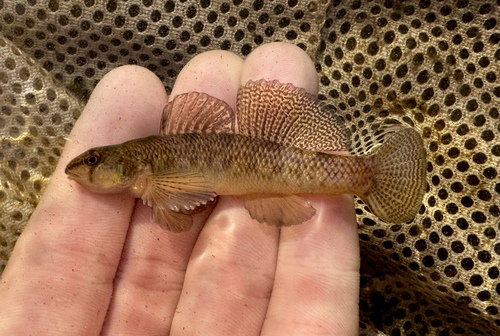
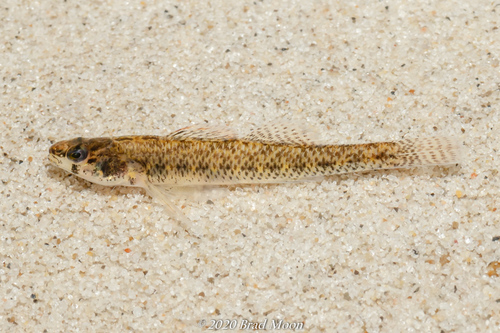
Etheostoma blennioides, commonly called the greenside darter, has an elongated body with a long, rounded snout.
Body Coloration & Markings
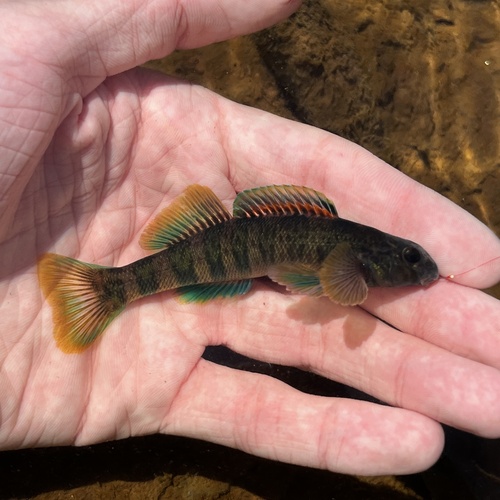
Its dorsum is greenish-brown, marked with six or seven dark square-shaped saddles, while its sides have five to eight dark green blotches that are typically U- or W-shaped.
Scaling Pattern
The nape, cheeks, opercle, and belly are fully scaled, and the breast is unscaled.
Anal & Pectoral Fin Characteristics
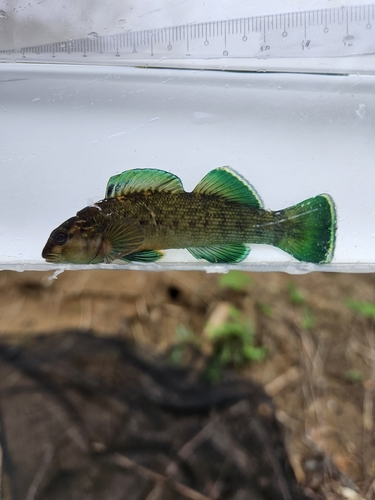
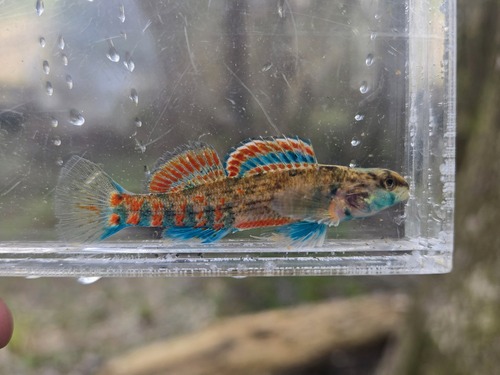
The anal fin has 6 to 10 rays, usually eight, and the pectoral fin has 13 to 16 rays; both fins are bright green in breeding males.
Caudal Fin Characteristics
Caudal fins range from yellowish to clear.
Dorsal Fin Characteristics
The dorsal fin has 12 to 15 rays, with red bands at its base.
Breeding Male Coloration
Breeding males have intensely bluish-green nasal and oral regions, and sometimes black coloring on the head.
Subspecies Divergence Origin
Subspecies of E. blennioides are thought to have diverged in separate drainage systems and glacial refugia during the Pleistocene ice ages, a period that destroyed older drainage connections and shaped new river systems.
Nominate Subspecies Range
The nominate subspecies, E. b. blennioides (northern greenside darter), ranges across the Ohio River basin and extends northeast into the Potomac and upper Genesee Rivers.
E. b. newmanii Range
E. b. newmanii (highlands greenside darter) lives in the Cumberland and Tennessee River drainages of Alabama, Kentucky, and Tennessee; it also occurs in the Arkansas, Ouachita, St. Francis, and White Rivers of Arkansas and Missouri.
E. b. pholidotum Range
E. b. pholidotum (central greenside darter) inhabits north-flowing rivers of the northern Ozarks, the Wabash basin, the Maumee River drainage, and the shores of Lake Erie and Lake Ontario.
Habitat Preference
Greenside darters live in gravel riffles of large creeks to medium rivers, and are often found in swift water over large boulders and large rubble.