About Eryx jaculus (Linnaeus, 1758)
Genus Shared Body Trait
Eryx jaculus, commonly known as the javelin sand boa, shares the uniform body thickness trait common to all species in the Eryx genus.
Size and Body Shape
It can reach a total length of 80 cm (31+1⁄2 inches) including its tail, and is heavy-bodied with a short, blunt tail.
Initial Dorsal and Ventral Coloration
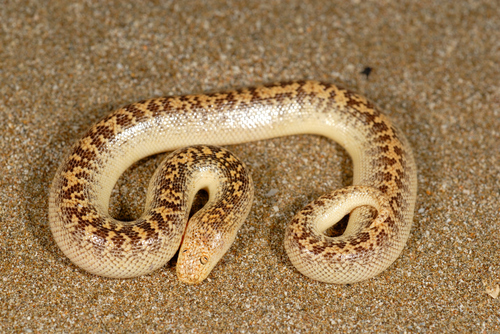
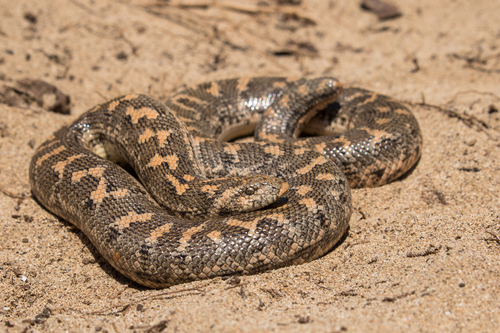
According to researchers from Razi University in Iran, the species is brownish-green or gray dorsally, with darker blotches, and has a white or yellowish belly that is either uniform or speckled with darker markings.
Dorsal Color Variation
Its overall coloration varies widely; dorsal color can also be tan or reddish, with darker blotches or bars arranged in an irregular network.
Facial and Ventral Color Markings
It typically has a dark streak running from the eye to the corner of the mouth, and the ventral surface is always whitish or yellowish.
Ventral Scale Width
The ventral scales are very narrow, less than one-third the width of the body.
Rostral Scale Characteristics
The rostral scale is large and broad, with an angular horizontal edge.
Eye and Lip Scale Features
The eye is separated from the lip scales by one or two rows of small scales, and there are 10 to 14 upper labial scales.
Dorsal Scale Arrangement and Texture
Dorsal scales are arranged in 40 to 50 rows; they are smooth on the anterior part of the body, but weakly keeled on the posterior.
Ventral and Subcaudal Scale Counts
There are 165 to 200 ventral scales and 15 to 34 subcaudal scales.
General Scale Build
Like other species in its family, Eryx jaculus has a relatively simple build with small scales.
Genus Shared Head Scale Trait
All members of the Eryx genus share a trait of three scales arranged like a star, pointing in different directions.
Head and Neck Identification Features
The entire head is covered in small scales, and the species can be identified by its small eyes and lack of a distinct neck.
Pupil Identification Feature
Other consistent identifying characteristics include a vertical pupil.
Research Status
This species has been very understudied.
2014 Iraq Field Survey
In May and September 2014, scientists in Iraq worked with local people to locate individuals of this snake.
Historical Distribution Research Goal
Researchers Schleich and Szyndlar have stated a goal to learn more about these snakes to understand their past distribution in the west.
Detailed Iranian Researcher Description
A more detailed description from the Iranian university researchers notes: "A green brown, or gray snake dorsally with darker blotches, and with a spotted yellowish or white belly; no neck, a stumpy tail, small plates on the head, a vertical pupil, posterior dorsals slightly keeled, ventrals narrow."
Global Distribution Range
Eryx jaculus is distributed across Eastern Europe, the Balkans, the Caucasus, the Middle East, and North Africa, and has also been recorded in India, Sri Lanka, and Mongolia.
Mongolian Common Name
In Mongolia, the species is called "batra", which translates to "father".
2014 Romania Rediscovery
In September 2014, the snake was rediscovered in Romania near the Danube; it had been considered extinct in the country since 1937, when the last specimen was observed near Cochirleni.
2015 Sicily Rediscovery
In late 2015, it was rediscovered near Licata on the south coast of Sicily, after not being officially recorded in Italy for eighty years.
Diet Composition
The diet of Eryx jaculus consists of lizards, small mammals, and other snake species.