About Corallus hortulana (Linnaeus, 1758)
Adult Size
Adult Corallus hortulana grow to an average length of 1.5 to 2 meters (5 to 6.5 feet), with an overall recorded length range of 525 to 1880 mm, and most individuals reach 1200 to 1500 mm.
Base Color Variation
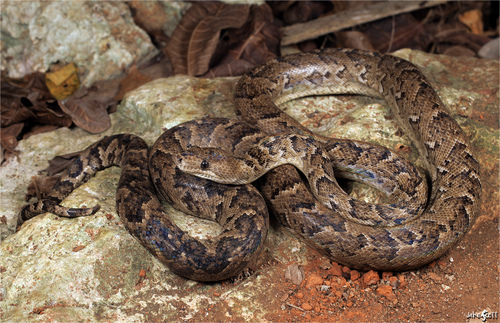
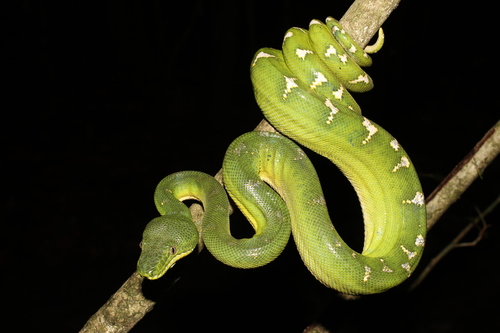
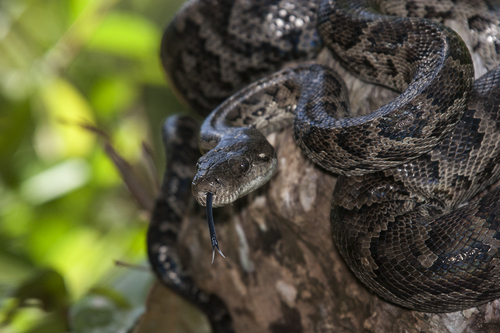
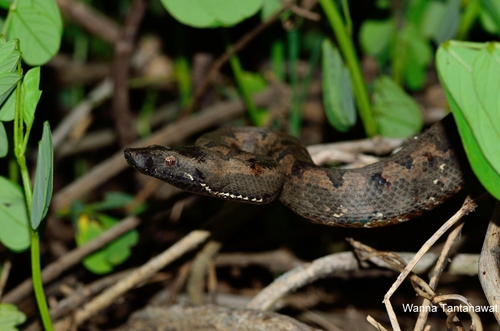
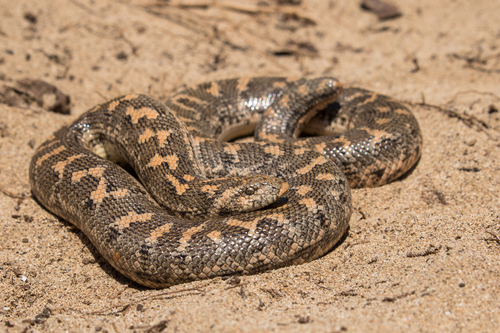
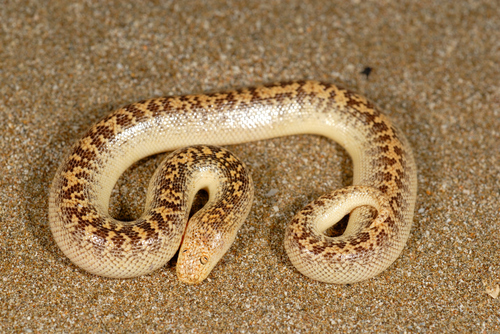
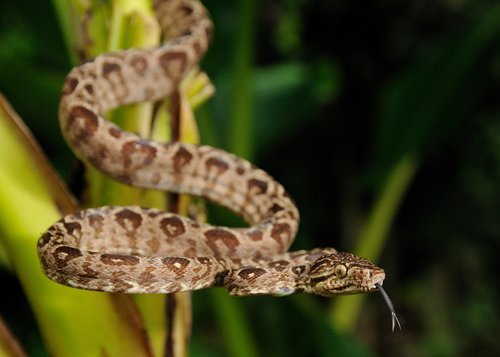
This species displays a wide variety of colors and patterns. Its base color can range across black, brown, gray, and any shade of red, orange, or yellow, plus many intermediate colorations.
Head Markings
The head usually has five dark stripes that extend outward from the eyes.
Eye Characteristics
Eye color can be yellowish, grayish, or reddish, and eyes have a reflective membrane that produces eyeshine at night.
Body Pattern Variation
Some individuals are patternless, while others have speckles, bands, or saddle-shaped rhomboid or chevron markings. Red-colored individuals may have yellow patterns, and yellow-colored individuals may have red or orange patterns.
Tongue Color
The tongue is black.
Sexual Dimorphism
Males and females are similar in size and markings.
Anal Spurs
Like all other boas, this species has a pair of small, claw-like anal spurs extending from the cloaca; these are vestigial remnants of hindlimbs.
Captive Color Phases
In the herpetoculture hobby, this species is often separated into two genetically inherited color phases: garden phase and colored phase. Garden phase boas have drab coloration, mostly brown or olive, with varied patterning, while colored phase individuals have combinations of red, orange, and yellow coloring.
Geographic Range
The geographic range of Corallus hortulana extends from southern Central America, across northern South America, and southeast to the Tropic of Cancer in Brazil.
Habitat Types
This species occupies a wide variety of habitats. It is common in high-humidity arboreal regions, especially the Amazon rainforest, but can also be found in drier areas such as savannas or dry forests.
Vertical Habitat Use
Most studied specimens are found 2 meters (6.6 feet) or more above ground, in trees or other vegetation, though individuals have also been observed feeding and reproducing on the ground.
Riparian Association
The species is also relatively common along rivers. It occupies forest, rainforest, and scrub forest terrestrial biomes, and is especially associated with riparian habitats.
Elevation Range
It occurs at elevations ranging from 0 to 900 meters (0 to 3,000 feet), though it is typically found below 300 meters (980 feet).
Reproductive Mode
Like other boas, Corallus hortulana is ovoviviparous, meaning it gives birth to live young.
Reproductive Season Variation
Its reproductive season varies between locations, and variation has been linked to both food availability and seasonal conditions.
Copulation Behavior
During copulation, the male wraps approximately 30% of his body around the female and makes head movements, including rubbing his chin against the female’s neck and head. In one captive observation, two males copulated with a single female for roughly 37 minutes, and no combat occurred between the males.
Gestation and Litter Characteristics
After a 6 to 7 month gestation period, females give birth to 2 to 29 live young, each measuring a total length of 28.2 to 64.4 cm (11.1 to 25.4 in).
Wild Reproduction Knowledge Gaps
Although the species has a wide distribution and is relatively abundant, comparatively little is known about its reproduction in wild populations. Only four cases of wild copulation have been documented to date.
Wild Mating Observations
Despite being primarily arboreal and nocturnal, wild Amazon tree boas have been observed mating during both the day and night, and both in the canopy and on the ground: two daytime mating observations were in trees, and two were on the ground.