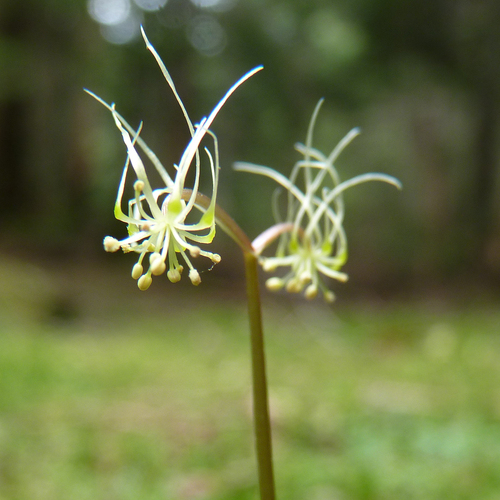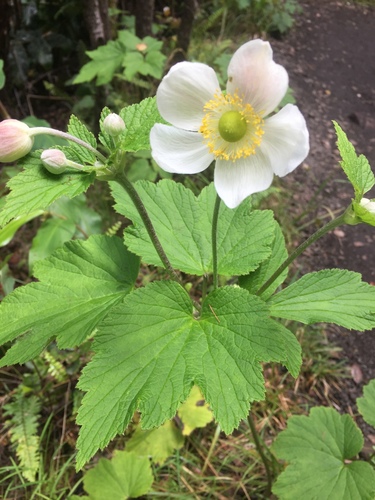
About Eriocapitella japonica (Thunb.) Nakai
Taxonomic Identity
Eriocapitella japonica (Thunb.) Nakai is a perennial herbaceous plant that grows 60 to 90 cm (2 to 3 ft) tall.
Plant Surface Characteristics
All plant parts are soft, downy, and covered in short hairs.
Basal Leaf Morphology
Its basal leaves are ternate, lobed, and toothed.
Inflorescence Structure
The inflorescence is a cyme, with flower stalks emerging from a whorl of leaves wrapped around the top of the stem.
Flower Dimensions and Parts
Each flower measures approximately 5 to 7.5 cm (2.0 to 3.0 in) across, and has 1–3 whorls of sepals (with no petals) and yellow stamens.
Sepal Coloration
The sepals are colored rosy purple or carmine.
Fruit Type
The fruits are silky achenes.
Native Distribution
This species is native to Central China, East China, South China, Taiwan, and Vietnam.
Cultivated Naturalized Range in China
It has been cultivated and naturalized in multiple Chinese provinces: Anhui, Jiangsu, Jiangxi, Zhejiang, and Fujian in East China; Guangdong in South China; and Yunnan in Southwest China.
Introduced Range in East Asia
It was introduced to Japan and Korea, and has been naturalized in Japan for hundreds of years.
Fall-blooming Anemone Classification
Alongside four other taxa – Eriocapitella hupehensis, Eriocapitella vitifolia, Eriocapitella tomentosa, and Eriocapitella × hybrida – this species is classified as a fall-blooming anemone.
Flowering Period
Just like E. hupehensis, E. japonica flowers from July to October in its native habitat.
Global Cultivation Status
Varieties of Eriocapitella japonica are cultivated across the world, particularly in China, Japan, and Korea, where naturalized populations occur.
Historical Cultivar Spread
Hundreds of years ago, a form of E. hupehensis with smaller, semi-double pink-sepaled flowers escaped cultivation and spread across China to Japan and Korea.
Cultivar Introduction to Europe
In 1843, plant explorer Robert Fortune found this form in a Shanghai graveyard and sent it to England, where it became known as E. japonica, the Japanese anemone.
Hybrid Cultivar Development
European horticulturists crossed this Japanese anemone with E. vitifolia to create cultivars of the artificial hybrid E. × hybrida.
Chicago Botanic Garden Experiments
Beginning in 1998, Rudy conducted 5 years of experiments with 26 cultivars of fall-blooming anemones at the Chicago Botanic Garden.
E. japonica Cultivar Bloom Performance
Four of the tested cultivars were E. japonica; one of these, E. japonica 'Prinz Heinrich', had the longest bloom length of any cultivar, at 65 days.
Royal Horticultural Society AGM Awards
As of March 2020, two E. japonica cultivars – 'Pamina' and 'Rotkäppchen' – hold the Royal Horticultural Society's Award of Garden Merit (AGM).
AGM List Removal
The cultivar 'Prinz Heinrich' was removed from the AGM list in 2013.