About Pulsatilla nuttalliana (DC.) Spreng.
Flowering Timing
Pulsatilla nuttalliana (DC.) Spreng. produces flowers before its foliage develops, blooming while leaves are just starting to emerge.
Flower Stalk Characteristics
The stalk holding the flower may be quite fuzzy or nearly smooth, but it is never completely hairless.
Bract Structure
Below the flower head, a ring of three highly divided bracts surrounds the flowering stalk, and these bracts are very different from the plant’s leaves.
Flower Arrangement
Each flower grows at the end of an individual stalk, and a single plant may produce either one or many flowers.
Sepal Color and Count
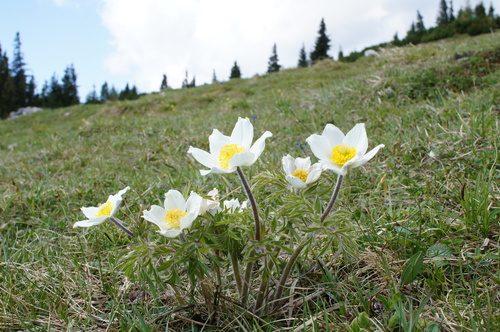
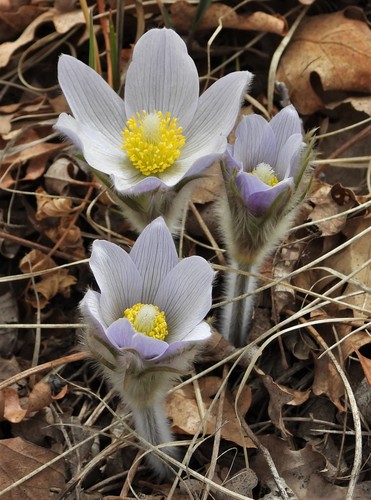
Flowers have five to eight lavender, blue-purple, or sometimes pale or nearly white sepals. Plants that bear flowers with higher numbers of sepals will typically revert to the more common six sepals in future years.
Flower Shape and Size
Petals are oblong to elliptic in shape, and flowers face upward like bells, measuring 20–40 mm long.
Flower Center Structure
The center of the flower is bright yellow, with a cluster of 150–200 stamens surrounding numerous styles.
Blooming Season Timing
The blooming period is very early; flowers often emerge as soon as snow melts, and may be covered by snow again afterward.
Temperature Response of Flowers
Flowers close during cold weather and reopen when temperatures warm.
Achene Structure
After blooming, fertilized flowers develop dry fruits called achenes, each with a feathery 20–40 mm long “tail” formed by the growing style.
Style and Seed Characteristics
Fertilized styles change color from whitish to pink or pink-brown, and each achene holds a single seed.
Seed Head Appearance
The entire seed head looks like a shaggy ball of threads.
Post-Flowering Stalk Growth
The stalk continues growing after flowering, moving the seed head far above the leaves and leaving the ring of bracts much lower down.
Pollination Mechanisms
Flowers can produce seed through either cross-pollination or self-pollination, and they exhibit protogyny (female parts develop before male parts) to encourage outcrossing.
Plant Type and Mature Height
Pulsatilla nuttalliana is a herbaceous perennial plant that reaches 5–40 cm in height at maturity, rarely growing as tall as 60 cm.
Stem Characteristics
Its stems are soft and covered in short, fine hairs.
Basal Leaf Structure
Basal leaves are ternately compound (divided into three parts), and each leaflet is further subdivided, resulting in end segments 2–4 mm wide.
Terminal Leaflet Attachment
The terminal leaflet attaches to the leaf stalk via a very short stalk or is almost completely sessile.
Full Leaf Dimensions and Shape
The full leaf has a teardrop or obovate outline, and measures 3–5 cm wide, rarely as narrow as 2.5 cm.
Root System and Vegetative Reproduction
The plant grows from a large underground tap root, and can also reproduce vegetatively by growing new rosettes from its vertically branched roots.
Natural Habitats
Natural habitats for Pulsatilla nuttalliana include cool northern prairies, open slopes, fescue grasslands, forest granite outcrops, and dry open woodlands in montane and boreal regions.
Anthropogenic Habitats
It also grows in human-created habitats such as clearcut areas, roadsides, and the edges of gravel pits.
Canadian Distribution
Pulsatilla nuttalliana is widely distributed across North America, ranging from Alaska (U.S.) and Nunavut (Canada) east to Ontario and across all western Canadian provinces.
US Distribution
In the U.S., it grows from Idaho east to Wisconsin, and south to Utah, Colorado, and parts of New Mexico, covering all upper Midwestern states and the Northern and Southern Rocky Mountains.
Global Conservation Status
NatureServe lists it as globally secure, but also classifies it as a subspecies rather than a full species.
Regional Conservation Status
It is assessed as critically imperiled in Washington, Illinois, and Ontario.
Pollinator Species
Pulsatilla nuttalliana is cross-pollinated by a range of insects including honeybees, solitary mining bees in the family Andrenidae, bumblebees, and hover flies.
Seed Dispersal Methods
Its seeds are dispersed by wind, or when they catch on the fur of passing animals.
Herbivore Forage Value
The plant has low forage value for herbivores because it is mildly toxic, containing protoanemonin.
Grazing Response
If grazed, it will grow new leaves from dormant buds, and populations of Pulsatilla nuttalliana increase in heavily grazed meadows.
Disturbance Adaptation
It is adapted to habitat disturbances including wildfire, but its seeds do not persist in the soil in significant quantities.
Ornamental Cultivation Context
Pulsatilla nuttalliana, also called prairie pasqueflower, is rarely grown as an ornamental garden plant, and is often confused with the commonly cultivated European species Pulsatilla vulgaris.
Ornamental Uses
It is still a useful ornamental, especially for gardeners interested in North American native species. It is planted somewhat more often in gardens designed to resemble an Upper Midwest prairie, in rock gardens, and for its value as spring forage for bees.
Fresh Seed Germination
Fresh seed of Pulsatilla nuttalliana (and other Pulsatilla species) germinates easily without stratification or other pretreatment, sprouting in about three weeks or slightly longer.
Stored Seed Germination
Dry-stored seed that has been stored for several months requires 60 days of cool moist stratification, then sprouts at 18 to 21°C.
Seed Storage Requirements
Seeds do not store well, so they should be planted immediately or kept in cool dry conditions.
Vegetative Propagation for Cultivation
Pasqueflowers can also be propagated vegetatively for gardens or habitat restoration by taking 2–4 cm root cuttings and planting them in well-drained potting medium.
Transplanting Guidelines
Seedlings are difficult to transplant, and transplanting any size of this plant requires avoiding root disturbance by digging with a large amount of surrounding soil.
Garden Soil Drainage Needs
Good drainage is critical for the health of garden-grown prairie pasqueflower.
Preferred Garden Soil Conditions
It grows best in moist to dry soils with a neutral to slightly alkaline pH (7.0 to 8.0) and winter snow cover.
Winter Hardiness
It is winter hardy in USDA zones 3–5.
Compost Tolerance
Unlike some wildflowers, it grows well when 7 centimeters of compost is added to the topsoil.
Light Requirements for Hot Climates
In regions with hot summers, the plant experiences less stress with partial to half-day shade.
Light Requirements for Cool Climates
In regions with cool summers such as mountain habitats and northern prairies, it requires full sun.