About Eremophila oppositifolia R.Br.
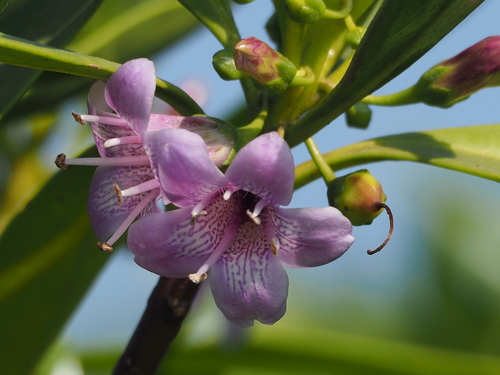
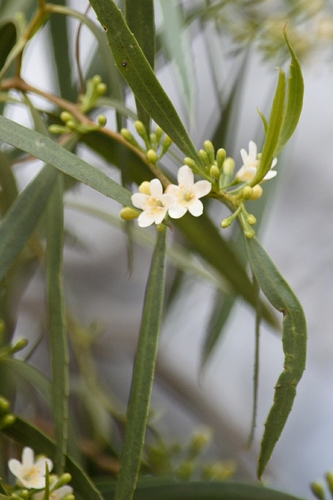
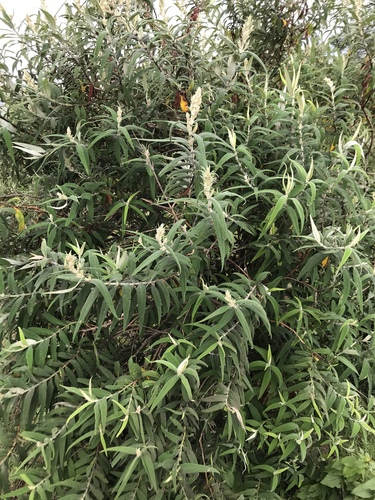
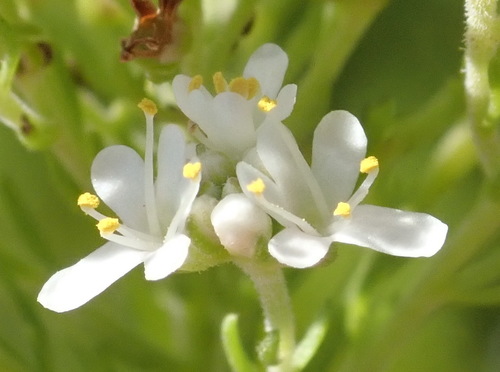
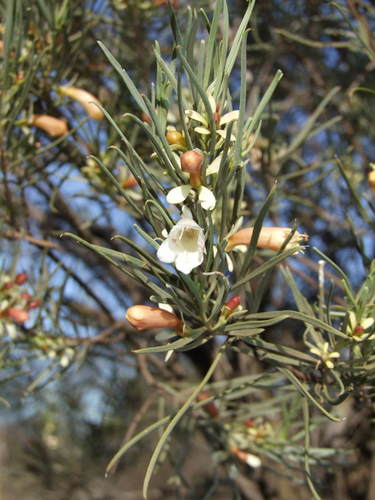
Eremophila oppositifolia R.Br. is a shrub or small tree that typically grows 1 to 5 metres (3 to 20 ft) tall, and occasionally reaches 10 metres (30 ft) in height. Fine hairs pressed against the surface cover the plant's branches, leaves, and flower stalks. The branches are rough because of persistent leaf bases, and sometimes become hairless with age. Leaves grow in opposite pairs along the branches, have a linear to almost cylindrical shape, and often end in a hooked tip. They are 29 to 120 millimetres (1 to 5 in) long and 0.9 to 7 millimetres (0.04 to 0.3 in) wide. They are covered with fine pressed hairs, and young leaves also have yellowish glandular hairs on their lower surface. Flowers grow singly or in groups of up to 4 in leaf axils, attached to hairy stalks 3 to 10.5 mm (0.1 to 0.4 in) long. This species has 5 hairy, spoon-shaped to lance-shaped sepals, which are mostly 7 to 18 mm (0.3 to 0.7 in) long and cream-coloured or brown. The petals are mostly 20 to 30 mm (0.8 to 1 in) long, joined at the lower end to form a tube. The petal tube is cream with a pink tinge, pink, red, or rarely maroon. The tube and its lobes are hairless except for the lobe margins and the inside of the tube, which is hairy. The four stamens extend slightly past the end of the petal tube. Flowering occurs from winter to early summer, and the fruits that develop after flowering are oval to cylindrical, 4 to 7 mm (0.2 to 0.3 in) long. The subspecies oppositifolia is widespread and common, ranging from the Eyre Peninsula and Gawler Ranges in South Australia east to south-western New South Wales and north-western Victoria, where it grows in clay-loam in woodland and shrubland. Subspecies angustifolia is widespread and common in Western Australia, and also grows in isolated locations in South Australia, occurring in a range of soils in mulga and Eucalyptus woodland. Subspecies rubra occurs from western Queensland to western and central New South Wales west of Condobolin, and usually grows in woodland. In horticulture, this large eremophila has attractive foliage, and its colourful sepals extend its flowering period. It works well as a feature plant, and can also be used as a windbreak or screening plant. It is easy to propagate from cuttings, and will grow in a wide range of soils including clay, in both full sun and partial shade. It tolerates long droughts, though occasional watering helps support a good flowering season. It survives light frosts with no damage, but heavy frosts may cause leaf loss.