About Cephalopholis sexmaculata (Rüppell, 1830)
Body Length to Depth Ratio
Cephalopholis sexmaculata has a body that is 2.5 to 3 times longer than it is deep when measured using standard length.
Head Dorsal Profile
In larger individuals over 30 centimetres (12 in) long, the dorsal profile of the head above the eyes is concave.
Preopercle Features
Its preopercle is rounded and has fine serrations, which are very small in adult fish.
Dorsal and Anal Fin Structure
The dorsal fin has 9 spines and 14 to 16 soft rays, while the rounded anal fin has 3 spines and 9 soft rays.
Caudal and Pelvic Fin Features
The caudal fin is rounded, and the tips of the pelvic fins usually do not reach the anus.
Lateral Line Scale Count
There are 49 to 54 scales along the lateral line.
Base Body Color and Small Blue Spot Pattern
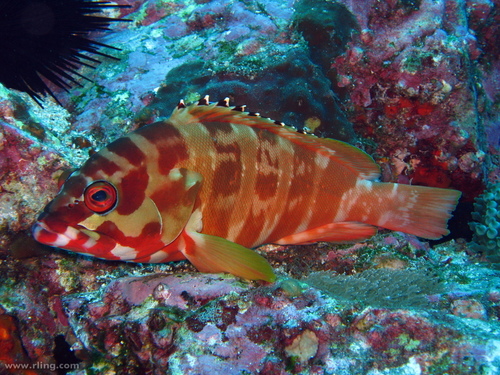
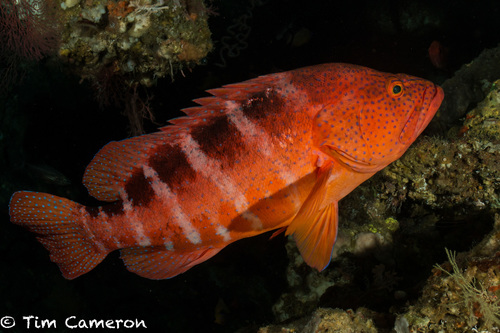
The base body color is orange-red, with a sparse scattering of small blue spots that becomes denser on the head and the dorsal, anal, and caudal fins.
Elongated Blue Head Markings
Elongated blue spots and bars also appear on the head.
Flank Dark Bars and Dorsal Blotches
The body has 4 faint to distinct dark vertical bars along the flanks; these bars merge on the back with blackish blotches at the base of the dorsal fin that extend onto the fin itself.
Caudal Peduncle Dark Bars
Two additional smaller dark bars are located on the caudal peduncle.
Interbar Color and Pectoral Fin Color
The spaces between these bars are sometimes noticeably paler, and the pectoral fins are orange-red.
Maximum Total Length
This species reaches a maximum total length of 50 centimetres (20 in).
Distribution Range
This species has an Indo-Pacific distribution, ranging from the Red Sea to South Africa eastward to French Polynesia, north to the Ryukyu Islands in southern Japan, and south to northern Australia.
Distribution Exclusions
It has not been recorded off the Indian subcontinent, in the Gulf of Oman, or in the Persian Gulf.
Adult Habitat
Adult Cephalopholis sexmaculata live on a variety of coastal to outer reefs, most often along deep walls with caves that support abundant, diverse invertebrate growth including large sponges and soft corals.
Social Structure
They can be found either solitary or in small groups.
Activity Pattern and Behavior
They are active in deeper water at night and move to shallower water during the day, and they are secretive in behavior.
Cleaner Shrimp Association
They frequently associate with the cleaner shrimp Periclimenes elegans.
Depth Range and Diet
They occur at depths between 6 and 150 metres (20 to 492 ft), and feed mainly on fish.