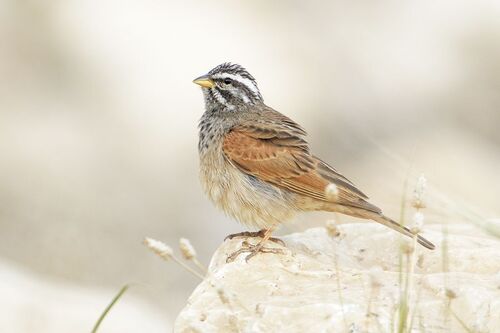
About Emberiza striolata (M.H.K.Lichtenstein, 1823)
Taxonomic Naming
This species, the striolated bunting, has a scientific name of Emberiza striolata (M.H.K.Lichtenstein, 1823).
Size
It measures 14 cm in length, matching the size of the house bunting, and is smaller than the similarly plumaged rock bunting.
Breeding Male Plumage
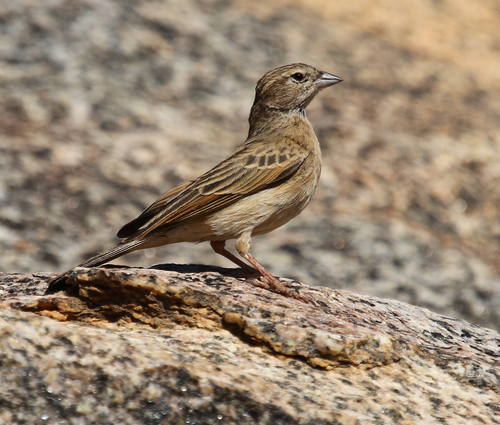
Breeding males have a chestnut-colored body, a grey head with darker streaking, plus a white supercilium and white moustachial streak.
Female Plumage
Females have a brown tint added to the grey of their heads, and more diffused streaking.
Plumage Comparison To House Bunting
Compared to the north African house bunting, the striolated bunting has stronger facial striping and a paler belly.
Historical Taxonomic Classification
The north African house bunting was previously considered conspecific with striolated bunting as the subspecies E. striolata sahari.
Subspecies Intergradation
Populations of the subspecies E. striolata jebelmarrae found in eastern Chad show some evidence of intergradation with the house bunting.
Song
Males sing from a perch; the striolated bunting's song is similar to that of the common chaffinch, but weaker.
Breeding Range
This bird is a resident breeder in dry regions across Africa and from Chad east through southwest Asia to northwest India.
Breeding Habitat
It breeds in isolated, remote wadis, unlike the related house bunting which lives around human settlements.
Nesting Behavior
It usually nests close to streams, building its nest on the ground or in a ground hole, and lays between two and four eggs per clutch.
Diet
Its natural diet is made up of seeds; when feeding chicks, it eats insects instead.