About Emberiza citrinella Linnaeus, 1758
Taxonomy and Size
The yellowhammer (Emberiza citrinella Linnaeus, 1758) is a large bunting that measures 16–16.5 cm (6.3–6.5 in) in length, has a 23–29.5 cm (9.1–11.6 in) wingspan, and weighs 20–36.5 g (0.71–1.29 oz).
Nominate Male Plumage
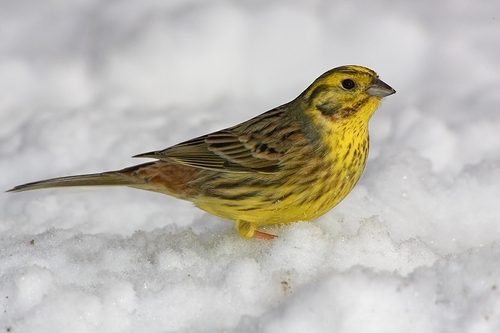
Males of the nominate subspecies E. c. citrinella have a bright yellow head, a heavily streaked brown back, a rufous rump, yellow underparts, and white outer tail feathers.
Female Plumage
Females have less bright coloration, and more streaking on the crown, breast, and flanks.
Non-breeding Plumage
Outside the breeding season, both sexes have less distinct markings, because dark fringes on new feathers cover their yellow plumage.
Juvenile Plumage
Juveniles are much duller, with far less yellow than adults, and often have a paler rump.
Adult Moult Pattern
After breeding, adult yellowhammers undergo a complete moult that takes at least eight weeks; males gain more yellow plumage with each moult.
Juvenile Moult Pattern
Juveniles go through a partial moult shortly after fledging, replacing their head, body, and some covert feathers.
Subspecies Variation Overview
Subspecies differences are small and occur gradually across geographic ranges.
E. c. caliginosa Male Traits
On average, male E. c. caliginosa are slightly smaller and darker than nominate subspecies males, with more back streaking, a greenish tint to the yellow head, and more chestnut coloring on the flanks.
E. c. erythrogenys Male Traits
Males of the eastern subspecies E. c. erythrogenys are paler and less streaked than E. c. citrinella. Their flanks, undertail, and wing bars are usually whiter, and their crown and throat are brighter yellow.
Subspecies Female Distinguishability
It is generally not possible to distinguish females of the three subspecies using plumage characteristics.
Pine Bunting Similarity and Differences
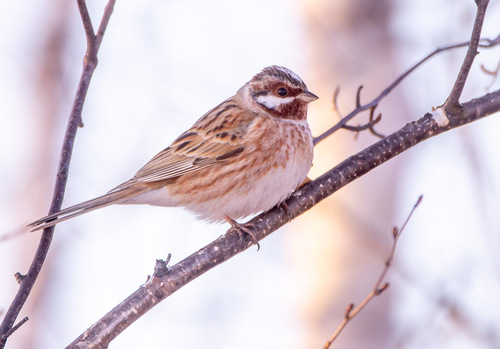
Females and juveniles, particularly of the pale eastern subspecies E. c. erythrogenys, may be confused with pine buntings, but yellowhammers always have a yellow tint to their plumage, a paler rufous rump, and more uniform upperparts than pine buntings.
Cirl Bunting Similarity and Differences
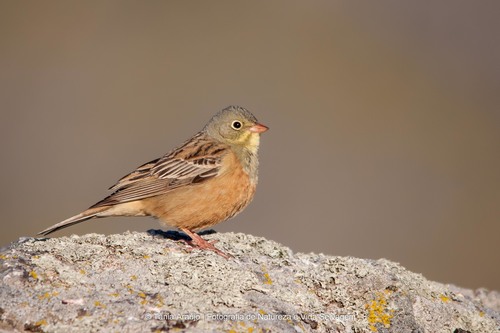
Young and female yellowhammers can be told apart from cirl buntings by the grey-brown rump that cirl buntings have.
Hybrid Traits
Male hybrids between yellowhammers and pine buntings typically have white faces and some yellow on the head, underparts, or flight feathers, but female hybrids are usually indistinguishable from female yellowhammers.
Breeding Range Overview
Yellowhammers breed across the Palearctic between the 16–20 °C (61–68 °F) July isotherms.
European Breeding Range
It is the commonest and most widespread European bunting, though it is not found in high mountains, Arctic regions, western Netherlands, most of Iberia and Greece, and low-lying regions of other countries adjacent to the Mediterranean Sea. Its breeding range extends through Russia east to Irkutsk, and across most of Ukraine.
Asian Breeding Range
In Asia, its range reaches into northwest Turkey, the Caucasus, and northern Kazakhstan.
European Wintering Range
Most European yellowhammers winter within their breeding range, and only the far northern part of the range is vacated for winter; some birds do move south of their breeding range into Spain, Italy, and other Mediterranean countries. Northern birds can travel up to 500 km (310 mi) to reach wintering grounds.
Asian Wintering Range
Asian yellowhammers are more strongly migratory, leaving most of the northern part of their range to winter in Iraq, Iran, and southern Central Asia.
Vagrant Records
The yellowhammer has been recorded as a vagrant in the United Arab Emirates, Egypt, Kuwait, Morocco, Malta, the Himalayas (as a winter vagrant from northern Afghanistan to central Nepal), the Balearic Islands, Iceland, and the Faroe Islands.
New Zealand Introduction
E. c. caliginosa, the yellowhammer subspecies native to Britain and Ireland, was introduced to New Zealand by local acclimatisation societies in 1862, and quickly spread across the country's main islands. They sometimes visit New Zealand's subantarctic islands, though they rarely stay to breed there, and have reached Australia's Lord Howe Island on multiple occasions.
New Zealand Pest Status
At the start of the 20th century, this bunting was considered a serious agricultural pest in its introduced range of New Zealand.
Other Introduced Populations
Yellowhammer populations have also been introduced to the Falkland Islands and South Africa.
Habitat Preferences
The yellowhammer inhabits dry, open country, and prefers areas with a mix of vegetation types plus some trees where males can sing. It is not found in urban areas, forests, or wetlands.
Habitat Historical Context
It probably originally occupied forest edges and large clearings, and has benefited from traditional agriculture, which created extensive open areas with hedges and scattered clumps of trees.