About Elgaria coerulea (Wiegmann, 1828)
Species Identification
The northern alligator lizard, Elgaria coerulea, is a medium-sized slender lizard species.
Size Measurements
Adult individuals reach a snout-to-vent length (SVL) of around 10 cm (3.9 in), and a total length that includes the tail of roughly 27.5 cm (10.8 in).
Scale and Skin Fold Features
Each side of the lizard has a distinct skin fold that separates the keeled scales on its back from the smooth scales on its ventral side.
Overall Color Variation
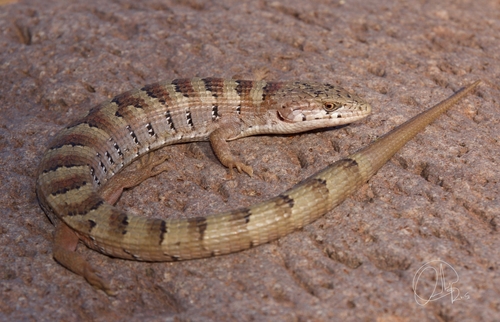
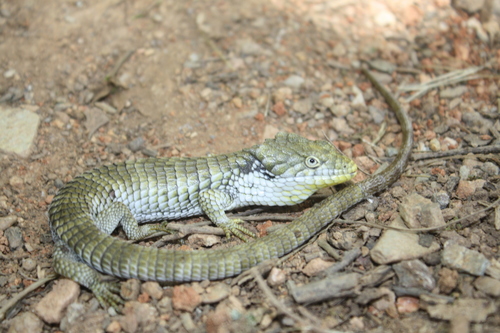
Its skin color varies, and may be a combination of brown and white, or greenish yellow and brown.
Dorsal Coloration
Dorsally, E. coerulea is brownish, and often has dark blotches that sometimes blend together to form bands.
Juvenile Throat Coloration
The throat and mouth area of some young northern alligator lizards can be yellow.
Belly and Eye Features
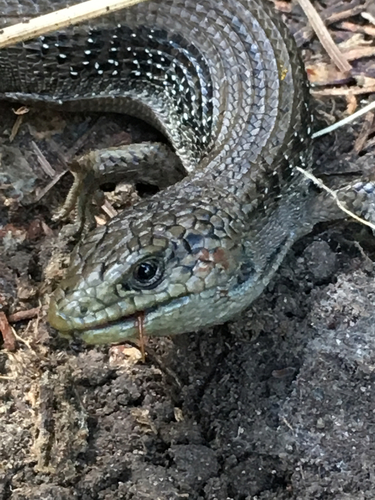
The belly is light gray, and the eyes are dark.
Broad Geographic Range
This species occurs along the Pacific Coast and in the Rocky Mountains, ranging from southern British Columbia through Washington, northern Idaho, and western Montana, then south through Oregon to the coastal range and the Sierra Nevada in central California.
Subspecies Distribution
Different subspecies have distinctly different geographic ranges: E. c. principis is the most widely distributed subspecies, while E. c. coerulea occurs mainly around the San Francisco area, and is also found further north into Humboldt County.
Elevation Range
The species is widely distributed along the Pacific coast, and can be found from sea level up to an elevation of about 3,350 m (10,990 ft).
Habitat Types
It lives in a variety of forested habitats and montane chaparral.
Brumation Trigger
When winter arrives, colder temperatures trigger brumation in northern alligator lizards.
Brumation Function
Brumation lets the lizards reduce their caloric usage and retain body heat during winter.
Brumation Hiding Sites
Northern alligator lizards most often hide under rocks to brumate, though logs and burrows are occasionally used for this purpose.
Reproduction Traits
The northern alligator lizard is live-bearing, and produces up to 15 young (typically 4–5) between June and September.
Breeding Season Mating Behavior
During the spring breeding season, a male grasps the female's head with his mouth and remains attached this way until she is ready for him to mate.
Mating Attachment Duration
They can stay attached for many hours, and are almost unaware of their surroundings.
Mating Attachment Purpose
This behavior both prevents the female from mating with another male, and likely demonstrates the male's strength and suitability as a mate to her.