About Anniella pulchra Gray, 1852
Size
Anniella pulchra measures around 7 inches (18 cm) from snout to vent, not counting the tail.
Head and Sensory Adaptations
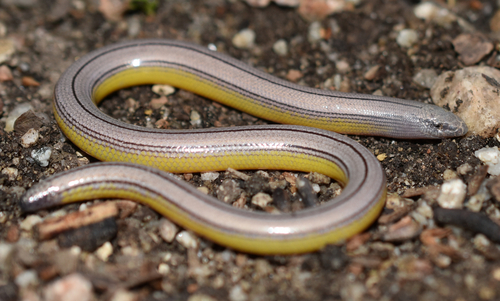
Its slightly pointed head and small eyes are adaptations for a primarily fossorial, or burrowing, lifestyle.
Typical Coloration
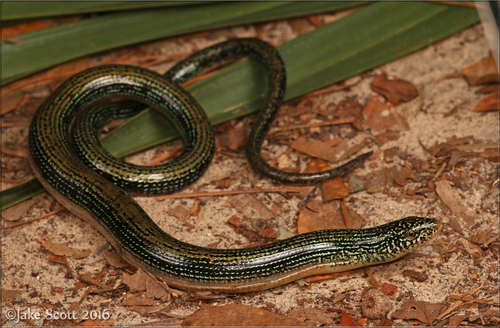
Most individuals have a silver-bronze dorsal (back) surface and a yellow underside, separated by black side stripes or markings that run the full length of the lizard's body from head to tail.
Morph Variants
Black (melanistic) and darker brown morphs have been observed in Monterey County, California; these forms were once thought to belong to a separate subspecies.
Habitat Substrates
A. pulchra inhabits loose, sandy soils, leaf litter, sand dunes, and dry washes beneath rocks along the Pacific coast.
Geographic Range
It occurs from Contra Costa County in Northern California, south to Baja California, with a often scattered population distribution.
Moisture Requirement
The species requires a source of moisture to support regular skin shedding; improper shedding can impair the lizard's ability to eat and see, potentially leading to starvation.
Coastal Dune Habitats
A. pulchra populations are usually concentrated in coastal regions, and often live in coastal dunes with native vegetation including bush lupine (Lupinus arboreus) and mock heather (Eriogonum parvilifolium).
Vegetation Benefits
These shrubs help retain soil moisture, provide shelter from heat, and attract insect prey.
Elevation Range Updates
Following recent classification updates that split multiple species previously grouped under A. pulchra, the confirmed range of elevations for the species runs from near sea level to about 2000 m, which is slightly lower than the range cited in older reports.
Vegetation Zone Occupancy
These lizards can be found in a variety of vegetation zones, from seaside dunes to inland open pine woodlands.
Regional Elevation Records
In the Sierra Nevada, the species has been recorded at elevations up to 2050 meters (6,725 feet), and up to 1360 meters (4,461 feet) in Sierra de Juárez and Sierra de San Pedro Mártir.
Museum Observation Records
The University of California Publications in Zoology holds observation records for the silvery legless lizard and the black legless lizard, both previously included in the A. pulchra species complex.
Silvery Legless Lizard Range
The silvery legless lizard has been observed from north of Contra Costa County, through San Ardo (Monterey County), east to Bear Valley (San Benito County), Sequoia National Park (Tulare County), and all the way south to La Puerta Valley and other areas of East San Diego County.
Black Legless Lizard Range
The black legless lizard has been observed in San Francisco, Pacific Grove, Marin County, and other locations.
Former Species Complex Distribution
Both of these related species can be found across multiple parts of California.
Sexual Dimorphism
Males of A. pulchra are slightly smaller than females, and there is no other obvious visible difference between the two sexes.
Breeding Period
Females are ovoviviparous, and breeding likely occurs between early spring and July.
Offspring Production
Females give birth to 1 to 4 young between September and November.
Newborn Characteristics
Newborn lizards are smaller versions of adult lizards, with a total length of 8 to 10 cm at birth. They share the silver-tan coloration of adults, which darkens as they grow.
Maturation and Parental Care
Individuals reach maturity around 2 to 3 years after birth, and there is no parental care after birth.
Reproductive Adaptations
A. pulchra's reproductive traits are adapted to its subterranean lifestyle; stable, thermally suitable sandy soils underground support embryonic development.