About Ardea pacifica Latham, 1802
Taxonomy and Basic Classification
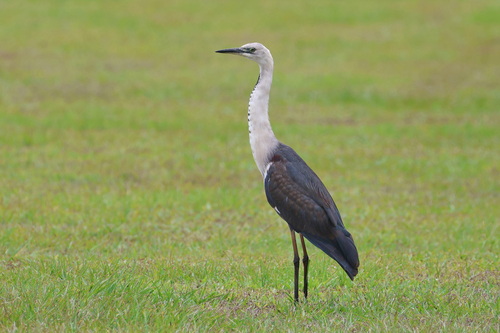
The white-necked heron (Ardea pacifica Latham, 1801) is a large, diurnal, long-legged waterbird.
Adult Body Coloration (Non-Breeding)
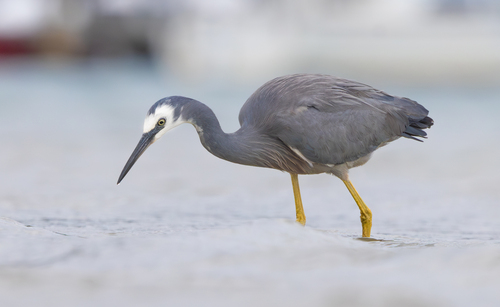
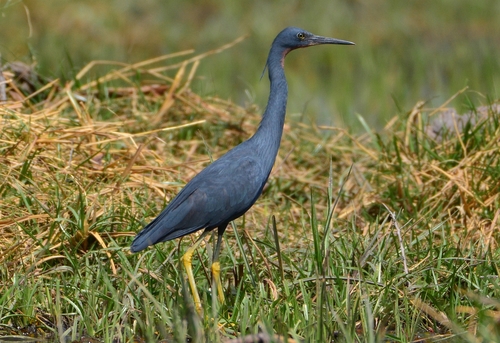
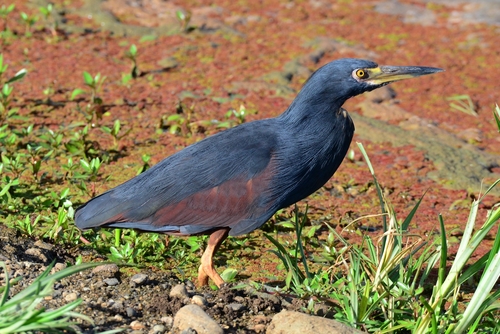
Most of its body is slate-grey to black, and it has distinctive black spots in the center of its lower fore-neck and throat. Most of its head and neck are white, and the black spots on the neck are only visible in non-breeding individuals.
Breeding Plumage
During the breeding season, plum-coloured nuptial plumes grow on the back and breast.
Flight Characteristics
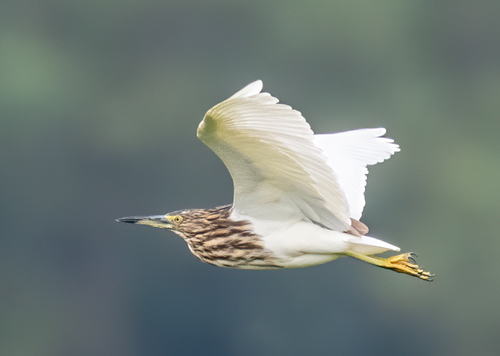
This heron flies in a stately manner, with slow, steady wing beats.
Size and Weight
It measures 76–106 cm (30–42 in) in length, has a wingspan of 147–160 cm (58–63 in), and weighs around 860 g (30 oz).
Bare Part Coloration
Its bill is black, its facial skin is most commonly blue or yellow, its eyes are green, and its legs and feet are black.
Feeding Adaptations and Diet
It has an elongated neck and beak adapted to reach out and catch fish, frogs, spiders, and other small animal prey found in its habitat.
Downy Young Appearance
Downy young white-necked herons have longer down, especially on the crown; their head and neck are white, while their upperparts and upper wings are light grey-brown.
Juvenile Plumage
Juvenile white-necked herons have dark grey feathers, with a broad grey-black strip running down the front of the neck. Their head and neck are commonly tinged brownish-grey.
Juvenile to Adult Molt
Adult feathers grow in as the juvenile feathers wear away.
Core Habitat Range
The white-necked heron is found across most of the Australian continent, and it commonly lives in wetlands, tidal areas, shallow fresh waters, farm dams, claypans, pastures, and runoff water in roadside ditches.
Human-Assisted Habitat Expansion
This species has thrived after the construction of irrigation systems, dams, and other man-made water sources.
Absent Distribution Areas
It is not present in some parts of Western Australia and South Australia, and also does not occur in the arid Great Sandy Desert, Gibson Desert, Great Victoria Desert, or the Nullarbor Plain.
Movement Patterns
The movement patterns of the white-necked heron remain largely unknown, due to its irruptive habits, which are commonly attributed to genetic adaptations to erratic environmental conditions.