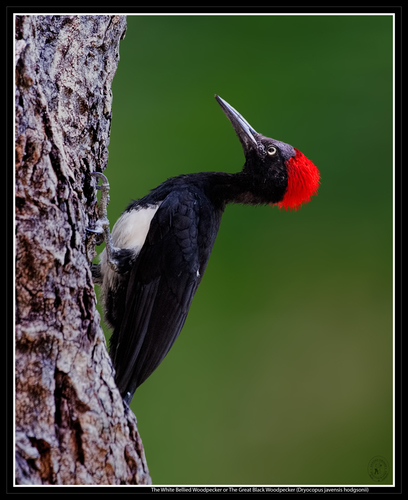
About Dryocopus javensis (Horsfield, 1821)
Taxonomy and Size Classification
Dryocopus javensis, first described by Horsfield in 1821, is one of the largest living woodpecker species in the world. Adult individuals measure 40 to 48 cm (16 to 19 in) in length, and are the third largest woodpecker species found in Asia, exceeded in size only by the great slaty woodpecker and the black woodpecker. This species is considered closely related to the more northern black woodpecker and the North American pileated woodpecker, and is similar in size to both of these species.
Body Mass
Body mass of adults ranges from 197 to 350 g (6.9 to 12.3 oz).
Standard Morphometrics
Standard measurements for the species are as follows: wing chord 20.5 to 25.2 cm (8.1 to 9.9 in), tail 14.3 to 18.9 cm (5.6 to 7.4 in), bill 4.6 to 6 cm (1.8 to 2.4 in), and tarsus 3.2 to 4.3 cm (1.3 to 1.7 in).
D. j. hodgsonii Plumage
The subspecies D. j. hodgsonii has whitish underwing coverts and a white rump, and no white markings on its face.
Juvenile Plumage
Juveniles of the nominate subspecies may have white streaks on the throat.
Proposed Taxonomic Split
Researchers have noted that the vocal and morphological differences between hodgsonii and other Southeast Asian subspecies of Dryocopus javensis are large enough to suggest hodgsonii should be reclassified as its own full species.
Social Structure
This large black woodpecker is most often seen alone or in pairs, though pairs may sometimes be accompanied by a third bird.
Foraging Behavior
Solitary adults may spend up to an hour foraging on a single suitable tree. It feeds mainly on insects such as ants or grubs, which it extracts mostly from under bark, but will sometimes eat fruit.
Roosting and Nesting Tolerance
The species roosts in tree holes. While generally shy, it will sometimes nest close to well-used tracks and areas disturbed by human activity.
Vocalizations
It has a range of distinct calls: short, sharp kuk notes, more intoned kyuk, kew, and kee-yow calls, with longer calls typically given before the bird flies away. When performing dipping flight, it produces a loud, single, laugh-like chiank call.
Drumming Behavior
It also performs loud drumming, especially during the breeding season.
Breeding Season Timing
Across most of its range, the breeding season for Dryocopus javensis falls mainly between January and March. For the hodgsonii subspecies found in India, breeding occurs from January to May.
Nest Characteristics
Nests are always excavated in large dead trees, often located in open forest, and the same nesting tree may be reused year after year.
Clutch Details
The usual clutch size for this species is two white eggs.
Local Threat
In the Bastar region of central India, local tribal groups seek out the squabs of this species for consumption, which has led to the species becoming rare in this area.