About Campethera abingoni (A.Smith, 1836)
Species Identification
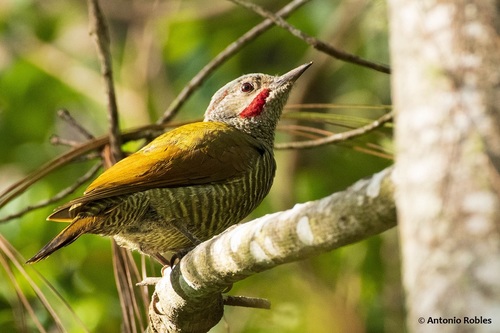
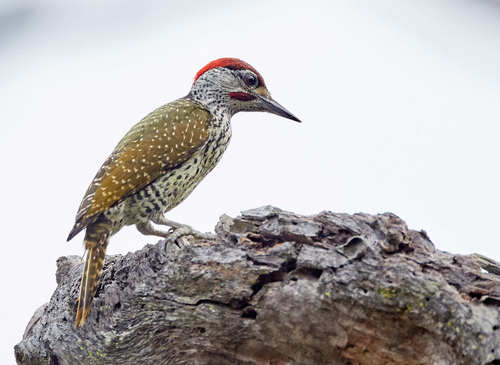
Campethera abingoni (A.Smith, 1836) can be readily identified by its combination of barred, greenish upper plumage and streaked underparts. While its golden-olive tail is not notably different from the tails of several related or sympatric woodpecker species, its single, strident call-note is characteristic of the species.
Body Length
Adults measure 20 to 21 cm from bill tip to tail tip.
Weight by Race
Southern races of the species weigh approximately 70 g, while the northern race C. a. chrysura only weighs around 55 g.
Sexual Size Dimorphism
On average, males are larger and heavier than females.
Sexual Fore-crown Differences
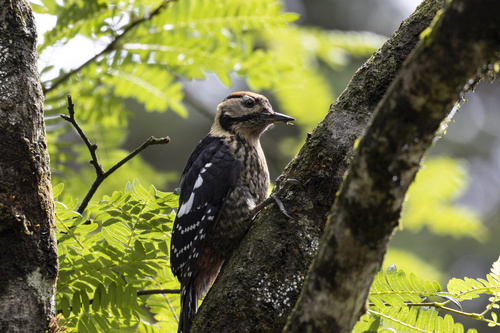
The sexes are most easily distinguished by head markings: the fore-crown of males is red and brown, which differs clearly from the black, white-spotted fore-crown of females.
Sexual Malar Stripe Differences
Males have red malar stripes, while females have black and white mottled malar stripes.
Adult Soft Part Coloration
The iris is most commonly dark red, though its color varies across individuals; the mandibles are slate grey, and the legs and feet are greenish-olive.
Juvenile Characteristics
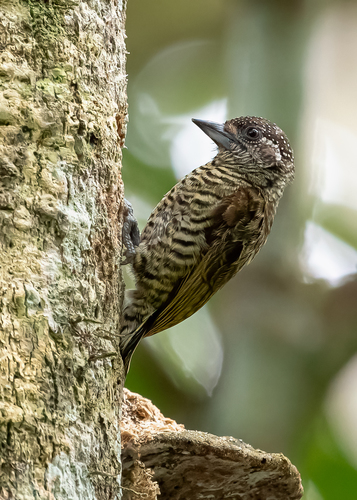
Juveniles have heavy streaking on the throat and breast, barring on the belly, mottled malar stripes, and a brown to brownish-grey iris.
Habitat Types
This species occurs in coastal forest, as well as miombo, mopane and acacia woodlands. It prefers riparian woodland, especially in the drier regions of southern Africa.
Foraging Behavior
It may forage intensively in small areas within the lower to middle tree strata.
Territoriality
It establishes fairly large territories that span 10 to 15 hectares, and can travel some distance between different foraging sites.
Broad Distribution Pattern
This species is very widespread in woodlands and forests south of the equator, and very localized north of the equator.
Recorded Range Countries
Confirmed recorded locations include Angola, Benin, Botswana, Cameroon, Central African Republic, Chad, Republic of the Congo, Democratic Republic of the Congo, Eswatini, Ivory Coast, Gambia, Ghana, Guinea, Guinea-Bissau, Kenya, Malawi, Mali, Mauritania, Mozambique, Namibia, Rwanda, Senegal, South Africa, South Sudan, Tanzania, Uganda, Zambia, and Zimbabwe.