About Melanerpes chrysogenys (Vigors, 1839)
Size and Weight
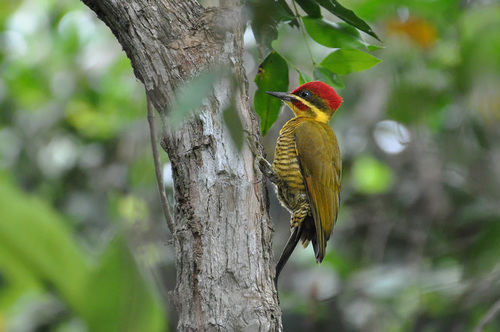
The golden-cheeked woodpecker (Melanerpes chrysogenys) measures about 19 to 22 cm (7.5 to 8.7 in) long and weighs 55 to 88 g (1.9 to 3.1 oz). Male and female plumage is identical except for head patterning.
Nominate Male Head Pattern
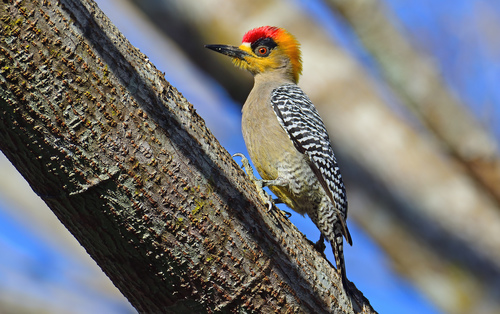
For adult males of the nominate subspecies, the forehead is whitish, the crown is red, and the nape and hindneck are yellow-gold.
Nominate Female Head Pattern
Adult females share the whitish forehead, but have a grayish-buff crown and an orange-red nape. In both sexes, a wide black area surrounds the eye.
Upperpart Pattern
Their upperparts are barred black and white, with the widest black bars on the rump and uppertail coverts. Their flight feathers are black with white bars across their entire length.
Tail Pattern
Their tail is black, with white bars on the central pair of feathers, and progressively more white on each feather pair moving outward from the center.
Face and Throat Coloration
Their lores and the area under the eye are deep golden-yellow, and their cheeks, chin, and throat are golden-buff.
Underpart Coloration
Most of their underparts are gray-brown to brownish-buff with a strong olive-yellow wash and a yellowish orange patch on the central belly. Their lower flanks and undertail coverts are grayer and marked with dark bars.
Bare Part Features
They have a moderately long black bill, a reddish to orange-brown iris, blackish bare skin around the eye, and green-gray legs.
Juvenile Plumage
Juveniles have grayer or browner upperparts with less contrasting barring than adults, and paler, grayer underparts with a strong yellow cast and obscure dark bars. Both juvenile males and females have red on their crown, but females have less red than males and often more black on the crown.
Subspecies Differences
The subspecies M. c. flavinuchus is slightly larger and duller than the nominate subspecies, has less yellow on its face, has yellow rather than red on its hindneck, and has grayer underparts.
Nominate Subspecies Range
The nominate subspecies of golden-cheeked woodpecker occurs in western Mexico, between Sinaloa and Nayarit.
M. c. flavinuchus Range
M. c. flavinuchus ranges from Jalisco in west central Mexico south along the coast to Oaxaca, and east as far as Puebla.
Habitat
This species inhabits the interior and edges of mesophytic to xeric forest, as well as more open landscapes including forest patches, tree-dotted savanna, and plantations.
Elevation Range
Its elevation range extends from sea level to approximately 1,500 m (4,900 ft).