About Dryobates scalaris (Wagler, 1829)
Taxonomy and Size
The ladder-backed woodpecker (Dryobates scalaris, first described by Wagler in 1829) is a small woodpecker, measuring between 16.5 and 19 cm (6½ to 7½ inches) in length.
Plumage Pattern
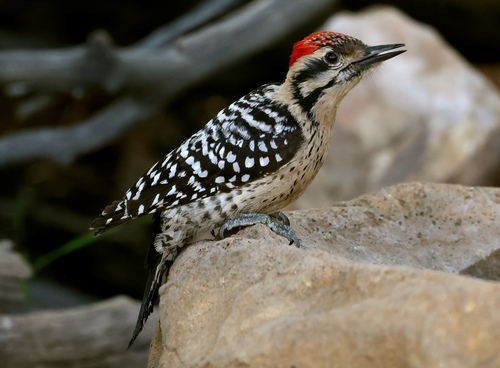
Its plumage is primarily black and white, with a barred pattern on its back and wings that resembles the rungs of a ladder.
Markings on Body Parts
Its rump has black speckles, which also appear on the cream-colored underparts of its breast and flanks.
Regional Morphological Variation
Populations of this species living in southern regions have duskier buff-colored breasts and distinctly smaller bills.
Sexual and Age-related Plumage Differences
Adult males have a red crown patch; this patch is smaller in immature individuals, and is entirely absent in adult females.
Similar Species Comparison
The ladder-backed woodpecker is very similar in appearance to Nuttall's woodpecker, but it has much less black coloring on its head and upper back.
Range Overlap and Hybridization
The two species' ranges overlap only minimally in southern California and northern Baja California, and hybrids between them have been recorded.
Nesting Site Selection
Ladder-backed woodpeckers nest in cavities that they excavate from tree trunks; in more arid environments, they will instead excavate nesting cavities in large cacti.
Egg Characteristics
The female lays between 2 and 7 plain white eggs.
Incubation and Nesting Knowledge Gaps
Both sexes share incubation duties, but the nesting period and other specific nesting details are not currently recorded.
Insect Foraging Behavior
Like most other woodpeckers, the ladder-backed woodpecker bores into tree trunks with its chisel-like bill to hunt for insects and their larvae.
Additional Food Sources
It also feeds on fruit produced by cacti.
Habitat and Distribution Overview
The ladder-backed woodpecker is fairly common in dry brushy areas and thickets, and has a rather large range.
Geographic Range Details
It can be found year-round across the southwestern United States (as far north as extreme southern Nevada and extreme southeastern Colorado), most of Mexico, and locally in Central America as far south as Nicaragua.