About Dryobates pubescens (Linnaeus, 1766)
Size and Range Context
Adult downy woodpeckers (Dryobates pubescens) are the smallest woodpecker species native to North America, though many smaller woodpecker species (especially piculets) exist elsewhere.
Standard Measurements
This species measures 14 to 18 cm (5.5 to 7.1 in) in total length, with a wingspan of 25 to 31 cm (9.8 to 12.2 in). Body mass ranges from 20 to 33 g (0.71 to 1.16 oz). Standard measurements for the species are: wing chord 8.5–10 cm (3.3–3.9 in), tail 4–6 cm (1.6–2.4 in), bill 1–1.8 cm (0.39–0.71 in), and tarsus 1.1–1.7 cm (0.43–0.67 in).
Core Plumage Features
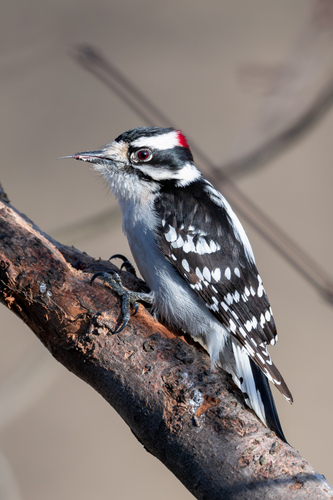
The downy woodpecker has mainly black upperparts and wings, with a white back, throat, belly, and white spotting on the wings. It has one white bar above the eye and one below.
Tail and Sexual Markings
Its tail is black, with white outer feathers marked with black bars. Adult males have a red patch on the back of the head, while juvenile males have a full red cap.
Hairy Woodpecker Comparison
The plumage pattern of the downy woodpecker is virtually identical to that of the larger hairy woodpecker, but the two species can be told apart by two features: downy woodpeckers have black spots on their white tail feathers, and the downy woodpecker's bill is shorter than the length of its head, while the hairy woodpecker's bill is approximately equal to its head length.
Vocalizations
Downy woodpeckers produce several distinct vocalizations, including a short pik call. Their rattle-call is a short burst that sounds similar to a bouncing ball; the rattle-call of the hairy woodpecker is a shorter burst at the same amplitude.
Drumming Behavior
Like other woodpeckers, downy woodpeckers create a drumming sound by pecking at trees with their beak, typically described as sounding like four taps. Their drumming is slower than that of other North American woodpecker species.
Native Habitat Range
Downy woodpeckers are native to forested, mainly deciduous, regions across North America. Their range covers most of the United States and Canada, excluding the southwestern deserts and northern tundra.
Movement Patterns
Most downy woodpeckers are permanent residents, though birds from northern areas may migrate further south, and birds from mountainous areas may move to lower elevations.
Nest and Roost Sites
Downy woodpeckers nest in tree cavities that the mated nesting pair excavate in a dead tree or dead tree limb. In winter, they roost inside tree cavities.
Excavation Preferences
They typically nest near soft snags, where the wood is softer and the inner heartwood of the tree is easier to access. The nest cavity is formed within the softer heartwood, and the harder outer sapwood of the tree protects the nest from the elements and predators.
Habitat Correlates
Since heartwood is often softer in dead or decayed trees, studies have found a positive correlation between the number of dead trees in a forest and the presence of downy woodpecker habitat. Downy woodpeckers prefer to nest in well-lit areas, so they favor broad-leaved trees including poplars, birches, and ashes, or forest openings and edges.
Foraging Behavior
Downy woodpeckers forage on trees: they pick food from the bark surface in summer, and dig deeper into wood in winter. They mainly eat insects, but also consume seeds and berries.
Agricultural Pest Control
They are a natural predator of the European corn borer, a moth that causes over $1 billion annually in crop losses and population control costs to the U.S. agriculture industry.
Backyard Feeding
Especially in winter, downy woodpeckers are often found in suburban backyards with mature trees, where they feed on suet and shelled peanuts provided in mesh birdfeeders.