About Hemicircus canente (R.Lesson, 1832)
General Appearance
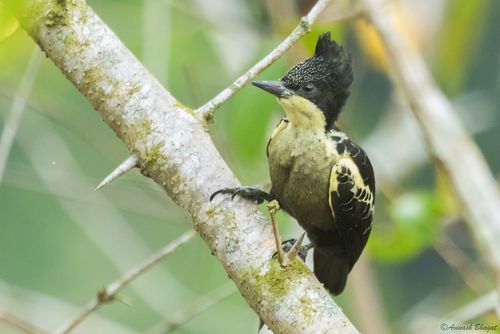
Hemicircus canente is a small woodpecker with a unique body shape, with primarily black and buff plumage. Its prominent large crest makes its head appear large relative to its short body and short tail.
Adult Plumage Common Traits
Both sexes are predominantly black, with heart-shaped black spots on white shoulders, broad white scapular patches, and barring on flight feathers.
Sexual Dimorphism
Females have buffy white coloration on the forehead and crown, while males have black forehead and crown marked with small white dots. This species has a whitish throat and dark olive grey underparts.
Specialized Back Feathers
It has specialized, lipid-rich feather tufts on its back. In preserved specimens, these feathers stick together.
Fat Quill Function Hypotheses
These specialized feathers, also called "fat quills", can sometimes make the rump feathers look buff, and it has been suggested they may be a form of "cosmetic colouration". The secretion from these feathers is reported to have a pleasant smell, but the functional significance of this feature is still unknown.
Habitat
The natural habitat of Hemicircus canente is subtropical or tropical moist lowland forests.
Global Distribution
Its distribution covers the Himalayan forests of India, extending into Bangladesh, Myanmar, Thailand, Laos, Cambodia, and Vietnam.
Distribution in India
Within India, the species is also found in the Western Ghats and forests of central India.
Subspecies Taxonomy
A subspecies named cordatus was described by Thomas C. Jerdon from a Western Ghats specimen, but it is not currently considered a distinct taxon.
Geographic Variation
Populations of Hemicircus canente differ slightly in plumage colour, and show clinal size variation, with northern birds being larger than populations closer to the equator.
Foraging Group Behavior
These woodpeckers typically forage in pairs, and will sometimes join mixed-species foraging flocks.
Flight Characteristics
Their flight between trees is sharply bounding, giving them a head-heavy appearance.
Foraging Behavior
They forage on thin branches and call frequently. They feed mainly on insects that live under bark, but have also been recorded pecking the pods of Cassia fistula to get insect larvae.
Vocalizations
Their calls include a sharp duet twee-twee-twee that sometimes transitions into a multi-note trill, along with a nasal ki-yeew and repeated su-sie calls.
Drumming Behavior
They drum infrequently, most often during winter before the monsoons, and may drum during the breeding season.
Nest Site Characteristics
Their nests are carved into dead branches, with a narrow 3 to 4 cm diameter entrance. The tunnel runs obliquely downward for about 20 cm before widening into a nesting chamber.
Alternative Nest Sites
Nests may occasionally be built in fence posts.
Clutch Details
The usual clutch size is two or three unmarked white eggs.
Parasite Record
The tick species Haemaphysalis spinigera has been found on Hemicircus canente.