About Dendropicos spodocephalus (Bonaparte, 1850)
Morphological Adaptations
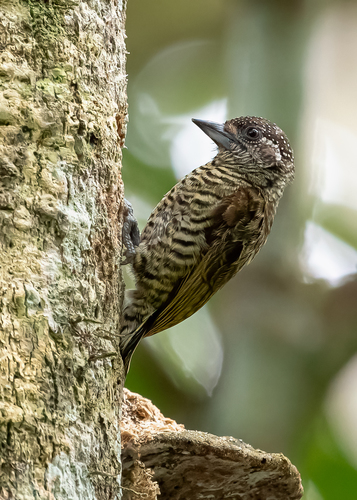
Like other woodpeckers, Dendropicos spodocephalus (eastern grey woodpecker) has a straight, pointed bill, a stiff tail that provides support against tree trunks, and zygodactyl (yoked) feet, with two toes pointing forward and two pointing backward. Its long tongue can be darted forward to capture insects.
Adult Plumage Sexual Dimorphism
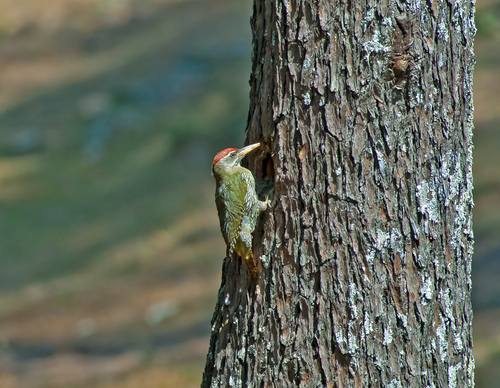
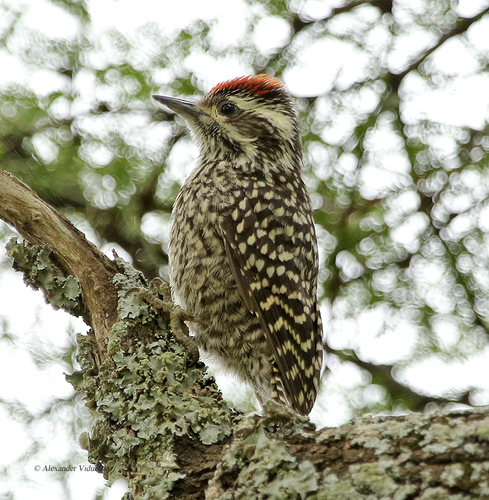
Adult males have a red crown and nape, while females have a plain grey head with no red crown.
Body Plumage Coloration
The species' upper body is yellowish-green, the rump is red, and the wings and tail are dark brown. Most of the head and the underparts are pale grey, except for a reddish patch on the hind portion of the belly.
Soft Part Coloration
The beak is dark grey or black, the legs are greenish-grey, and the eyes range from red to brown.
Juvenile Plumage
Juvenile birds resemble adult females, but have paler red markings; both sexes of young birds may also have faint barring on the flanks and some red on the crown.
Geographic Range
The eastern grey woodpecker is native to tropical eastern Africa, and its range covers Ethiopia, Kenya, South Sudan, Sudan and Tanzania.
Habitat and Altitude Range
It inhabits humid forests, forest verges and gallery forests, and occurs in lowlands as well as at altitudes up to 3,300 m (10,800 ft).
Diet
Like other woodpeckers, this species is an insectivore. It forages on trees and on the ground for moths, centipedes, larvae and pupae.
Behavior
It is frequently encountered, and regularly taps or drums on wood.
Taxonomic History
This species and the African grey woodpecker were formerly considered to be the same single species.