About Draco dussumieri Duméril & Bibron, 1837
Common Name and Base Coloration
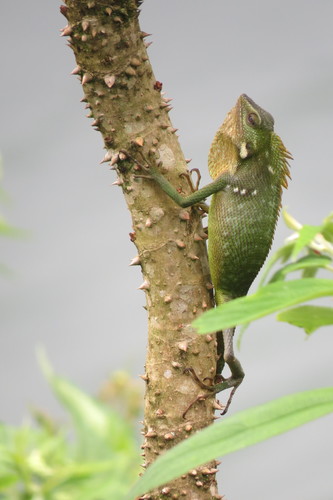
This species, commonly called the southern flying lizard, has a brown base color marked with grey patches that match tree bark patterns, and can change its color to a limited extent.
Size Measurements
Adult southern flying lizards reach a total length of about 23 cm (9.1 in), with a snout-to-vent length (SVL) of 7–9 cm (2.8–3.5 in) and a tail length of 10–13 cm (3.9–5.1 in).
Head Morphology
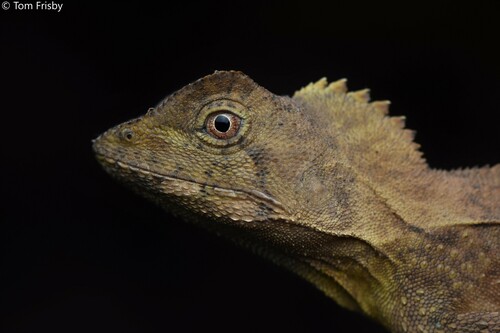
The lizard has a rounded head with a short snout, and its nostrils point upwards.
Activity Pattern
It is active during the day, after warming up in the early morning sun.
Sexual Dimorphism (Dewlap)
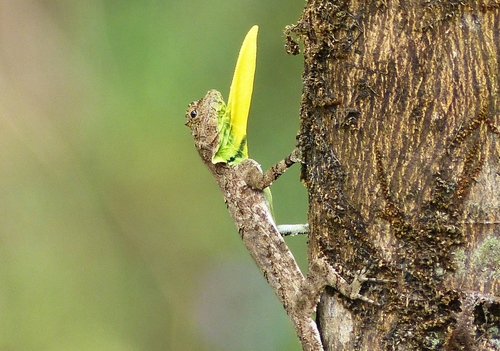
Males have a long yellow dewlap, which is shorter in females.
Foraging and Gliding Behavior
The lizard climbs tree trunks to search for insect prey, and leaps from tree tops to glide to adjacent trees.
Patagium Structure
It glides by extending its patagia, which are flaps of skin on both sides of the body supported by six elongated ribs, with specialized musculature to extend them outward.
Modified Breast Muscles
Its breast muscles are also modified to support more efficient breathing and its active lifestyle.
Glide Control Structures
The sides of the neck are stretched to form a pair of smaller "wings" around the head, and the lizard uses its tail to control glide direction.
Patagium Underside Markings
The underside of the patagium is patterned with black blotches over yellow and purple; these patterns vary individually, and the unique markings are used to identify individual lizards and estimate population sizes.
Ocular Tubercle
A prominent horn-like conical tubercle sits behind and above the posterior part of the eye.
Male Secondary Sexual Traits
Males have a small crest on the nape, and a long narrow yellow gular sac on the throat that is longer in males.
Dorsal and Throat Texture
The lizard's back is rough, and its throat has irregular brown spots.
Head Wing Structure
In addition to the patagia, the hyoid apparatus (a structure associated with the tongue) expands throat lappets horizontally to create the small wing-like structures that support the sides of the head.
Primary Distribution Range
Draco dussumieri is primarily found along the Western Ghats and associated hill forests of Karnataka, Kerala, Tamil Nadu, Goa, and Maharashtra in southern India.
Eastern Ghats Records
It has also been reported from parts of the Eastern Ghats (Talakona) in Andhra Pradesh.
Historical Distribution Observation
Nelson Annandale recorded the species as "common about ten miles north of Trivandrum, but apparently very local."
Modified Habitat Use
It is often found in coconut and betel-nut plantations located near forests.
General Diet and Activity Traits
The southern flying lizard feeds exclusively on insects, and is strictly diurnal, sleeping on flat surfaces at night.
Regional Diet Preference
Specimens collected from northern Karnataka were found to feed heavily on weaver ants (Oecophylla smaragdina).
Breeding Display Period
In Kerala, males display actively from February to April, mostly in the forenoon after warming up in the sun.
Male Courtship Initial Behavior
Males maintain small territories; when they detect a nearby female, they bob their head and extend their gular pouch.
Pre-Gliding Color Change
Before gliding toward the female, males can change their skin color to silvery grey to become more conspicuous.
Glide Initiation Mechanism
They leap using their hind legs, with specialized adapted musculature at the base of the tail, before spreading the patagium.
Glide Landing Process
During gliding, the forelimbs are attached to the patagium, and are released just before landing.
Seasonal Daily Activity Pattern
During the hot midday in summer, the lizard rests in the cooler canopy and becomes active again in the late afternoon.
Cool Weather Basking Behavior
During cooler weather, it basks in the sun.
Courtship Behavior
Males chase females and court them with ritualized movements.
Copulation Behavior
During copulation, the male mounts the female and bites her nape.
Male Rival Display
To intimidate rival intruding males, males expand and fold their patagium and make conspicuous movements.
Arboreal Lifestyle
The southern flying lizard is almost entirely arboreal.
Female Nesting Behavior
Females descend to the ground to lay eggs in soil during the monsoon.
Clutch and Incubation Details
Females lay a clutch of about four eggs, which hatch after around fifty days.
Lowland Population Density
A population estimate conducted in an areca plantation in the Western Ghats found a population density of about 13 lizards per hectare.
High Altitude Population Density
At the higher altitude site of Valparai, population density was much lower, at less than 2 lizards per hectare.
General Predators
The southern flying lizard has many predators, including arboreal snakes and birds.
Avian Predator Species
Two bird species observed preying on this lizard are the Indian golden oriole and the black-capped kingfisher.
Mammalian Predator Species
Lion-tailed macaques have also been recorded feeding on southern flying lizards.