About Bronchocela jubata Duméril & Bibron, 1837
Size
Bronchocela jubata reaches a total length of 550 mm (22 in), with a long hanging tail that accounts for four fifths of its total length.
Neck Crest Morphology
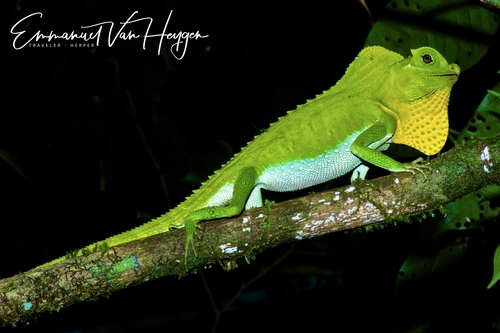
It has a jagged crest on its neck, which resembles hair more closely than the crest of its close relative B. cristatella, which looks more like the points of a crown. The crest is made up of elongated scales, and is flabby like skin.
Head Structure
The head of Bronchocela jubata is square in shape, with a soft sack under the chin. It has large, flexible eyelids formed from fine speckled scales.
Dorsal Coloration
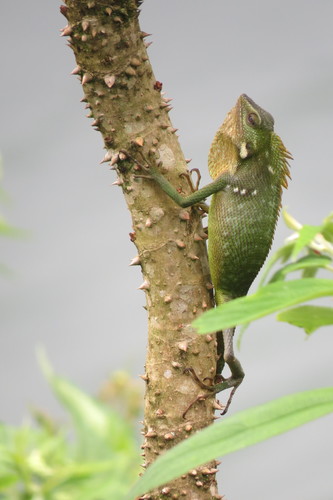
The dorsal side ranges in color from light green to dark green, and this lizard can change its color to brown or black when it feels threatened. A rust-colored stain appears under the lizard's throat.
Body Markings
Additional spots, which often blur together to form a stripe, are visible on the shoulder and front lateral side. The lizard's color becomes duller towards its back.
Underside Coloration
The underside of the lizard—under the chin, neck, stomach, and back of the legs—ranges from yellowish to white. The undersides of the hands and feet are yellowish brown.
Tail Appearance
The tail is green at its base, with bluish stains, and becomes dull brown towards its tip, which has whitish spots.
Scale Texture
The scales of Bronchocela jubata are hard, coarse, and strong, and the tail has an angular texture.
Oviposition Behavior
For reproduction, Bronchocela jubata lays its eggs in loose earth, sand, or humus. Like most members of the Agamidae, the mother lizard digs a hollow for the eggs with her snout.
Egg Characteristics
The eggs are white, waxy, and have a leathery texture.
Situgede Jungle Nest Observation
A study conducted in the Situgede jungle near Bogor found that Bronchocela jubata eggs were buried in sandy soil under a layer of humus, directly under bushes in a fairly open area of the forest. The two eggs recovered were elongated, approximately 7 by 40 millimeters in size, placed side by side, and covered by a thin layer of soil.
Walat Mountain Nest Observation
On Walat Mountain in Sukabumi, eggs of this species were found covered by a thin layer of humus in the middle of a jungle path.