About Epinephelus lanceolatus (Bloch, 1790)
Body Proportions
Epinephelus lanceolatus, commonly called the giant grouper, has a robust body, where its standard length is 2.4 to 3.4 times its body depth. The dorsal profile of the head and the intraorbital area are convex.
Head Structure
Its preopercle has a rounded corner and a finely serrated margin, and the gill cover has a convex upper margin.
Fin Ray Counts
The dorsal fin holds 11 spines and 14–16 soft rays, while the anal fin has 3 spines and 8 soft rays.
Caudal Fin & Scales
The caudal fin is slightly rounded, and there are 54 to 62 scales along the lateral line.
Adult Coloration
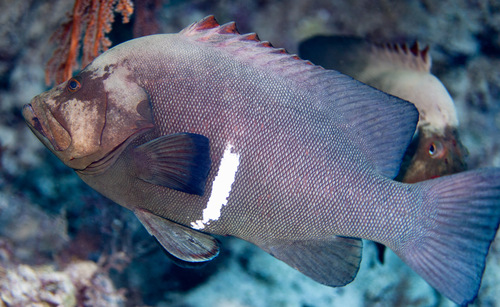
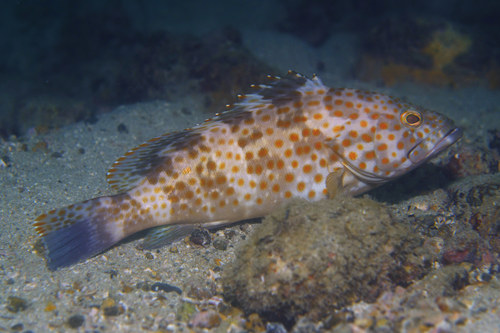
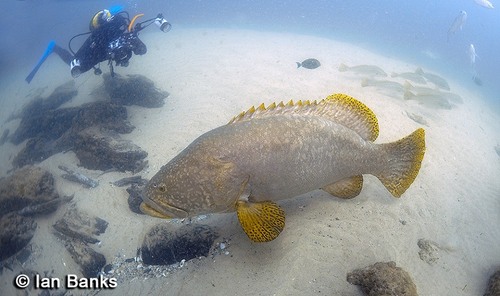
Adult giant groupers are grayish-brown with an overlaying mottled pattern and darker fins.
Juvenile Coloration
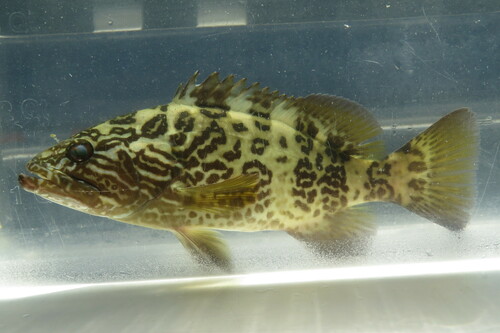
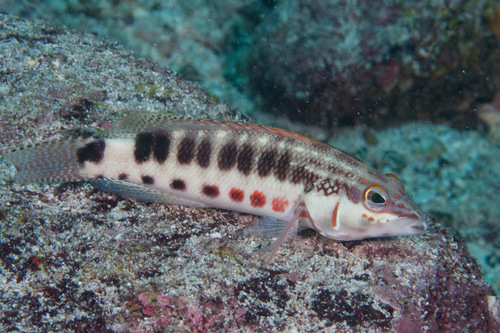
Small juveniles are yellow, with wide, dark irregular bars and irregular dark spots on their fins.
Size & Weight
This species can grow to an extremely large size: the maximum recorded standard length is 270 centimetres (110 in), though individuals are more commonly around 180 centimetres (71 in), and the maximum published weight is 400 kilograms (880 lb).
Distribution Range
The giant grouper has a wide Indo-Pacific distribution, and it is the most widely distributed grouper species in the world. Its range extends from the Red Sea and the eastern coasts of Africa south to Algoa Bay, South Africa, across the Indian Ocean into the Western Pacific Ocean east as far as the Pitcairn Islands and Hawaii.
Latitudinal Range
It is found as far north as southern Japan and as far south as Australia.
Australian Distribution
In Australia, it occurs from Rottnest Island in Western Australia, north and east along the country's tropical coasts (including offshore reefs), then south along the eastern coast to Woy Woy, New South Wales. It is also found around Christmas Island, the Cocos (Keeling) Islands, and the Elizabeth and Middleton Reefs Marine National Park Reserve in the Tasman Sea.
Unconfirmed Distribution Reports
There are also unconfirmed reports of its presence at Younghusband Peninsula in South Australia and northeastern New Zealand.
West & Central Indian Ocean Distribution
It is absent from the Persian Gulf, but is found off the coast of Pakistan and southern Oman.
Potential Invasive Range
It has been listed as a potential invasive species in the Bahamas, but confirmation of its presence there is still needed.
Depth Range
This is a shallow water fish species that occurs at depths from 1 to 100 metres (3.3 to 328.1 ft).
Reef Association
It is associated with reefs, and is the largest known bony fish found on reefs. Large individuals have been caught from shore and in harbours.
Habitat Preferences
They inhabit caves and shipwrecks, while secretive juveniles live on reefs and are rarely observed. Adults are mainly solitary and hold territories on the outer reef and in lagoons.
Soft Substrate Habitat
Prawn fishermen have also caught giant groupers in turbid water over silt or mud seabeds.
General Diet
The giant grouper is an opportunistic ambush predator that feeds on a wide range of fishes, as well as small sharks, juvenile sea turtles, crustaceans, and molluscs, all of which it swallows whole.
Coral Reef Diet
Giant groupers living on coral reefs and rocky areas prefer spiny lobsters as prey; a 177-centimetre (70 in) specimen captured off Maui, Hawaii had two spiny lobsters and a number of crabs in its stomach.
Estuarine Diet
In estuarine environments of South Africa, this species was found to feed almost exclusively on the crab Scylla serrata.
General Behavior
This species is normally solitary and long-lived. It is also curious, and often approaches divers closely.
Human Interaction Risk
It is not generally considered dangerous to humans, but divers are advised to treat large specimens with caution and avoid hand feeding them, as there have been reports of large individuals attacking humans.
Reproductive Mode
Like most groupers, giant groupers are protogynous hermaphrodites.
Spawning Timing
They spawn following a lunar cycle, with spawning events lasting around 7 days.
Spawning Strategy
They are aggregative broadcast spawners, typically with several females per male.
Captive Spawning Behavior
Studies of captive populations show that the dominant male and female start the spawning event and are almost the only spawners for the first day or two, but other members of the aggregation fertilize more eggs as the event progresses, even the most recently transitioned males father offspring.
Diandric Protogyny
Giant groupers are diandric protogynous hermaphrodites, which means while some males develop from reproductively functional females, other males begin producing sperm without ever going through a reproductive female phase.
Commercial & Recreational Fishery Value
The giant grouper is a highly valued food fish, caught by both commercial and recreational fisheries. It is valued as a live fish in Hong Kong for the live reef food fish trade, especially smaller specimens.
Traditional Medicine Uses
Its skin, gall bladder, and stomach are used in Traditional Chinese Medicine.
Mariculture Status
This species is cultivated in mariculture, a practice that is widespread, though the supply of juveniles is limited.
Captive Breeding
Hatcheries in Taiwan have produced captive-bred juveniles, and export some to other parts of Southeast Asia for further grow-out.
Aquaculture Hybrids
Many aquaculture-raised giant groupers are hybrids between this species and E. fuscoguttatus.