About Diodon liturosus Shaw, 1804
Common Name and Taxonomy
Diodon liturosus Shaw, 1804, commonly called the Black-blotched porcupinefish, is a medium-sized fish.
Size
It reaches a maximum length of 65 cm (26 in), while the average size most commonly observed is 45 cm (18 in).
Body and Head Shape
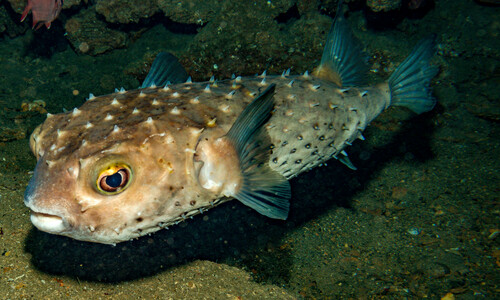
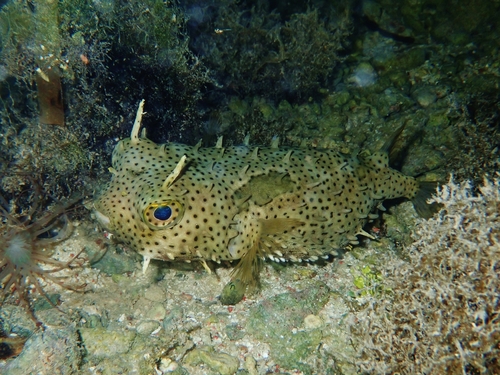
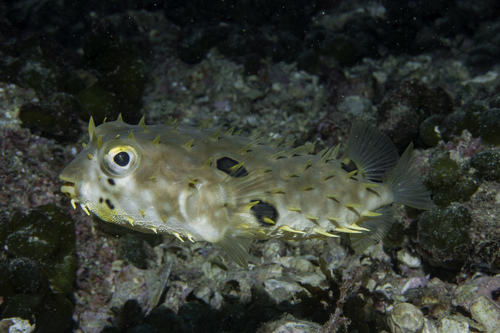
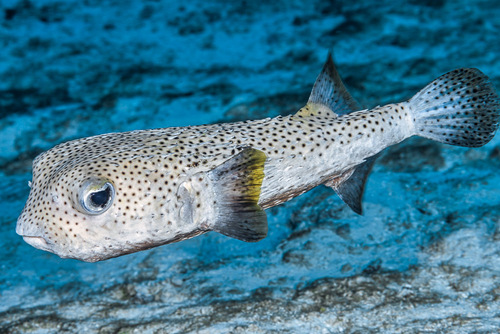
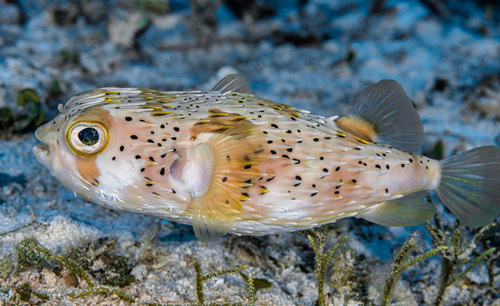
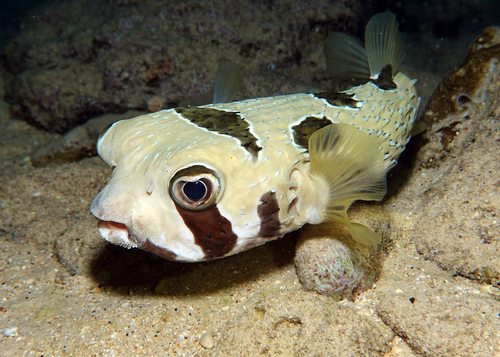
It has an elongated body, a spherical head with large round protruding eyes, and a large mouth that is rarely closed.
Fin Arrangement
It has large pectoral fins, no pelvic fins, and anal and dorsal fins positioned close to the caudal peduncle.
Swimming Fin Movement
The anal and dorsal fins move simultaneously when the fish swims.
Fin Coloration
All fins are a uniform white or yellowish tint with no spotting.
Skin and Spines
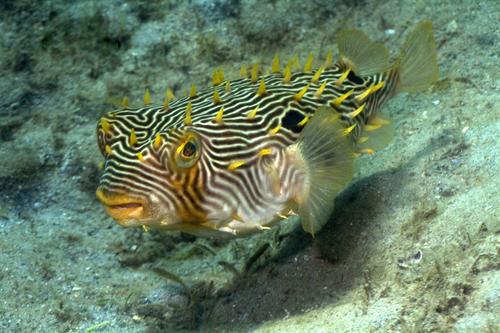
Its skin is smooth and firm, with scales modified into spines that point toward the back.
Body Color Pattern
Its body base color ranges from light brown to sandy yellow, with dark blotches outlined by white lines, and a pale ventral surface.
Similar Species Distinction
It can be confused with the long-spine porcupinefish, Diodon holocanthus, but the Black-blotched porcupinefish has much shorter spines and lacks a dark streak running between its eyes.
Inflation Defense
When threatened, the porcupinefish can inflate itself by swallowing water.
Spine and Volume Defense
This increases its body volume to deter predators, and it can also raise its spines for defense.
Toxin Presence
The species concentrates the powerful neurotoxin tetrodotoxin in parts of its body including the liver, skin, gonads, and viscera.
Toxin Function
This toxin acts as an additional defense to discourage potential predators.
Habitat Climate Range
The Black-blotched porcupinefish lives in tropical and subtropical waters.
Geographic Distribution
It occurs in the Indo-Pacific region from the eastern coasts of Africa to Japan, the Society Islands, and Western Australia, and also in the southeastern Atlantic Ocean off the coast of South Africa.
Adult Habitat and Depth
Adult individuals prefer lagoons, top reefs, and seaward coral or rocky reefs at depths between 1 and 90 m, though they are most often found between 15 and 30 m depth.