About Dendrocopos leucotos (Bechstein, 1802)
Size Status
This species is the largest spotted woodpecker found in the western Palearctic. It measures 24–26 cm in length, with a wingspan of 38–40 cm.
Plumage Characteristics
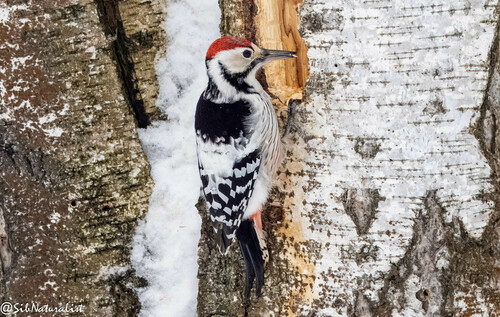
Its plumage resembles that of the great spotted woodpecker, but differs in having white bars across the wings instead of white spots, along with a white lower back. Males have a red crown, while females have a black crown.
Vocalizations and Drumming
Male drumming is very loud, and the species' calls include a soft kiuk and a longer kweek.
Subspecies Distribution
The nominate subspecies D. l. leucotos lives in central and northern Europe, while the subspecies D. l. lilfordi is found in the Balkans and Turkey. Ten additional subspecies occur across the region extending eastward as far as Korea and Japan.
Habitat Requirements
This is a scarce bird that requires large areas of mature deciduous forest with high volumes of standing and fallen dead wood.
Conservation Status
Population numbers have decreased in Nordic countries; in Sweden, this population decline has led the Swedish government to grant the species protection under the national Biodiversity Action Plan.
Nesting Behavior
During the breeding season, the woodpecker excavates a nest hole around 7 cm wide and 30 cm deep in a decaying tree trunk. It lays three to five white eggs and incubates them for 10–11 days.
Diet
Its diet consists predominantly of wood-boring beetles and their larvae, and also includes other insects, nuts, seeds, and berries.