About Melanerpes chrysauchen Salvin, 1870
Taxonomy and Size
The golden-naped woodpecker, Melanerpes chrysauchen Salvin, 1870, grows to a length of approximately 18 cm, or 7 inches. It looks similar to the beautiful woodpecker, but the two species have no overlapping ranges.
Sexual Dimorphism in Crown
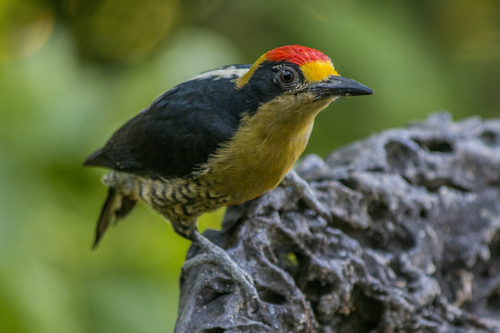
The sexes share a mostly similar appearance, with one key difference: males have a yellow fore-crown and a red central crown, while the entire crown of females is yellow except for a narrow transverse black band across its center. Both sexes have a yellow nape, and a black mask that surrounds the eyes and extends to the nape.
Facial Markings
A small white patch is present behind each eye. The lores, cheeks, chin, throat, and breast are pale yellow, buff, or grey.
Underpart Markings
The lower breast, belly, and flanks have black and white barring, and there is a red patch on the mid-belly.
Upperpart and Wing Coloration
The mantle is mainly black, the wings are brownish, and the tips of the flight feathers are white. The back and rump are mainly white, and sometimes have black blotches.
Tail and Bare Parts
The tail is black, with white barring on the outer feathers. The iris is brown, the beak is greyish-black, and the legs are greyish-olive.
Geographic Range
This species is endemic to Central America, and restricted to the Pacific slopes of southwestern Costa Rica and western Panama.
Altitudinal Range
It occurs at altitudes from sea level up to about 1,500 m, or 5,000 ft.
Habitat
It is a non-migratory forest species that inhabits primary humid rainforest, particularly open areas with tall trees, as well as woodland edges, secondary forests, plantations, and degraded areas located close to natural forest.
Fruit Diet
The golden-naped woodpecker's diet consists largely of fruit, including dates, bananas, figs, and Cecropia fruits. It also forages on tree trunks for insects like beetle larvae.
Aerial Foraging
Particularly at dusk, it makes short flying flights from a perch high in the air to catch winged termites and other flying insects.
Nesting
It excavates its nest in a hole in a tree.
Breeding
Its breeding season runs from March to June, and the species may occasionally raise two broods in a single breeding season.