About Delphinium scopulorum A.Gray
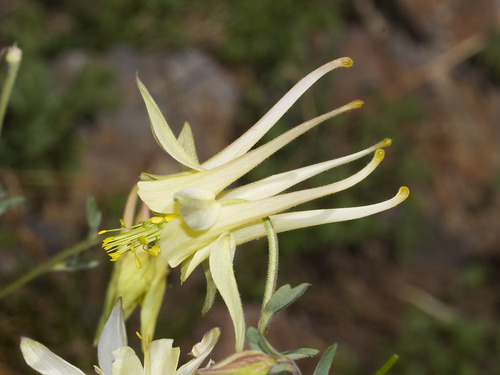
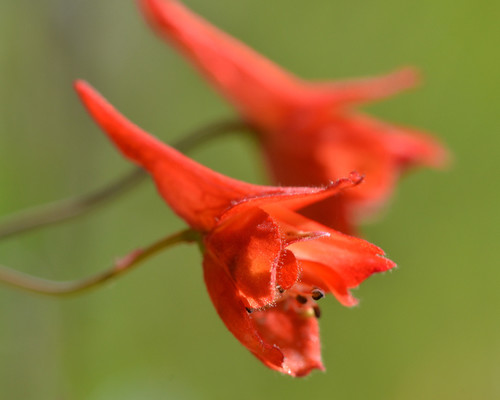
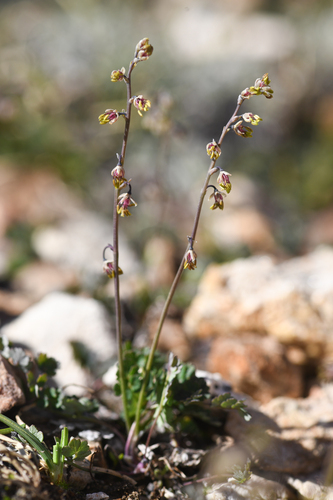
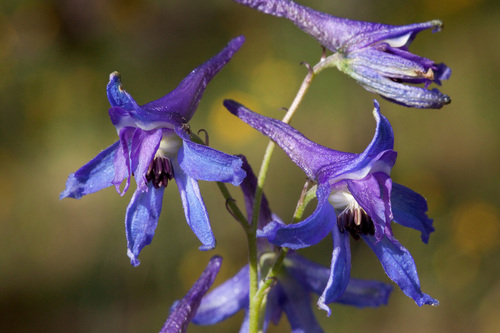
Delphinium scopulorum has stems 50–120 cm long. The stem base is reddish and puberulent, while the mid-stem is glabrous to subglabrous. Leaf blades are round to pentagonal, measuring 1.5–10 cm by 2–16 cm, and are glabrous. Most leaves grow on the proximal third of the stem; leaf petioles reach around 15 cm long. Leaves are strongly lobed and palmately divided. The inflorescence is an open, elongated cylindric raceme. Bracteoles are linear, green, and measure 2–7 mm long. Flower segments are deeply 5–7 lobed with cuneate divisions that have 3–7 teeth; the central segment of each division is prominent. Sepals range from light to dark violet-purple, are glabrous, and lateral sepals point forward. Upper petals are notched and purple-tipped. Lower petal blades cover the stamens, have sparse hairs, and are centered below the junction of the blade and claw. A large spur grows behind each flower. Fruits are glabrous, around 16–20 mm long, and about 4.5 times longer than they are wide. Seeds are black to brown, rectangular to pyramidal, and have winged margins. This species attracts hummingbirds and butterflies. Delphinium scopulorum is found in a North American floral region, specifically in the U.S. states of New Mexico and Arizona. It grows as a forb or herb. It is native to the contiguous United States, has a National Wetland Indicator Status of FAC, and a Regional Wetland Indicator Status of 7(FAC). According to the Canadian Department of Agriculture, this larkspur is poisonous to cattle in the western prairies of Canada. Because larkspur commonly grows at high-elevation locations, many ranchers wait until late summer to move cattle into these areas, when toxicity has decreased. Delphinium scopulorum is toxic enough that death can occur within a few hours of ingestion, caused by neuromuscular blocking and cardiotoxic effects.