About Deirochelys reticularia (Latreille, 1801)
Overall Resemblance & Distinct Neck
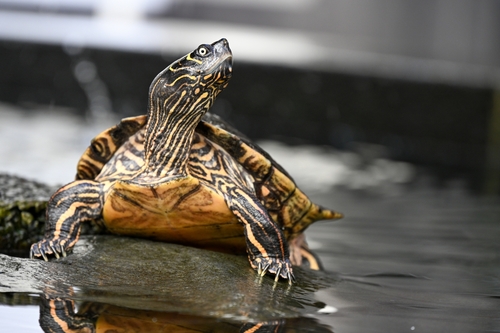
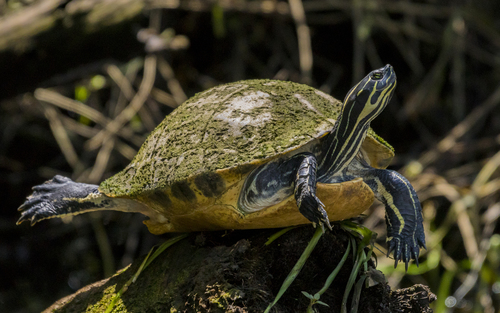
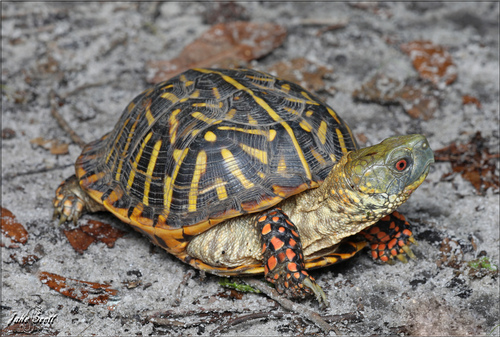
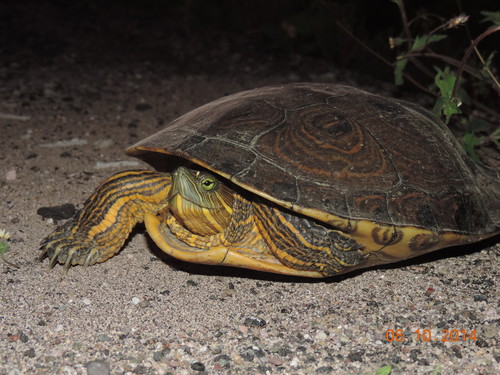
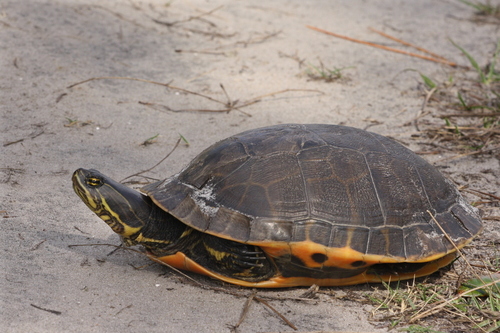
The chicken turtle, Deirochelys reticularia, resembles painted turtles (Chrysemys picta) and cooters (genus Pseudemys) in overall appearance, but has an unusually long neck that is nearly as long as its shell. It often also has black blotches on the underside of the shell bridge—the structure connecting the upper carapace and lower plastron—markings that are not present in these similar species.
Carapace Shape
The chicken turtle's carapace is elongated and pear-shaped, with the rear half noticeably wider than the front.
Carapace Color & Pattern
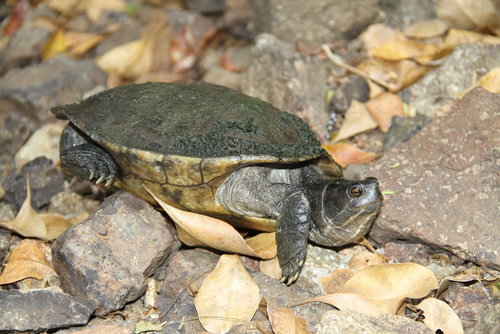
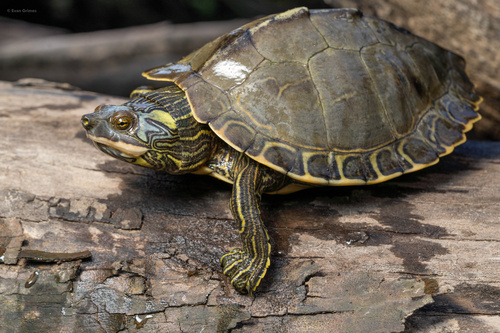
It ranges in color from dark green to brown, and features a distinct yellowish net-like pattern across its entire upper surface.
Carapace Scute Texture
The scutes of the upper shell have a ridged or wrinkled texture and feel rough to the touch.
Internal Rib Adaptation
Under its shell, the chicken turtle has particularly slender ribs, thought to be adapted to accommodate its long, muscular neck.
Taxonomic Relationship to Blanding's Turtle
While the chicken turtle shares some morphological traits with Blanding's turtle (Emydoidea blandingii), including these elongated ribs and skull shape, DNA analysis confirms the two species are not closely related.
Skin Base Color
Published descriptions disagree on the base color of the chicken turtle's skin, but it is generally reported to be darker than its carapace, and varies from olive to brown to black.
Limb Markings
One key distinguishing feature of D. reticularia is a broad yellow stripe running along the forelegs.
Head, Neck & Tail Markings
The skin of the neck and head also has light stripes, though these are narrower, while the tail and rear legs have vertical yellow markings.
Head & Foot Morphology
The head itself is elongated with a somewhat pointed snout and no other distinct features, and the foot digits are webbed and tipped with claws.
General Size Classification
The chicken turtle is small to medium sized compared to other turtle species.
Adult Carapace Length
Adult carapace length ranges from around 10–25 cm (4–10 in), with an average length of about 13 cm (5 in).
Carapace Width Ratio
The carapace width is roughly 65 percent of its length.
Sexual Dimorphism
Mature chicken turtles show a degree of sexual dimorphism: females are larger and heavier than males, while males have longer, thicker tails.
Foreclaw Sex Difference
Unlike in painted turtles, there is no difference between the sexes in foreclaw length.
Hatchling Size & Weight
Newly hatched chicken turtle hatchlings measure approximately 28–32 mm (1.1–1.3 in) and weigh around 8–9 g (0.28–0.32 oz).
Hatchling Shell & Skin Traits
Hatchlings have much rounder shells than adults, and both their shell and skin are considerably brighter in color, with a greater number of light stripes.
Hatchling Plastron Markings
Young western chicken turtles already have the species' distinctive dark plastron markings when they hatch.
Overall Geographic Range
The chicken turtle is found throughout the southeastern United States.
Eastern Range Extent
Its range extends from the Atlantic coastal plain, including North Carolina, South Carolina, Georgia and Florida, westward through the Gulf plain toward the Mississippi River.
Range Elevation Preferences
It tends to stay in coastal areas and is largely absent from the Piedmont plateau and more mountainous regions in the northern parts of these states.
Western Range Extent
West of the Mississippi River, its range reaches as far north as Missouri and as far west as Oklahoma and central Texas.
Population Distribution
Across its range, the chicken turtle may occupy many hundreds or possibly thousands of separate wetland sites, though populations at any single location are generally small.
Habitat General Type
Chicken turtles are semiaquatic, equally at home in wetland habitats and on land.
Preferred Wetland Preferences
All three recognized subspecies share similar habitat preferences: they favor quiet, still or slow-moving bodies of water such as shallow ponds, oxbow lakes, drainage ditches, borrow pits, marshes, swales, cypress swamps, and Carolina bays.
Water Depth Preferences
Generally, the chicken turtle prefers water with a maximum depth of around 70 cm (2.3 ft), but it is known to live in ponds up to 2 m (6.6 ft) deep.
Moving Water Tolerance
It rarely lives in moving water such as streams or rivers, but may sometimes colonize quieter rivulets or pools in the riparian zone.
Water Salinity Preference
It strongly prefers fresh water and avoids brackish water whenever possible.
Habitat Vegetation & Substrate
The chicken turtle thrives in water bodies with dense aquatic vegetation and a soft, muddy substrate.
Ephemeral Wetland Use
These are often ephemeral or temporary wetlands that dry out readily during summer or drought periods.
Wetland Ecological Benefits
Such habitats tend to lack both fish, which would compete for food, and large potential predators such as alligators.
Dry Period Terrestrial Survival
When a wetland dries, chicken turtles migrate onto land, burrowing into soil or hiding under foliage to survive dry conditions.
Dry Period Site Fidelity
Although they are well adapted to terrestrial life, they rarely leave their original habitat even during extended dry spells, and return to the water once it refills.
Island Populations
While the chicken turtle does not generally inhabit islands, isolated populations are known on the Outer Banks barrier islands off North Carolina.
Island Population Traits
These maritime forest habitats dry out easily in summer and can be affected by storms and sea spray, but research on one of these island populations found no meaningful differences in longevity, growth rate or sex ratio between island members and their mainland counterparts.