About Graptemys pseudogeographica (Gray, 1831)
Common Names
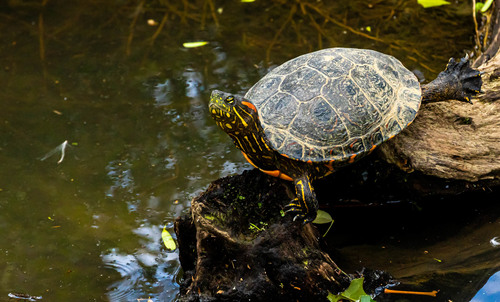
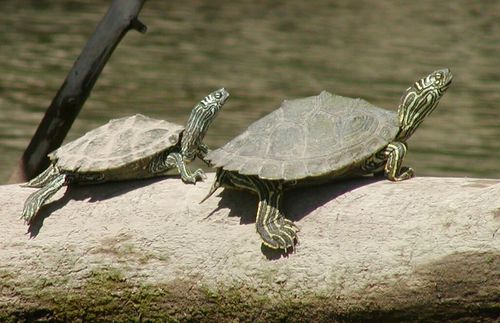
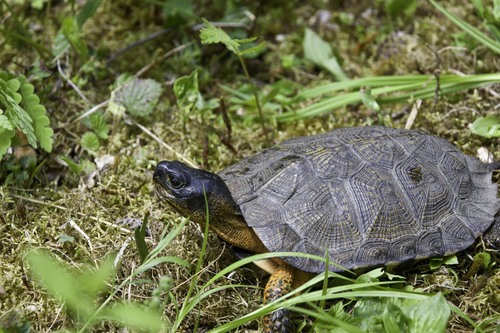
Graptemys pseudogeographica, commonly called the false map turtle or sawback turtle, has a carapace with a vertebral row of low spines, and its posterior rim is serrated.
Carapace Coloration and Markings
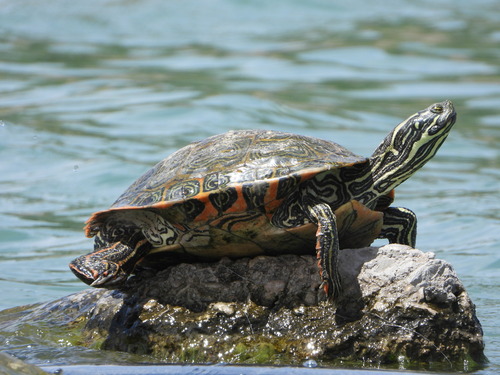
The carapace ranges in color from olive to brown, and has light yellowish markings bordered by dark edges, with a dark mark often present on each scute.
Plastron Characteristics
The plastron’s color varies from cream to yellow, and juveniles have dark lines patterned along the plastron seams.
Body Coloration and Striping
The body of the false map turtle is grayish brown to blackish, marked with light brown, yellow, or whitish stripes.
Eye Features
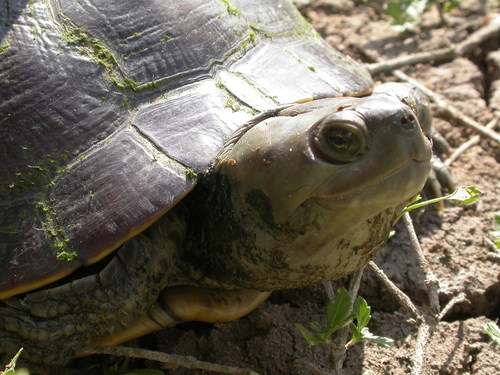
The eye may be brown, light yellow, white, or green, and is crossed by a dark bar.
Post-Eye Head Markings
A distinct "L" shaped mark can appear just behind each eye. Narrow hooked marks behind the eye fuse with dorsal lines on the head and neck.
Lower Head Markings
Small light-colored spots also occur below the eye and on the chin.
Native Range
This species lives in large streams of the Missouri and Mississippi River systems, with a range extending from Ohio, Indiana, Illinois, Wisconsin, Minnesota, through the Dakotas, south to southwestern Alabama, southern and western Mississippi, and Louisiana. It also inhabits several other river systems in Southwest Louisiana and East Texas.
Preferred Habitat Features
The false map turtle is a strong swimmer that prefers rivers and large creeks with moderate currents, that contain aquatic vegetation plus snags or floating logs. It tolerates deep, swift water well.
Habitat Occurrence Limits
It can be found in oxbow lakes and sloughs, but does not occur in lakes, ponds, or small streams.
Basking Behavior
Basking is an important behavior for these turtles, and they can even be found on steep, slippery snags.