About Egernia stokesii (Gray, 1845)
Common Name & Dorsal Coloration
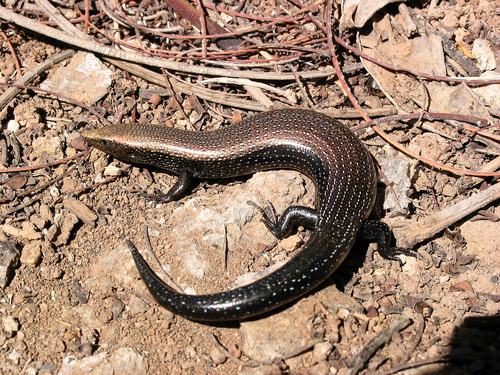
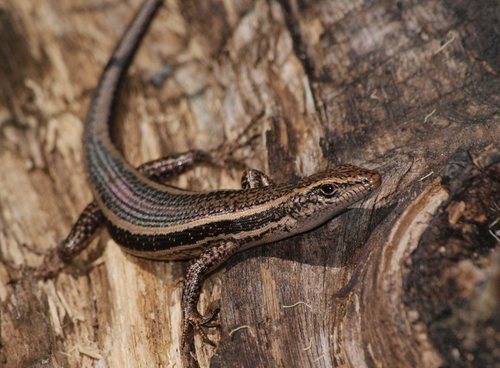
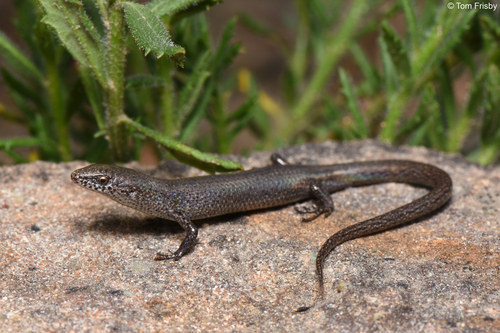
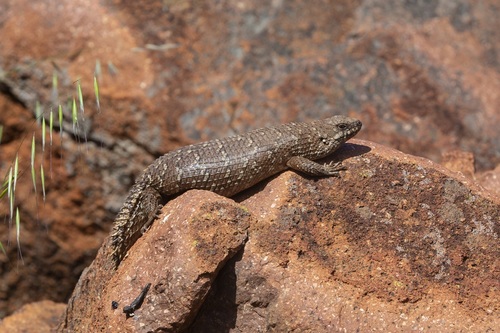
Egernia stokesii, commonly known as Stokes's skink, ranges in color from olive to reddish brown, with lighter ventral scales that vary from white to yellow. The species often has scattered lighter-colored scales across its back.
Scale & Tail Morphology
Its dorsal scales are keeled from the back of the neck to the tail, and spiny scales on the tail are a prominent feature of the species. The tail is flattened rather than cylindrical, and is shorter than the animal’s head and body, measuring approximately 35% of the snout to vent length.
Tail Autotomy Ability
E. stokesii cannot autotomize, meaning it cannot drop its tail to escape predators.
Adult Body Size
The snout to vent length of a mature adult ranges between 155 and 190mm.
Maturation & Lifespan
This species is slow to reach sexual maturity, maturing between five and six years of age, and has a lifespan between 10 and 25 years.
Social Aggregation Size
Egernia stokesii has a complex social organization, forming stable social aggregations of up to 17 closely related individuals.
Social Structure Benefits
Research suggests this complex social structure helps the species detect predators and regulate body temperature. These groups remain stable over time, with evidence that adult individuals can stay in the same social group for more than five years.
Philopatry
E. stokesii displays philopatry, meaning juveniles typically stay within their natal group until they reach maturity.
Social Group Composition
Social aggregations usually consist of a breeding pair, immature juvenile and sub-adult offspring from multiple successive litters, and other closely related individuals.
Home Range & Refuges
Each group has a defined home range that contains several core, preferred rock or log crevices shared by all group members.
Group Recognition
Each group maintains a common scat pile outside these refuge crevices, and can distinguish group members from non-group members using olfactory chemical cues.
Shared Margin Crevices
Multiple groups may share crevices located on the margins of home ranges.
Basking Behavior
Individuals within these social groups bask in close proximity to one another, sometimes touching, and their basking sites are always adjacent to crevices.
Diet Overview
This species is omnivorous; its diet includes arthropods such as beetles and grasshoppers, plus a variety of plant material.
Identified Dietary Seeds
Seeds from both native and introduced plant species have been found in its scats, including the native Enchylaena tomentosa (ruby saltbush), and the introduced Portulaca oleracea (common pigweed) and Medicago minima (woolly burr medic).
Dietary Variation Patterns
Both seasonal and ontogenetic dietary changes are documented for this species. Juveniles have a higher proportion of insects than plant matter in their diet.
Adult Seasonal Diet Shifts
Adults consume a proportionally higher percentage of plants relative to insects, and the proportion of plant material in their diet increases from mid to late summer.
Diet Shift Hypotheses
The cause of these dietary shifts has not been confirmed, though it may be linked to competitive pressure from juveniles after parturition, or seasonal changes in resource availability.
Known Predators
Known potential predators of E. stokesii include mammals such as cats, foxes, and dingos; reptiles such as the eastern brown snake and monitor lizards; and birds of prey.
Anti-Predation Adaptations
The species uses two main mechanisms to reduce predation risk: its spiny tail morphology, and defensive behavior that includes rarely straying far from its rock crevice refuges.
Habitat Types
Egernia stokesii may be saxicolous, meaning it lives on rocky outcrops, or semi-arboreal, and occurs in grassland, woodland, or shrubland habitats.
Activity & Shelter
It is diurnal and non-burrowing, and shelters in rock crevices, under logs, or in tree hollows.
Geographic Distribution
This species is found in New South Wales, the Northern Territory, Queensland, South Australia, and Western Australia.
Mating System
Egernia stokesii is highly monogamous, and there is evidence that individuals select mates from their established social group that are unrelated, have dissimilar genotypes, and high genetic diversity.
Reproductive Mode & Litter Size
The species is viviparous, giving birth to live young, and produces between 1 and 8 young per litter.
Parturition Duration
Parturition, the process of giving birth, can take between one and twelve days, with an average duration of 2.8 days.
Litter Size Correlates
Litter size has been shown to positively correlate with both the female’s snout to vent length and her gravid mass.
Birth Morphology
Young are born head first, encased in membranes with a yolk sac attached.
Post-Birth Membrane Consumption
After birth, either the newborn skinks or the mother may consume the birth membranes and yolk sac.
Infanticide Observation
Infanticide has also been observed in this species.
Newborn Size & Weight
Newborn juveniles have a reported snout to vent length between 65 and 95mm, with an average birth weight of 8.15g.
Eastern Population Birth Timing
Populations of E. stokesii in eastern Australia typically give birth annually during the summer months of February and March, but do not necessarily produce a litter every year.
Western Population Winter Birth Record
One instance of winter birth has been recorded in a wild individual from Western Australia.
Mortality Rates
Juveniles have a relatively high infant mortality rate during their first year of life, while adult E. stokesii have a low mortality rate.