About Daption capense (Linnaeus, 1758)
Plumage Features
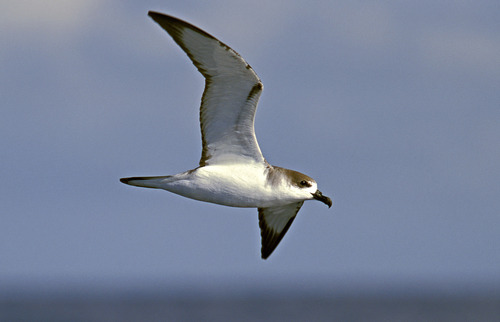
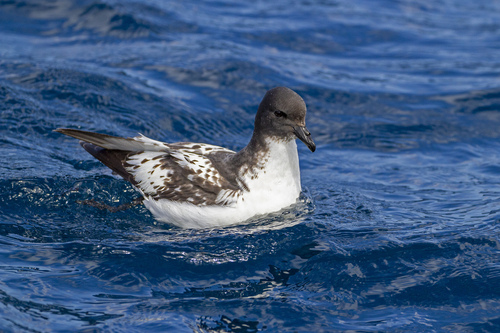
The pintado petrel, also known by the scientific name Daption capense, has a black head and neck. Its belly, breast, and underwing are white, with the underwing edged in black. The back, upperwings, and tail are speckled black and white, and the tail also has a black band.
Size Measurements
This bird measures 35–40 cm (14–16 in) in length, with a wingspan of 80–90 cm (31–35 in).
Subspecies Status
Two subspecies are recognized, though intermediate individuals also occur.
Nominate Subspecies
The nominate subspecies, D. c. capense (Linnaeus, 1758), breeds on circumpolar subantarctic islands and winters at sea north to around the Tropic of Capricorn, reaching locally as far north as the Equator around the Galapagos Islands along cold currents. It is larger, with a white back marked by black spots.
Second Subspecies
The second subspecies, D. c. australe Mathews, 1913, breeds on subantarctic islands around and south of New Zealand, and ranges northwest to southeastern Australian waters outside the breeding season. It is smaller, with a solid blackish-brown back that extends down to the top of the rump.
Distribution and habitat
Feeding Range
In terms of distribution and habitat, pintado petrels feed at sea around Antarctica during the breeding season. In winter, they range further north, reaching as far as Angola and the Galapagos Islands.
Breeding Locations
They breed on many islands in Antarctica and the subantarctic, with some breeding colonies located as far north as the Auckland Islands, Chatham Islands, and Campbell Island. Their main breeding grounds are on the Antarctic Peninsula, South Georgia, the Balleny Islands, the Kerguelen Islands, and islands in the Scotia Sea.
Northern Hemisphere Records
While individual birds have been reported in Northern Hemisphere waters, their presence there is of unknown origin, and they were likely captured by sailors and released into northern waters.