About Ctenosaura bakeri Stejneger, 1901
Juvenile Coloration
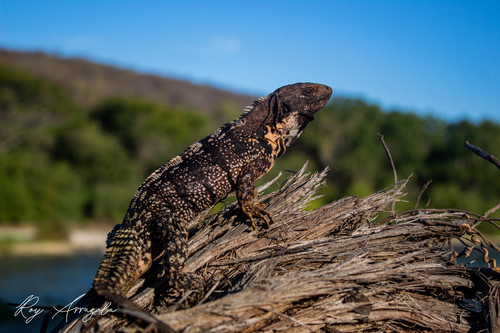
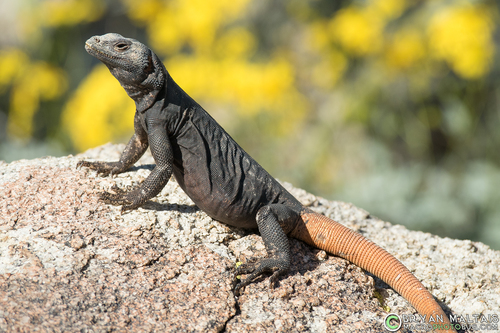
The Utila iguana, scientifically named Ctenosaura bakeri Stejneger, 1901, has grey-brown to black coloration when young. It is the only spiny-tail iguana species that has such a dark juvenile color; other species in its genus are green or yellow when young and darken as they age.
Adult Coloration
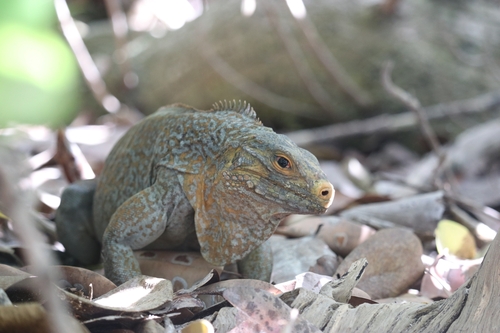
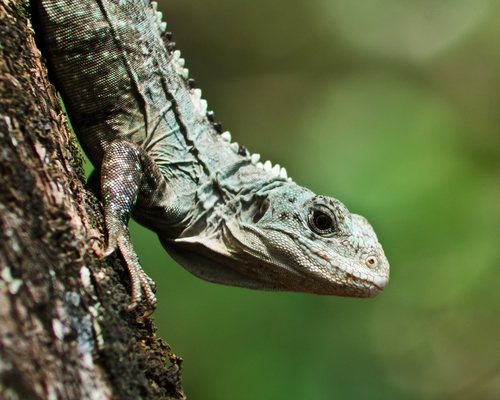
As mature Utila iguanas, their color can shift to blue or light gray, which depends on temperature conditions and even the individual’s temper.
Size
Males reach a maximum total length of 76 centimeters (30 inches), including the tail, while females are typically 30% smaller, with a maximum total length of 56 centimeters (22 inches).
Sexual Dimorphism
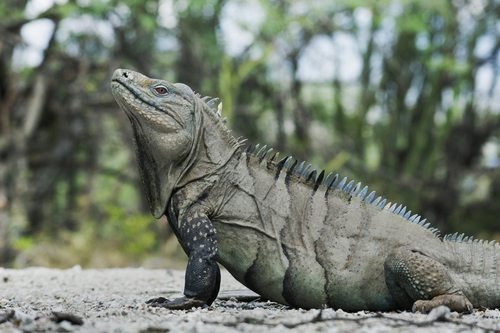
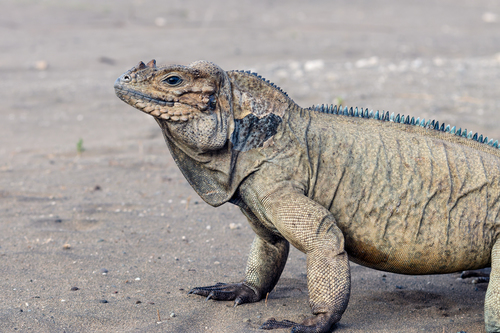
Males have a small dewlap and a dorsal crest formed by 56 large dorsal spines, making this species sexually dimorphic. The spines on this dorsal crest are white and black, arranged in alternating groups of two or three spines of the same color.
Endemic Range
Ctenosaura bakeri is endemic to Utila, an island off the northern coast of Honduras.
Habitat Extent
It only inhabits 8 square kilometres (3.1 sq mi) of mangrove forest on the island.
Habitat Origin
Researchers believe that C. bakeri was forced into mangrove swamps by competition from the larger, more aggressive Ctenosaura similis, which normally occupies drier habitats on Utila; this is a unique habitat for iguanids and rare among reptiles.
Interspecific Hybridization
C. bakeri has interbred with C. similis and produced viable hybrid offspring.
Mangrove Habitat Adaptations
Living in brackish mangrove forests requires very specific adaptations for diet, behavior, and resource use from an evolutionary and ecological standpoint. It is one of only two known lizard species that live exclusively in mangrove forests, the other being the Utila anole, Anolis utilensis.
Arboreal vs Terrestrial Lifestyle
Adult Utila iguanas live in holes in different mangrove tree species and have an arboreal lifestyle, while juveniles are strictly terrestrial for their first year of life.
Nesting Migration
Because Utila iguanas cannot successfully lay eggs in mangrove swamps, gravid females must migrate to nearby sandy beaches to bury their egg clutches, so the eggs can incubate in hot sunlight.
Post-Nesting Behavior
After digging nest burrows and laying their eggs, females abandon the nests and return to the mangroves.
Hatchling Development Timeline
Hatchlings emerge 60 to 74 days later and move back to the swamps.
Hatchling Size
Newly emerged hatchlings have a total length of 15 centimeters (5.9 inches): their body length is only 3 centimeters (1.2 inches), and the tail makes up 12 centimeters (4.7 inches) of the total length.
Hatchling Camouflage
The dark skin of hatchlings lets them blend into the dark forest floor of mangroves, which helps them avoid predators.