About Cyanoliseus patagonus (Vieillot, 1818)
Adult Size
Adult burrowing parrots (Cyanoliseus patagonus) measure 39–52 cm in total length, with a 23–25 cm wingspan and a long, graduated tail that ranges 21 to 26 cm. The species is slightly sexually dimorphic in size: males are slightly larger, weighing approximately 253–340 g, while females weigh 227–304 g. It is the largest member of the New World parakeet group commonly known as conures.
Facial Markings
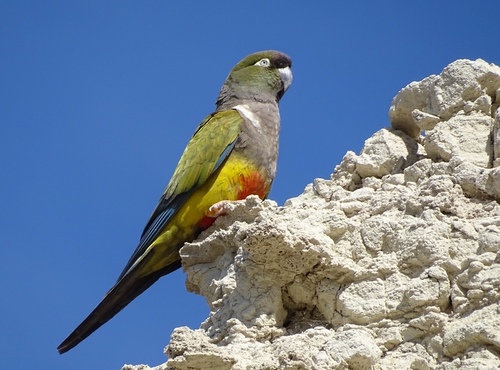
The burrowing parrot is a distinctive species with a bare white eye ring and a white post-ocular patch.
Upper Body Plumage
Its head and upper back are olive-brown, its throat and breast are grey-brown with a variable whitish pectoral marking that rarely extends across the entire breast.
Abdominal Plumage
Its lower thighs and abdominal center are orange-red; researchers think the extent and hue of this red plumage indicates an individual’s quality as a breeding partner and parent.
Lower Body Plumage
Its lower back, upper thighs, rump, vent and flanks are yellow, and its wing coverts are olive green.
Tail Appearance
Its tail is olive green with a blue tint when viewed from above, and brown when viewed from below.
Soft Part Coloration
The species has a grey bill, yellow-white iris, and pink legs.
Immature Traits
Immature birds resemble adults, but have a horn-colored patch on the upper mandible and a pale grey iris.
Sexual Dichromatism
While both sexes look very similar to the unaided human eye, the species is sexually dichromatic: males typically have significantly redder and larger abdominal red patches, and the two sexes look different under ultraviolet light: males have brighter green feathers, while females have brighter blue feathers.
Geographic Range
Burrowing parrots are found across most of Argentina, with isolated populations in central Chile.
Migration Patterns
Central and southern Argentine populations are austral migrants that travel north as far as southern Uruguay in winter, while Chilean populations move vertically downslope to avoid colder high elevations. Populations in northwestern Argentina also move based on food availability.
Elevation Range
The species prefers dry, open country, especially near water courses, and occurs up to 2000 m in elevation.
Natural Habitat
Its natural habitats include montane grassy shrubland, Patagonian steppes, arid lowlands, woodland savanna, and the plains of the Gran Chaco.
Anthropogenic Habitat
It may also live on farmland and at the edges of urban areas.
Nest Burrow Excavation
Burrowing parrots are best known for their nesting behavior: they excavate extensive burrows into limestone or sandstone cliff faces, most often in ravines. These burrows can reach up to 3 m deep into the cliff, connect with other tunnels to form a labyrinth, and end in a dedicated nesting chamber.
Burrow Reuse
Breeding pairs reuse burrows from previous years and may enlarge them.
Colony Nesting
The species nests in large colonies, some of the largest ever recorded for parrots, a behavior thought to reduce predation. Burrowing parrots tend to select larger, taller ravines, which allow larger colonies and higher placement of burrows, resulting in higher breeding success.
Anthropogenic Nest Substrates
When suitable ravines or cliffs are not available for nesting, burrowing parrots will use human-made substrates such as quarries, wells, and pits. Rarely, they have been recorded nesting in tree cavities.
Mating System
Research confirms burrowing parrots are both socially and genetically monogamous.
Clutch Characteristics
The breeding season begins in September, and eggs are laid through December, with clutch sizes ranging from two to five eggs.
Incubation Period
Incubation lasts 24–25 days; only the female incubates, while the male provides her with food.
Chick Survival
Eggs hatch asynchronously, and mortality is higher for the fourth and fifth chicks in a clutch. Both parents care for the chicks.
Fledging Period
Chicks fledge from late December to February, approximately eight weeks after hatching, and fledglings remain dependent on their parents for up to four months.