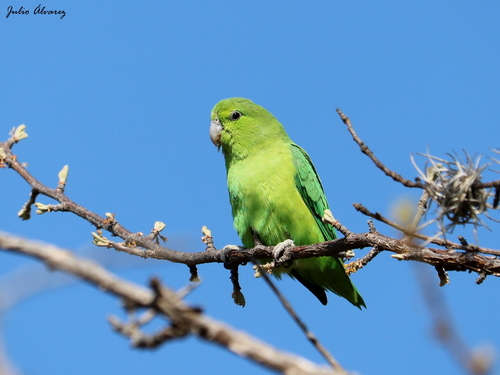
About Psittacula himalayana (Lesson, 1831)
Species Identification
This species, commonly called the slaty-headed parakeet, has the scientific name Psittacula himalayana (Lesson, 1831).
Plumage Coloration
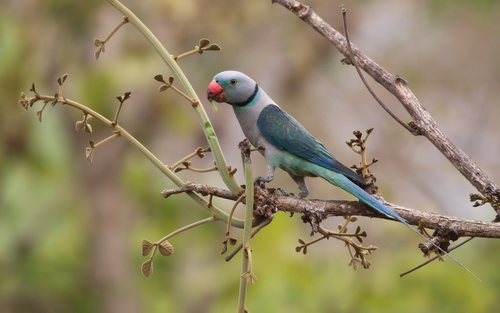
Adults of both sexes have green feathers with a blue tint across most of the body. They have a dark grey, slate-colored head with a light blue tint at the junction where the head meets the neck.
Sexual Dimorphism
Males have dark maroon patches on the inner wing coverts, which females lack. Males also have longer central tail feathers, while those of females are shorter.
Tail & Bill Features
The tail is green at its base, turns deep blue towards the tip, and ends in a broad bright yellow tip. This parakeet has a bright red-orange upper mandible and a pale yellow lower mandible, with pale yellow eyes.
South Asian Distribution
The slaty-headed parakeet has a wide range across the Himalayas and surrounding areas. It occurs in western Bhutan, most of Nepal, and the Indian states of Sikkim, Uttarakhand, Himachal Pradesh, and southern Jammu and Kashmir.
West Asian Distribution
It can also be found in a small area north of Islamabad, and in the southern parts of the Federally Administered Tribal Areas of Pakistan. In Afghanistan, it inhabits small pockets of mountainous terrain in the provinces of Kabul, Logar, Nangarhar, and Paktia.
Habitat & Elevation
The species typically lives at elevations between 460 and 2400 meters, in its natural habitat of highland and hillside forest, as well as valley woodlands.
Foraging Behavior
Individuals are most commonly seen in small flocks or family groups foraging for a diet that includes various wild and cultivated fruits, nuts, pine nuts, seeds, nectar, and acorns.
Seasonal Movement
Larger flocks often form near the end of the wet season, when the birds descend into valleys to spend most of the winter.
Mixed Flocking
They frequently mingle with other parakeet species, including the rose-ringed parakeet, plum-headed parakeet, and blossom-headed parakeet.
Egg Characteristics
Females usually lay 4 to 5 eggs that measure approximately 28.5 x 22 mm. Eggs incubate for around 23 to 24 days before hatching.
Nesting Habits
In the Afghanistan portion of its range, this species often nests in abandoned nest cavities made by scaly-bellied woodpeckers, and the two species may nest close to one another for protection against predators.
Breeding & Lifespan
The slaty-headed parakeet usually breeds between March and May, and has a typical lifespan of 15 to 17 years.