About Cruziohyla craspedopus (Funkhouser, 1957)
Species Identification
Cruziohyla craspedopus can be told apart from other species in the genus Cruziohyla by a set of distinct physical traits.
Adult Size
Adult males of this species have a snout–vent length of 53–66 mm (2.1–2.6 in), while adult females measure 68–76 mm (2.7–3.0 in) in the same measurement.
Head and Snout Morphology
The head of this frog is slightly wider than it is long, and the snout has a sharply truncated shape when viewed from the side.
Limb Morphology
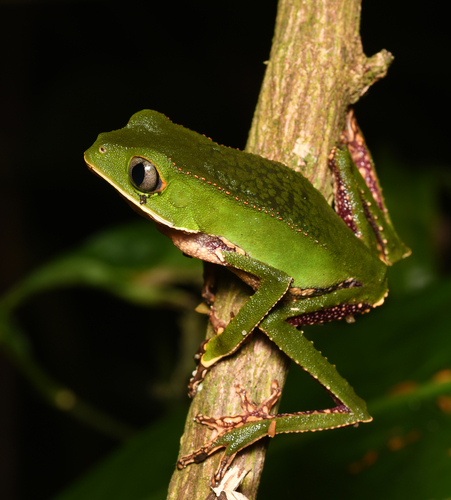
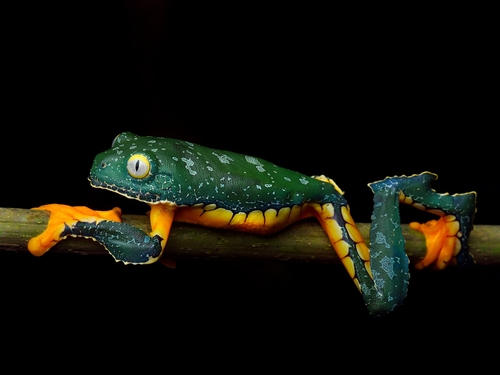
Both the fingers and toes are webbed, and the hind margin of the tarsus has extensive dermal appendages that form irregular spurs.
Dorsal Coloration
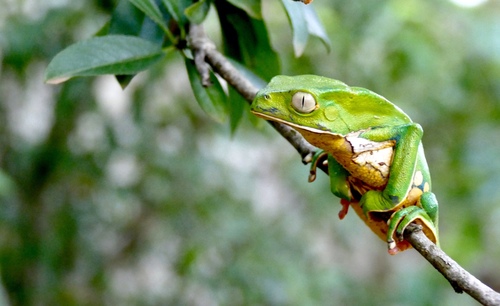
The dorsum has a uniform dark green base color, scattered with large, irregular, pale blue-grey blotches that look like lichen.
Flank Markings
Narrow black lines mark the flanks.
Ventral and Hidden Surface Coloration
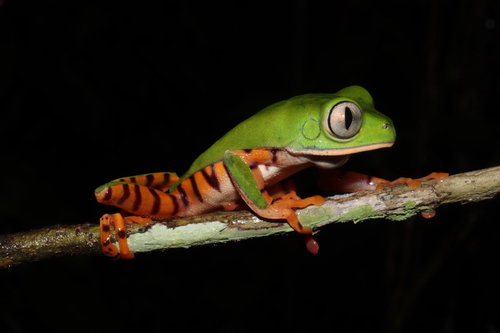
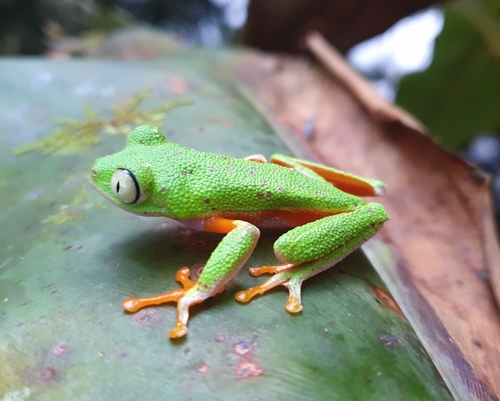
The undersides, as well as the hidden surfaces of the flanks and legs, are yellow.
Camouflage Adaptation
When the frog adheres to a surface, this yellow coloration is hidden, which helps it camouflage.
Habitat and Elevation Range
Cruziohyla craspedopus is a high-canopy frog that lives in primary tropical lowland rainforest, at elevations between 50 and 600 m (160–1,970 ft) above sea level.
Breeding Habitat
It only descends to lower branches to breed, which occurs in fallen trees that hold small pools of water.
Tadpole Habitat
Tadpoles of this species have also been found in small ground pools.
Protected Area Presence
This frog is present in multiple protected areas, including Yasuni National Park in Ecuador and Manú National Park in Peru.
IUCN Red List Status
Cruziohyla craspedopus was listed as Least Concern on the IUCN Red List of Threatened Species in 2004.
Population Trend
It is a rare species, and its most recent population assessment recorded a decreasing population trend.
Threats
It does not face major threats overall, but local populations can be harmed by habitat loss caused by human activities such as agriculture.