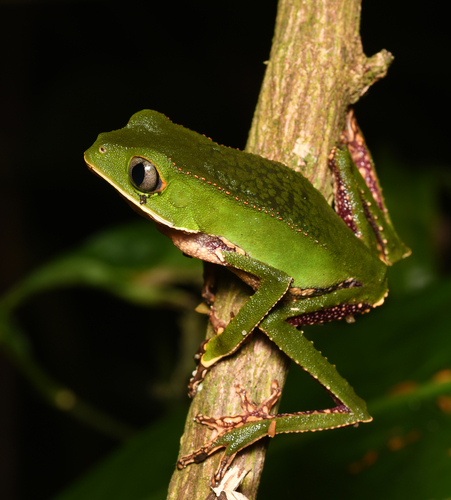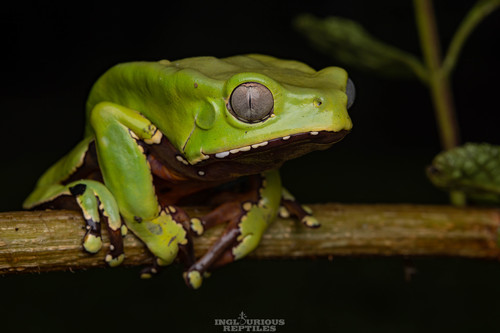
About Agalychnis saltator Taylor, 1955
Size
Male Agalychnis saltator measure 38–44 mm (1.5–1.7 in) in snout–vent length, while females measure 52–62 mm (2.0–2.4 in).
Eye Features
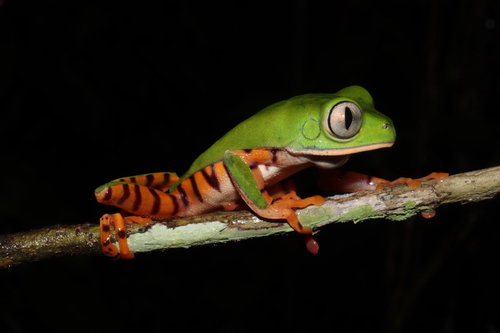
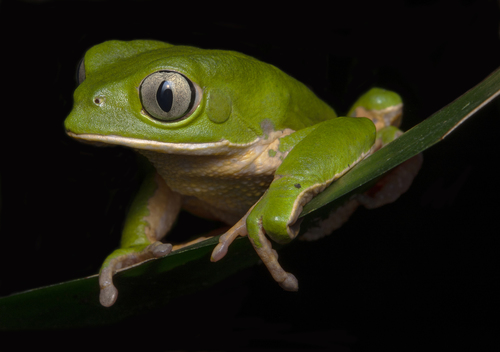
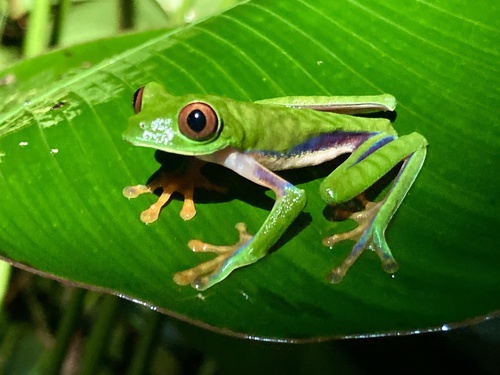
This species has distinctive red eyes with vertical pupils.
Body Coloration
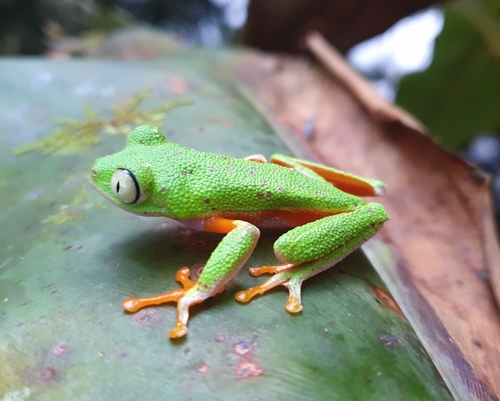
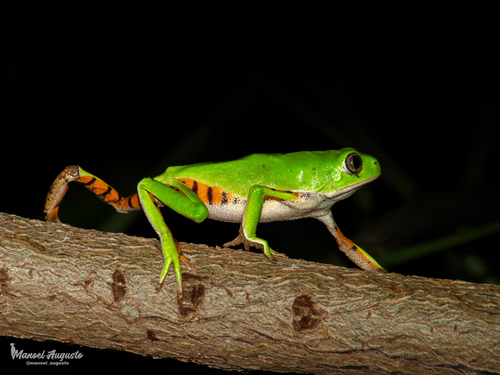
Their dorsum is either light or dark leaf green, and their flanks are bluish purple.
Limb Structure
They have large suction disks and extensive webbing between the fingers and toes.
Activity Pattern
Agalychnis saltator is a nocturnal, arboreal species.
Habitat Range
It inhabits lowland and montane humid and wet forests, and to a lesser degree, adjacent premontane wet forests and rainforests.
Microhabitat and Reproduction Location
These frogs live in tree canopies, and descend to temporary pools to reproduce.
Parachuting Behavior
Males can leap from considerable heights to plants at mating sites, extending their limbs and spreading the skin between their fingers and toes — this behaviour gives the species its common name "parachuting frog".
Breeding Timing
Agalychnis saltator is an explosive breeder that breeds after heavy rains.
Breeding Aggregation Size
A single breeding aggregation can contain 25 to 400 frogs, most commonly 100 to 200 individuals.
Breeding Site Substrate
Aggregations form on vines that overhang temporary forest ponds, and on marsh vegetation such as Spathiphyllum.
Amplexus Dynamics
Most individuals in a breeding aggregation are pairs in amplexus, with one female accompanied by one to four males.
Egg Laying and Predation Risk
Eggs are laid among mosses growing on these vines, but eggs are very vulnerable to predation at this stage.
Interspecific Amplexus
Male Agalychnis saltator have also been observed in amplexus with female Agalychnis callidryas; any eggs produced from these pairings are infertile.