About Crotalus tigris Kennicott, 1859
Head Shape and Rattle
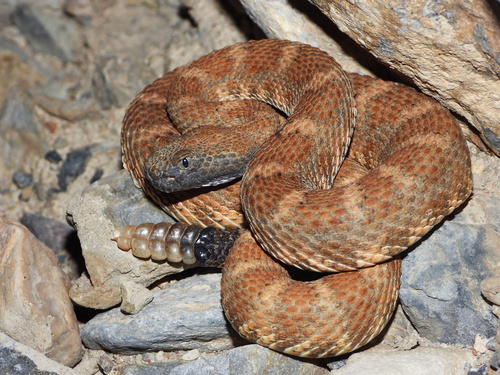
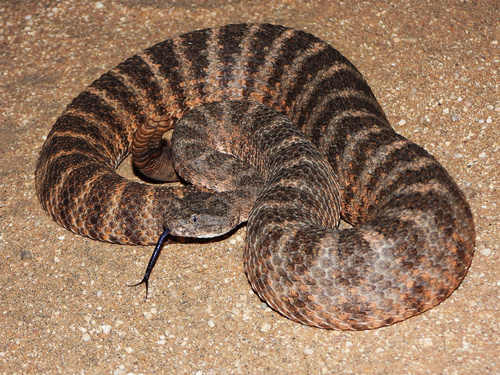
Crotalus tigris, commonly known as the tiger rattlesnake, is easily identified by its small, spade-shaped head that accounts for roughly 1/25 of its total body length. This species has the smallest head of any rattlesnake, paired with a large rattle.
Base Body Coloration
Its base coloration ranges across gray, lavender, blue-gray, pink, or buff, and typically shifts to pink, pale orange, or cream along the sides.
Dorsal Crossband Pattern
Tiger rattlesnakes are the only rattlesnake with crossbands on the front portion of their bodies; 35 to 52 gray, olive, or brown bands made up mostly of heavy speckling run across the back. These crossbands have unclear borders, are wider on the dorsum than on the sides, and become wider than the separating gaps along the mid-dorsal line. Toward the rear of the body, the crossbands darken and gain clearer definition, with 6 to 10 distinct posterior rings present.
Head Markings
Head markings are mostly vague and irregular, though a few dark markings toward the back of the head may form paired occipital blotches and upper temporal streaks. The clearest marking on the head is a dark cheek stripe.
Dorsal Scales
Dorsal scales are keeled and arranged in 21 to 27 rows.
General Size and Weight
This is a relatively small rattlesnake species: individuals can reach a maximum weight of 454 g (16.0 oz), with total body lengths ranging from 460 to 910 mm (18 to 36 in) and an average length of 609 mm (24.0 in). The largest recorded specimen measured 88.5 cm (34.8 in) per 1956 research by Klauber, before H.M. Smith and Brodie reported a maximum length of 91.2 cm (35.9 in) in 1982.
Sexual Dimorphism
Females have 164 to 177 ventral scales and 16 to 21 caudal scales, while males have 158 to 172 ventral scales and 23 to 27 caudal scales; males are also typically larger than females.
Eye Characteristics
The species has relatively small eyes with elliptical pupils.
Geographic Range
The geographic range of Crotalus tigris extends from central Arizona south through south-central Arizona in the United States to southern Sonora, Mexico, including Isla Tiburón in the Gulf of California; the species was recently discovered in the southern Peloncillo Mountains of Arizona.
Type Locality
The type locality is recorded as "Sierra Verde and Pozo Verde"; Pozo Verde is a spring located on the Sonora side of the US-Mexico border near Sasabe. Per Stejneger's 1893 account, this spring sits on the western slope of the southern Sierra Verde, which is also called the Sierra del Pozo Verde.
Elevation Range
Across its range, the tiger rattlesnake occurs at elevations from sea level to around 1,465 m (4,806 ft); reported sightings at higher elevations have not been confirmed.
General Habitat Types
Its habitats include rocky desert canyons, foothills, and bajadas, found in vegetation zones that range from thornscrub, ocotillo-mesquite-creosote bush, saguaro-paloverde, mesquite grassland, and chaparral, to tropical deciduous forest in southern Sonora, and the lower edge of oak woodland.
Seasonal Habitat Use
In southeastern Arizona, this snake is restricted to rocky areas during winter and spring, but uses arroyo edges during summer.
Movement Habits
It is a primarily terrestrial species, though it may climb into low vegetation.
Common Habitat Locations
Across its entire range, tiger rattlesnakes are often observed in foothills, rocky canyons, and ravines of deserts or mesquite grasslands between 300 and 1,520 m (1,000 to 5,000 ft) in elevation. They also inhabit escarpments, rock outcroppings, and cliff faces within thorny scrub desert habitat.
Home Range and Movement
In southeastern Arizona, the mean home range size recorded was 3.48 ha (0.0134 sq mi), and individuals moved an average of 33 m (108 ft) per day during the active season. Little widespread information exists on average home range size for the species overall; one study recorded an observed home range of approximately 3.5 km2 (1.4 sq mi).
Mating System
Tiger rattlesnakes are polygynandrous, meaning either the male, female, or both individuals mate with more than one partner during a single breeding season. Little else is confirmed about the species' reproductive behavior, which is thought to be similar to that of Crotalus atrox and Crotalus scutulatus.
Copulation Behavior
Copulation in viperids can last from minutes to days, and may occur multiple times over a few days.
Reproductive Cycles
Female tiger rattlesnakes follow a biennial reproductive cycle, while males follow a seasonal reproductive cycle, storing sperm in the vasa deferentia over winter.
Breeding Season
Breeding takes place from late May to mid-August, during the summer monsoon season.
Reproductive Mode and Clutch Size
Like most rattlesnakes, tiger rattlesnakes are ovoviviparous. The average clutch size is five young.
Sexual Maturity Size
The smallest recorded sexually mature female measures 541 mm (21.3 in; 54.1 cm) in snout-vent length, while the smallest recorded mature male measures 512 mm (20.2 in; 51.2 cm) in snout-vent length.
Parental Investment
In general, rattlesnakes invest very little in their offspring after birth. However, like other viperids, female tiger rattlesnakes invest resources to provision developing embryos. Females feed early in pregnancy, then locate a safe sheltered site to provide the optimal thermal conditions for embryo development.