About Crotalus atrox Baird & Girard, 1853
Taxonomy and Naming
Crotalus atrox, the western diamondback rattlesnake, is a large venomous snake species first described by Baird & Girard in 1853.
Adult Length
Adult western diamondbacks commonly reach 120 cm (4 ft) in length. Specimens over 150 cm (5 ft) are rarely encountered, individuals over 180 cm (6 ft) are very rare, and the maximum reliably reported total length is 213 cm (7 ft).
Sexual Size Dimorphism
Males grow much larger than females, but this size difference does not appear until the snakes reach sexual maturity.
Weight Range
Medium-sized adult individuals weigh between 1.23 and 2.7 kg (3 to 6 lb), while the largest reported specimens can weigh up to 6.7 kg (15 lb).
Relative Size Ranking
Overall, this species is likely the second largest-bodied rattlesnake, outranked only by its close cousin the eastern diamondback rattlesnake. It is also the second largest venomous snake native to North America; bushmasters, which reach similar weights and greater total lengths, have a range extending as far north as Nicaragua.
Base Body Coloration
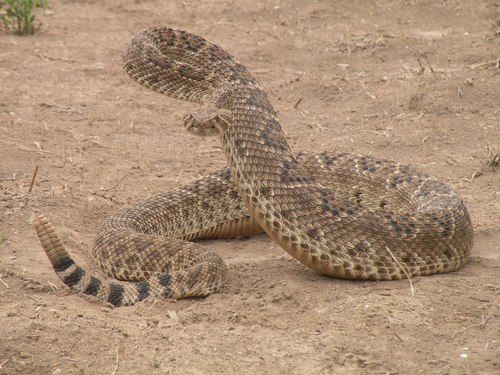
The base body color of this species is typically khaki, but can also be pinkish, fallow, brick red, yellowish blonde, or white.
Dorsal Blotch Characteristics
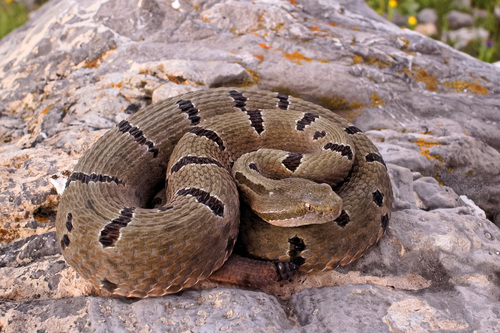
A series of 23 to 45 (average 36) brown or dark umber blotches overlay the base color along the dorsal side of the body. The first dorsal marking may be a pair of short backward-extending stripes that eventually merge.
Dorsal Blotch Shape Progression
The first few dorsal blotches are often somewhat rectangular, before becoming more hexagonal, and ultimately developing the species' distinctive diamond shape. Small specks often blur the clarity of these markings.
Tail Band Pattern
The tail has two to eight (most often four to six) black bands separated by pale white or gray spaces, which earned the species the nickname "coontail", though other rattlesnake species such as the Mojave rattlesnake also have similarly banded tails.
Head Stripe Markings
A gray or umber postocular stripe extends diagonally from the lower edge of the eye across the side of the head. This stripe is almost always bordered below by a white stripe that runs from the upper preocular scale down to the supralabial scales below and behind the eye.
Similar Species Identification Context
The wide range of C. atrox overlaps or lies close to the ranges of many other rattlesnake species, so it is often confused with them, but consistent identifying differences exist.
Mojave Rattlesnake Distinction
The Mojave rattlesnake (C. scutulatus) also has tail rings, but its black rings are narrow compared to its pale rings.
Timber Rattlesnake Distinction
The timber rattlesnake (C. horridus) has no tail rings at all.
Western Rattlesnake Distinction
In the western rattlesnake (C. oreganus), the pale tail rings match the color of the snake's body ground.
Black-tailed Rattlesnake Distinction
The black-tailed rattlesnake (C. molossus) has a uniformly black tail, or only indistinct tail rings.
Mexican West Coast Rattlesnake Distinction
The Mexican west coast rattlesnake (C. basiliscus) also has a mostly dark tail with obscure or absent rings.
Tiger Rattlesnake Distinction
The tiger rattlesnake (C. tigris) has a relatively small head, large rattle, and a dorsal pattern made up mostly of crossbands.
Middle American Rattlesnake Distinction
The Middle American rattlesnake (C. simus) has a generally uniform gray tail with no rings, plus a pair of distinct paravertebral stripes running down its neck.
Sistrurus Genus Distinction
All members of the genus Sistrurus lack tail rings and have enlarged head plates.
Overall Geographic Range
This species is found in the United States from central Arkansas to southeastern and central California, and ranges south into Mexico as far as northern Sinaloa, Hidalgo, and northern Veracruz. Isolated disjunct populations exist in southern Veracruz and southeastern Oaxaca.
Type Locality
Its type locality is given as Indianola, Calhoun County, Texas.
Texas Coastal Occurrence
Western diamondback rattlesnakes are common on Texas coastal beaches such as Surfside Beach, Brazoria County, Texas.
United States Detailed Distribution
In the United States, it occurs in central and western Arkansas; Oklahoma excluding the northeast, north-central region, and panhandle; Texas excluding the northern panhandle and eastern part of the state; southern and central New Mexico and Arizona; extreme southern Nevada; and southeastern California on both sides of the Chocolate Mountains.
Kansas Distribution Records
Records from extreme southern Kansas (Cowley and Sumner Counties) may represent natural occurring populations, while multiple records from near Kanopolis Reservoir in Ellsworth County indicate an established, though isolated, population.
Mexico Detailed Distribution
In Mexico, it occurs in Nuevo León, Coahuila, Chihuahua, Sonora, extreme northeastern Baja California, northern Sinaloa, northeastern Durango, Zacatecas, most of San Luis Potosí, northern Veracruz, Hidalgo, and Querétaro.
Oaxaca Population Rediscovery
While specimens had been collected multiple times in the mountains northwest of Tehuantepec, Oaxaca, no sightings were reported there from the 1940s until 2023, when its presence was confirmed after 79 years without records.
Gulf of California Island Occurrence
This species has also been reported on multiple islands in the Gulf of California, including San Pedro Mártir, Santa María (Sinaloa), Tíburon, and the Turner Islands.
Recognized Subspecies
The Tortuga Island diamond rattlesnake is recognized as a subspecies of Crotalus atrox.
Habitat Types
Crotalus atrox occupies a wide range of habitats, from flat coastal plains to steep rocky canyons and hillsides. It is associated with many different vegetation types, including desert, sandy creosote areas, mesquite grassland, desert scrub, and pine-oak forests.
Activity and Movement Patterns
It frequently roams during the day, and is often encountered on blacktop roads when ambient temperatures drop, due to the heat retained by the pavement.
Reproductive Mode
Like other rattlesnakes, C. atrox is viviparous.
Gestation and Brood Size
Gestation lasts six to seven months, and broods average around a dozen young.
Juvenile Dispersal and Mortality
The young only stay with their mother for a few hours before dispersing to hunt and find shelter on their own, which leads to a very high young mortality rate.
Mating and Maximum Litter Size
Mating occurs in the fall, and females can give birth to as many as 25 live young, each measuring up to 30 cm (12 in) long.
Newborn Venom Capability
Newborn western diamondbacks are fully capable of delivering a venomous bite from the moment they are born.