About Conospermum mitchellii Meisn.
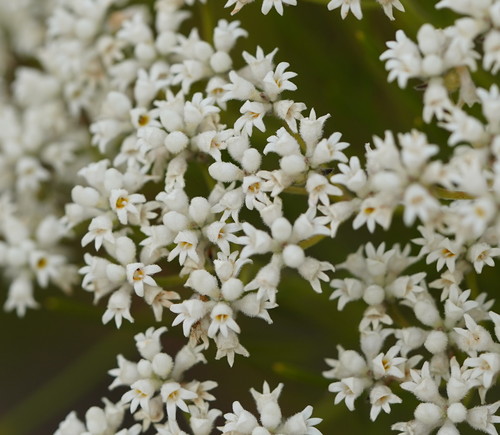
Conospermum mitchellii Meisn., commonly known as Victorian smokebush, is a multistemmed shrub that typically reaches a height of 1 to 2 meters (3 feet 3 inches to 6 feet 7 inches). Its branches are covered in silky hairs, and it bears crowded, erect, linear leaves that measure 50 to 120 millimeters (2.0 to 4.7 inches) long and 1 to 4 millimeters (0.039 to 0.157 inches) wide. Flowers are arranged in panicles that are longer than the leaves, borne on a 45 to 185 millimeter (1.8 to 7.3 inch) long peduncle. Each flower has egg-shaped to lance-shaped bracteoles that are 2.5 to 4.5 millimeters (0.098 to 0.177 inches) long and 1.0 to 2.8 millimeters (0.039 to 0.110 inches) wide. The perianth is white, blue, or lilac, and forms a tube 2 to 4 millimeters (0.079 to 0.157 inches) long. The upper lip of the perianth is egg-shaped, measuring 2.5 to 4 millimeters (0.098 to 0.157 inches) long and 1.8 to 3.0 millimeters (0.071 to 0.118 inches) wide. The lower lip is fused for 1.5 to 2.5 millimeters (0.059 to 0.098 inches), with narrowly oblong to oblong lobes that are 1.5 to 2.3 millimeters (0.059 to 0.091 inches) long and 0.5 to 1 millimeter (0.020 to 0.039 inches) wide. Flowering occurs between July and December. The fruit is a hairy nut, approximately 2 millimeters (0.079 inches) long and 2.1 millimeters (0.083 inches) wide, with a reddish brown base. This species grows in heath and heathy woodland on sandy soils. It is found in Grampians National Park, Lower Glenelg National Park, and near Anglesea, with most populations occurring in western Victoria, Australia.